


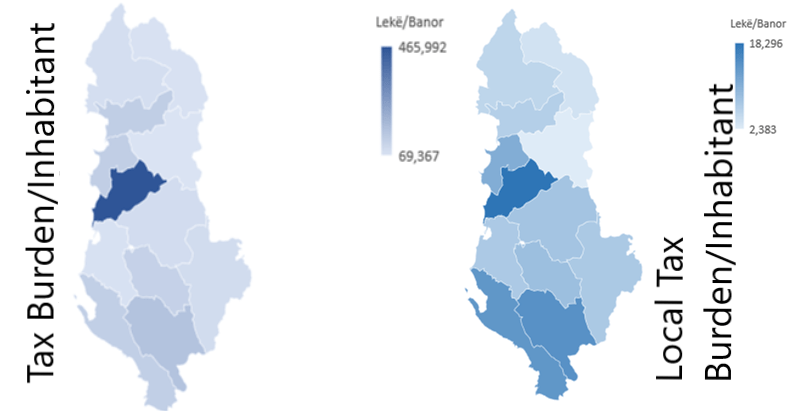
Central and Local taxes and fees per inhabitant in Albania in 2023
The method of calculating the tax burden expressed as taxes and taxes per inhabitant
The tax burden is based on municipal/district data on population and local revenues collected by the Municipality, DPT and DPD. The income that is calculated as a tax burden includes the obligations paid by the business registered in each municipality, as well as for those payments of taxes and local fees that are part of the tax income paid by individuals and families, according to the inclusion that is made in the bulletins fiscal.
The statistical data at the country level were obtained from the INSTAT information bulletin, from other data published by the tax and customs administrations and the decisions and annual reports approved by the local government, crossed with the data of the publications of the Monetary Fund, the World Bank , as well as the studies carried out for Albania by local projects, which have served as a reference for the calculation of the tax burden and other comparative indicators.
For the calculation of the district’s domestic production for 2022, our experts also evaluated the publication of the Institute of Statistics, as well as the regional trend of the structure of domestic production in the previous three years compared to the average. The calculation of local revenues for municipalities is based mainly on the calculations of the capacity of taxes and fees, information obtained from the budget program of local taxes and fees, in their realization, as well as on the policies defined for the following period, according to legal acts for them.
In this calculation the error reaches up to ± 3 %
The total tax burden[1] is the product of the revenues collected by the central tax administration and the customs administration, from the revenues from the local government, as well as the receipts for the social and health insurance contributions constitute the comprehensive part that is calculated in relation to the number of inhabitants regions[2] in 2023[3].
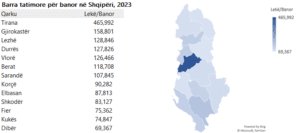 From the calculations according to the applied methodology, it results that the tax burden in 2023 is the highest in the Tirana region with an average of 465.99 thousand ALL per resident resident of Tirana throughout 2023.
In second place are the citizens of the Gjirokastra region, who are burdened with an average tax burden of 158.8 thousand ALL per inhabitant in 2023. Regarding the distribution of the tax burden through the municipal budget for 2023 and 2024, you can read in the publication dedicated to this purpose [4].
In third place are the residents of the Lezha region who paid an average of 128.8 thousand ALL/inhabitant.In fourth place are the residents of the Durrës region who have borne an average tax burden of 127.8 thousand ALL.
In fifth place are the residents of the Vlora region (without Saranda Municipality), who bear an average annual tax burden of 126.4 thousand ALL. Regarding the distribution of the tax burden through the municipal budget for 2023 and 2024, you can read in the publication dedicated to this purpose[5]
In sixth place are the residents of the Berat region with an average annual tax burden of 118.7 thousand ALL. Regarding the distribution of the tax burden through the municipal budget for 2023 and 2024, you can read in the publication dedicated to this purpose [6].
In seventh place are the residents of Saranda Municipality with an annual tax burden of 107.8 thousand ALL.
In the other 6 Albanian regions below, it is calculated that the annual tax burden is below ALL 100,000 per year, as can be seen in the graph and the table next to it above.
In eighth place are the residents of the Korça region with an annual tax burden of 90.2 thousand ALL.
In ninth place are the residents of the Elbasan region, who have borne an average tax burden of 87.8 thousand ALL. Regarding the distribution of the tax burden through the municipal budget for 2023 and 2024, you can read in the publication dedicated to this purpose[7].
In tenth place are the residents of the Shkodra region, who have borne an average tax burden of 83.1 thousand ALL.
In eleventh place are the residents of the Fier region with an annual tax burden of 75.3 thousand ALL.
In twelfth place are the residents of the Kukës region with an annual tax burden of 74.8 thousand ALL.
In thirteenth place are the residents of the Dibra region, who have borne an average tax burden of 69.3 thousand ALL. Regarding the distribution of the tax burden through the municipal budget for 2023 and 2024, you can read in the publication dedicated to this purpose[8].
In the analysis of the tax burden, it is calculated that if the burden were to be distributed equally for each inhabitant of Albania, without considering regional divisions, then the average tax burden per inhabitant of Albania is 222.89 thousand ALL in 2023.
If the tax burden is calculated only for the age of 15 and over, then it is 324,940 ALL per adult in 2023.
Tax burden according to the largest municipalities that include several municipalities within the district results that the highest level is in Tirana, where on average each resident has borne an average tax burden of 465,992 ALL throughout the year 2023.
All other municipalities of the country have a tax burden equal to 1/3 of the tax burden of the residents of Tirana, but even less than half of the average level of the tax burden per inhabitant of the country.
If we look at the tax burden only from local taxes and fees, then the calculations show that:
The residents of Tirana carry the highest local burden with 18,296 ALL per year.
The residents of Saranda have a high local tax burden of 16,050 ALL per year.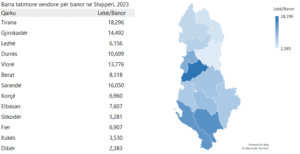
The residents of Gjirokastra have a high local tax burden of 14,492 ALL per year.
The residents of Vlora have a local tax burden of 13,776 ALL per year.
The residents of Durrës have a local tax burden of 10,699 ALL per year.
The residents of Berat have a local tax burden of 8,318 ALL per year.
The residents of Elbasan have a local tax burden of 7,607 ALL per year.
The residents of Korça have a local tax burden of 6,960 ALL per year.
The residents of Fier have a local tax burden of 6,907 ALL per year.
The residents of Lezha have a local tax burden of 6,156 ALL per year.
The residents of Shkodra have a local tax burden of 5,281 ALL per year.
The residents of Kukës have a local tax burden of 3,530 ALL per year.
The residents of Dibra have a local tax burden of 2,383 ALL per year.
From the comparison of some of the country’s municipalities[9] for the level of expenses per inhabitant, it is noticed that their level is closely related to the tax burden, where the tendency is that the smaller the tax burden, the lower the value of the expenses per inhabitant.
[1] This burden includes the VAT that each buyer pays for goods and services, for drinks and fuel that each consumer pays, for the tax on wages that each employee pays, the payments of profit tax from businesses, for the capital tax that each individual pays receives income from rent, from bank interest, from the sale of movable and immovable property, from intellectual property, from dividends, household payments for local taxes and fees, payments of social and health insurance contributions, customs fees and duties, national taxes and other tax obligations, which are not mentioned by name.
[2] Saranda has been treated as a special area for its economic nature related to tourism
[3] https://www.instat.gov.al/media/11653/popullsia-e-shqiperise-1-janar-2023.pdf
[4] https://altax.al/product/veshtrimi-civil-projektbuxheti-2024-per-gjirokastritet/
[5] https://altax.al/product/veshtrimi-civil-projektbuxheti-2024-per-vlonjatet/
[6] https://altax.al/product/veshtrimi-civil-projektbuxheti-2024-per-beratasit/
[7] https://altax.al/product/veshtrimi-civil-projektbuxheti-2024-per-elbasanasit/
[8] https://altax.al/product/veshtrimi-civil-projektbuxheti-2024-per-dibranet/
[9] https://altax.al/product/veshtrimi-civil-projektbuxheti-2024-per-5-bashki/



Leave a Reply
You must be logged in to post a comment.