


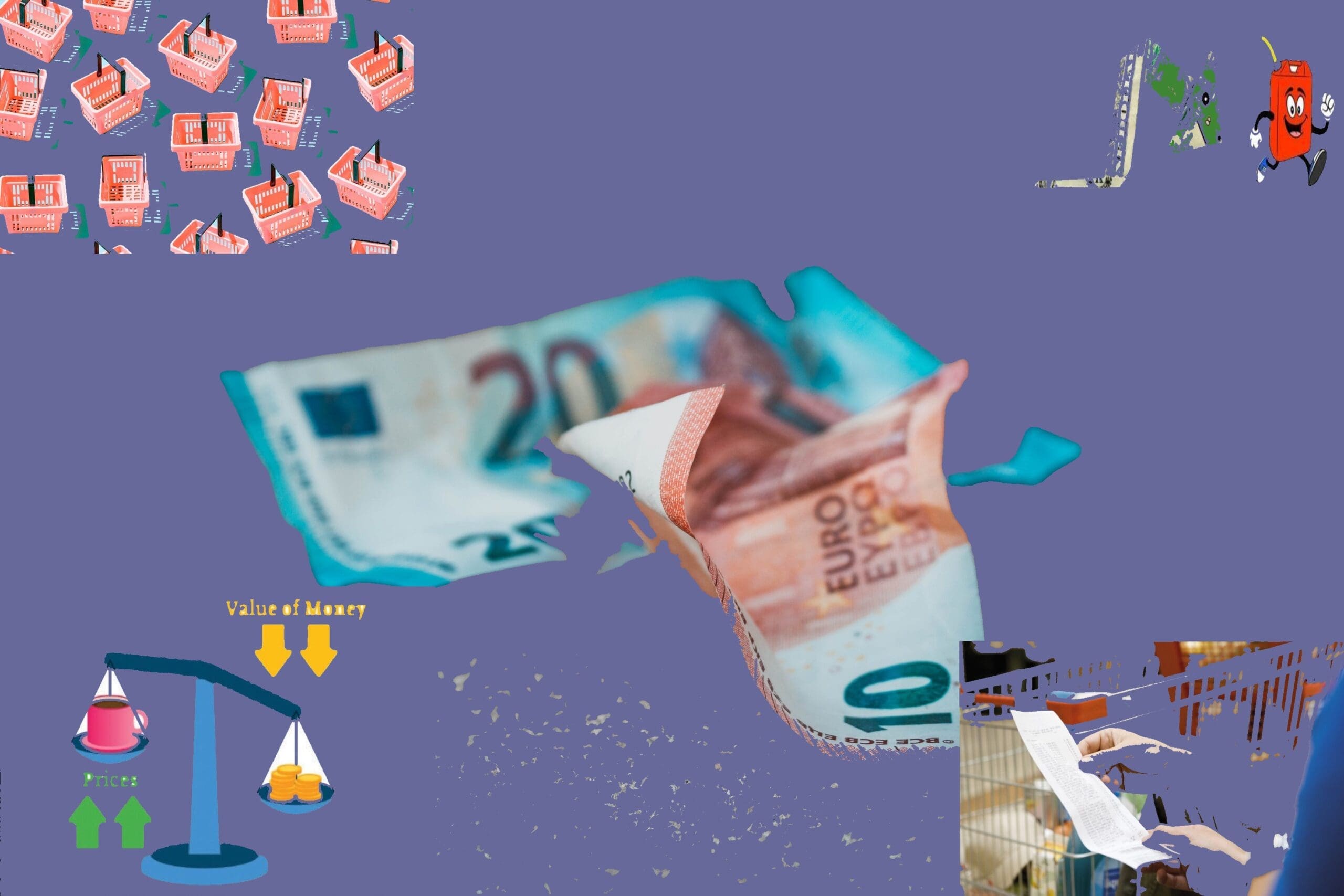
What is happening with prices and Euro and what is waiting for the monetary and fiscal policy?
In a clarification of the current situation, if our market would be like that of advanced countries, it is that the lost fight against evasion and corruption, as well as failure to act in time to have an expanded and competitive market makes all the measures that use these countries in not suitable for Albania. Each country of the region, after having finished the analysis and based on an uncorrupted political will, adapts, and influences those segments of the economy and society to enable a fair distribution of well-being.
But, returning to the argument to clarify the chaotic situation with prices, exchange rates and the reactions of institutions, it must first be accepted by all that the variability of the exchange rate has widespread positive effects on the general uncertainty in the market.
But how real is the situation of inflation and the weakening of the Euro in reaction to the monetary and fiscal policies declared as the right direction by the institutions?
First, the experience of advanced countries shows us that the appreciation of the Lek through the supply channel and cheaper imports of goods should encourage the expansion of production and reduce price inflation. Imports can appreciate the local currency due to stronger economic activity or depreciate the Euro and other currencies due to an increase in the supply of the local currency. In fact, the supply of Lek to the market seems to have shrunk and not the other way around.
Regarding the implications of fluctuations in the nominal effective exchange rate, currency appreciation has a dominant expansion in output growth and deflationary effects through the cheaper cost of intermediate goods. However, currency appreciation, through loss of competitiveness, has a widespread negative effect on investment growth.
Secondly, currency appreciation mostly signals improvement in economic activity in support of more inflows and improvement in the financial balance.
Through this trend, the assessment of economists supports the growth of consumption.
Facts from other countries support the appreciation of the currency in the face of higher export growth, testifying to a dominant share of goods exports. However, currency appreciation reduces the demand for exports. This reality is already confirmed by the official statistics of the first 5 months of 2023. The net negative effect on external balances is the most expected. The decrease in exports is more dominant, resulting in widespread negative effects on the trade balance and current account.
Although the fact of the entry of foreign investments has increased compared to the past, the phenomenon that 34.7% of them are from offshore companies and the rest have not gone to the productive sectors, but to the service sector, should be singled out. If we had effective FDI flows, they should increase the demand for the local currency and appreciate the exchange rate or should have a more dominant depreciating effect by increasing the demand for imports.
Third, the increase in consumption is another key indicator that supports the argument of the existence of strong economic activity and with effect the appreciation of the Lek exchange rate. In 2022, part of the increased household consumption is due to the historical rate of inflation in most consumer products, even above the average rate of 6.7%. Meanwhile, in 2023, after a low drop in some prices, there is also a drop in consumption, which shows that its dependence is not directly related to economic activity, since most of the impact of economic growth came from tourism and construction, which do not make up the majority of gross domestic product.
Consumption stripped of inflation, i.e. in real terms, increases due to the cheaper cost of imports after currency appreciation. Conversely, currency appreciation has widespread negative effects on export growth and lowers the cost of imports in local currency.
In fact, here is the Albanian uniqueness that informality and dishonest competition motivated by political corruption and the collective attraction to it undo this formula of the economy that follows this rule in many countries. Evidence from the Albanian economic environment demonstrates the need to create an environment that is more conducive to investment growth and export diversification, to reap greater currency appreciation benefits in the form of higher growth and lower inflation to mitigate adverse effects from the trade balance.
Fourthly, higher government spending could be supportive of economic activity and a stronger currency. Increased public investment can support strong economic activity and a stronger currency or increase demand for imports and depreciate the local currency.
And then what is happening with the devaluation of part of the domestic production that is based on the Euro?
Money has typically played a minor role in the direction of monetary policy in influencing the inflationary trend over the past thirty years. However, the recent rise in inflation, preceded by non-standard monetary policy measures that have increased the size of central bank balance sheets and the money supply, has revived the debate about the role of money in inflation.
The assessment may be supportive of further external stability, while there is no capacity to mobilize imports to increase capacity in support of internal stability, diversification, investment and sustainable real growth and job creation[1].
In this extraordinary situation, where the Euro is weakening also due to weak internal policy actions and measures, based on the necessary lack of coordination and the passivity of institutions, what has no monetary logic is the devaluation of the US dollar against the Lek, just like the Euro. The devaluation of this currency would make market-based sense only in response to higher oil prices in oil and grain importing countries and some products that are purchased in US dollar-quoted markets. In fact, this market moment for these products does not respond to this situation.
The relationship between money supply growth and inflation is statistically unstable since the maximum impact of money growth can affect the upward trend of inflation.
It is inflation that is widening its base with a domino effect, as well as the gloomy outlook for economic growth that could further weigh on the euro’s devaluation in the coming months.
The growing pessimism of consumption is based on a significant depreciation of the common currency (-17% from the beginning of 2022) and it is difficult to identify the catalysts that could change the course of the euro.
Despite the fact that the Bank of Albania started its intervention cycle from 2022 beyond its routine program, it is still not entirely clear how much impact all this monetary policy has had on the euro, which seems to continue to struggle unsuccessfully against the Lek. The possibility of a further devaluation is real, in a scenario where the euro falls well below the current exchange rate, if energy and inflationary problems persist through the autumn and winter.
With fewer monetary “weapons” now available, the country’s economic recovery may need to go through a new phase of reforms and productivity growth, but only if it is driven by a new governing team with a new spirit to lead the masses. can stop this flow of excess euros in the market. However, even though the expectations for mentality with fresh faces could be necessary, it remains to be mentioned that there is a long and winding road ahead.
The devaluation of the euro is making the inflation problem even worse than it already is by influencing further price increases due to the weak euro, but also other currencies influencing the country’s trade relations. The transition of the effect of import goods from a weak euro to high inflation is inevitable, since the country’s large importers themselves are not only such, but also exporters and large spenders in lek, which in the financial balances of their groups convey a moment of increase in the costs of the total of their businesses. It seems as if the big oligarchs have entered a boomerang process, both from the greed to speculate as much as possible in this situation, but also from the lack of exhaustive analysis to understand how they can get out of this situation.
Above all, the costs of energy and raw materials may increase, although the market situation seems to be normalizing should push the objective of fiscal policies “toward a growth with a broad base of sectors to prevent the increase in the cost of living from eroding the purchasing power of individual families that comes from unfulfilled tasks against informality and corruption in the leadership of institutions with a top-down approach.
Finding that monetary policy has no effects beyond constitutional duties, fiscal policy is the only way out.
The first route is to raise taxes (temporarily) on wealthy individuals and on capital, which reduces their spending power and can help ease inflation.
But the base of taxpayers must be expanded, who, although they should be burdened with fiscal burdens, currently do not pay their due share, due to the incompetence of fiscal administration and the growing corruption in these institutions. Failure to tax resources generated in capital from crime through laundering their money into the economy, but also money laundering from corruption would be the best help for this purpose.
All this approach should be done by persons who have not been caught in crime, as well as by organizing a national operation of fiscal purity.
On the other hand, the freezing of tax benefits and exemptions, to increase the effectiveness of the income, however, can also increase the budget income, without significantly and directly reducing the purchasing power. The whole changed approach should aim to clean the internal and external control institutions from corrupt connections and political patronage, since a corrupt and politically supported audit undoes the monitoring effect of the approach and compromises the entire employee base by keeping and further hostage to corruption
Moreover, the revenue generated by tax reform would reduce the deficit, a potential factor in medium to long-term inflationary pressures.
These proposals would stimulate savings, calm demand, boost supply and reduce the deficit, thereby reducing inflation in the medium to long term.
The second way out is the rationalization of government expenditures that have a depravity of budget discipline, after confirmation directly from the KLSH, which is the institution that must be listened to carefully by the government to reflect.
Responsive fiscal policy can play an important complementary role to monetary policy in helping to moderate inflation. As the Bank of Albania continues to keep interest rates high in the short term, there is a valuable opportunity for policymakers to implement contractionary fiscal policy with the multitude of spending and revenue options available to bolster these efforts. Such action would not only support critical efforts against high inflation but help stabilize our deficit and debt challenges over the longer term, which in turn leads to a brighter economic future. stronger and more stable.
[1] https://www.sciencedirect.com/science/article/pii/S2214845015000289


Leave a Reply
You must be logged in to post a comment.