


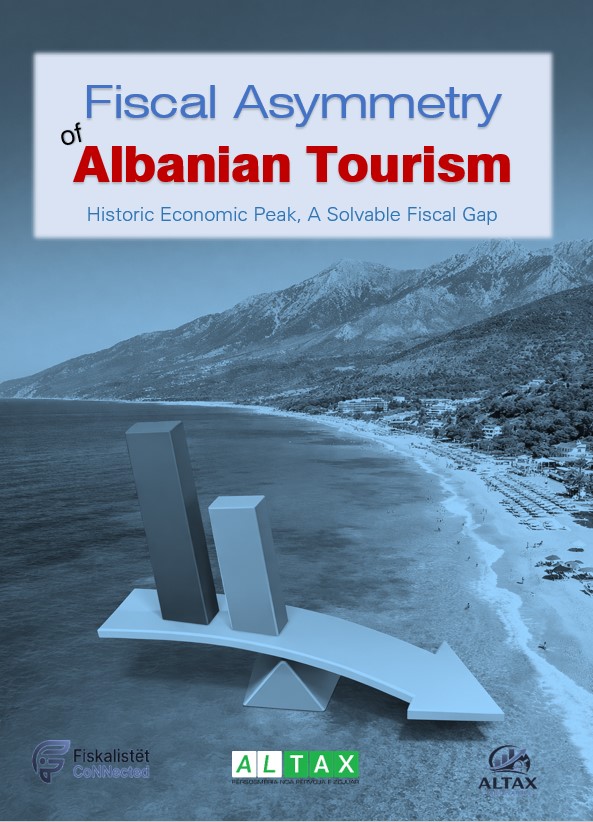
Albania’s Tourism Boom Meets a Digital Fiscal Gap
ALTAX Publishes First Integrated STR Market Analysis.
Albania’s tourism sector has reached a historic peak, but a newly released analytical study by ALTAX reveals a growing imbalance between rapid digital market expansion and fiscal capture. For the first time, the study integrates data from multiple sources, including Airbnb (2024, DPT), AirDNA (2025), Booking.com (2025), INSTAT, WTTC, and ALTAX — to provide the most comprehensive quantitative picture of the short-term rental (STR) market and its fiscal implications.
A Record-Breaking Tourism Economy
In 2025, Albania welcomed 12.466 million foreign visitors, marking a +6.6% increase compared to 2024. Tourism now contributes 26.4% of GDP (ALL 685.3 billion), a historic record and a sharp rise from 20.6% in 2019. Total tourist spending reached approximately €5.7 billion, with a strong multiplier effect of 2.6–2.8×, making tourism the primary engine of national economic growth.
At the same time, 7.137 million overnight stays by non-residents were recorded, of which about 33% are linked to short-term rentals (STR) — a rapidly expanding segment within the accommodation sector.
First-Time Integration of Airbnb Data (2024)
A key innovation of this study is the integration of official Airbnb data from the Albanian tax administration (DPT), revealing:
- 8,472 active Airbnb operators, mostly micro and seasonal
- €39.7 million in total bookings (2024)
- Average annual income per operator: ~€4,680
- Platform commission: 4.4%, confirming full digital traceability
These findings confirm a highly fragmented but fully digitalized market, where transactions are recorded electronically but largely remain outside the tax system.
The Real Size of the STR Market
By combining Airbnb data with AirDNA and Booking.com estimates, the study concludes that the total STR market in 2025 reaches €130–170 million annually. Booking.com dominates with about 63% of the market, while Airbnb accounts for 25–30%, with additional activity occurring off-platform.
However, 70–80% of STR units operate informally, creating a structural fiscal gap.
€40–60 Million Annual Fiscal Loss
The analysis estimates that Albania loses €40–60 million per year in tax revenues from the tourism sector, primarily due to unreported STR activity. Even Airbnb alone accounts for an estimated €3–5 million in annual fiscal losses.
This gap is not due to lack of data — but due to the absence of a legal and administrative framework to convert digital transactions into taxable income.
A High-Impact, Zero-Cost Reform Opportunity
ALTAX proposes a three-phase reform aligned with the EU DAC7 Directive, requiring digital platforms to report and withhold taxes:
- Phase I (2026): Mandatory reporting → +€15–20 million
- Phase II (2027): Withholding tax at source → +€25–40 million
- Phase III (2028+): Full EU DAC7 alignment
The reform is estimated to close 70–90% of the fiscal gap, generating €25–40 million annually with near-zero cost for the state budget, as implementation costs fall on digital platforms.
A Strategic Turning Point
The study highlights that Albania’s tourism sector is now at a critical juncture. While the sector delivers record growth and employment, the persistence of a large informal digital economy risks undermining fiscal sustainability, fair competition, and long-term development.
Regional experience shows that countries applying automated platform reporting (such as Croatia, Greece, and Montenegro) have reduced STR informality below 30%, compared to 70–80% in Albania.
English Version Now Available
To support international stakeholders, investors, and policy dialogue, ALTAX has published the full analytical study in English, providing detailed data, methodology, and policy recommendations. Albania’s tourism success story is undeniable. Yet, the challenge ahead is clear: aligning fiscal systems with digital market realities. As the report concludes, the difference between action and inaction is measurable €40–60 million per year and growing.



Leave a Reply
You must be logged in to post a comment.