Bashkohuni me ekipin tonë. A jeni gati të rrisni biznesin tuaj? Mëso më shumë


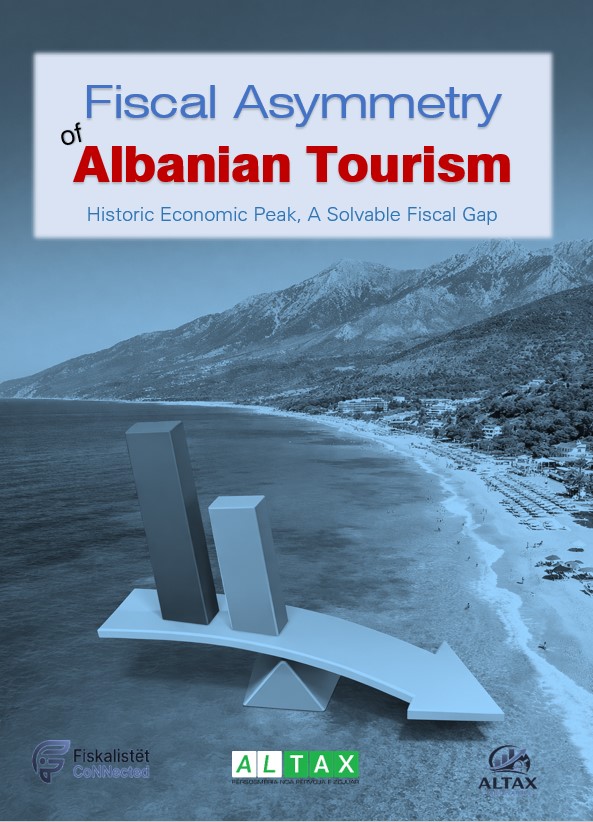
Fiscal Asymmetry of Albanian Tourism
0 €
In 2025, tourism in Albania reached record levels, consolidating its position as the primary pillar of the national economy.
Me 12.46 million visitors, 7.14 million non-resident overnight stays (+37.9%) and €5.7 billion in tourist spending, the sector contributed approximately 26.4% of GDP (roughly €6.45 billion).
With over 270,000 employees across the tourism industry and related activities and an economic multiplier of 2.6–2.8×, tourism now plays a decisive role in economic growth and fiscal stability, generating €970m–1.23bn in budget revenues.
However, this performance is accompanied by a structural mismatch between sector growth and its fiscal capture. The short-term rental (STR) market, which accounts for approximately one-third of overnight stays, operates predominantly outside the formal system, with 70–80% of units informal, creating a sustained fiscal gap of €40–60 million per year. This gap tends to widen as tourism grows and supply digitalises.
The General Tax Directorate has addressed the sector through the Tourism Plan 2025, which represents an important step towards improving fiscal administration.
However, an analytical reassessment shows that the feasibility index reaches only 74/100, due to three main limitations: (i) heavy reliance on non-scalable manual controls, (ii) lack of digital economy and platform integration, and (iii) absence of a clear institutional operational model. These limitations make the plan effective at a tactical level but insufficient to address structural informality.
The optimal solution lies in adopting a reform based on the principles of DAC7 Directive, structured in three phases: mandatory platform reporting (2026), withholding tax (2027) and harmonisation with EU standards (2028+). This approach enables the transition from manual controls to automatic revenue capture.
The expected impact of the reform is considerable: +€25–40 million in additional revenue per year, 70–90% reduction of the fiscal gap, and formalisation of over 80% of the STR market. At the same time, competition between operators improves, transparency increases and administrative costs fall.
Ultimately, the main challenge of Albanian tourism is not growth alone, but above all the effective and equitable integration of that growth into the fiscal system
- Description
Description
This analysis examines the central fiscal asymmetry of the Albanian tourism sector in 2025, a sector contributing 26.4% of GDP (ALL 685.3 billion, ~€6.45 billion) and generating €970–1,230 million in central fiscal revenues, while simultaneously losing €40–60 million per year to informality in the short-term rental (STR) accommodation segment. Integrating data from Airbnb 2024 (8,472 active operators, €39.7 million in bookings, effective commission 4.4%), AirDNA 2025 (monitored STR market €106–130 million), Booking.com 2025 (17,225 operators, €80.1 million over 9 months), INSTAT (12.466m visitors, 7.137m non-resident nights) and the technical assessment of the DPT Sectoral Tourism Plan 2025 (feasibility index 74/100), the analysis identifies three systemic gaps (legal, administrative and analytical) that allow this gap to be reproduced every year.
The gross STR market reaches €130–170 million per year (approximately 33% of the 7.137 million nights confirmed by INSTAT), with 70–80% of units operating outside the tax system, generating a calculable fiscal loss: 6% VAT (€5.5–8.2m), 15% income tax (€9–14m) and local fees (€2–4m). Analysis of Airbnb 2024 data confirms extreme market fragmentation (average turnover €4,680/operator/year) and high transaction digitalisation — two characteristics that make the market traceable yet fiscally uncaptured without a new legal framework.
Regional comparison (Croatia, Greece, Montenegro) confirms that adopting DAC7 logic and platform-level withholding tax reduces STR informality below 30% with ROI above 500%. The proposed three-phase reform (mandatory reporting 2026, withholding tax 2027, DAC7-EU harmonisation 2028+) can raise the feasibility index from 74 to 94/100 and generate €25–40 million in additional revenue per year at zero cost to the state budget
Related products
-
ALTAX PRODUCTS
The federal system of taxes in Bosnia and Herzegovina
Original price was: 8 €.6 €Current price is: 6 €. -
ALTAX PRODUCTS
Tax system incentives in Macedonia
Original price was: 16 €.11 €Current price is: 11 €. -
ALTAX PRODUCTS
Tax burden in Albania, Kosovo and Western Balkans, 2020
Original price was: 35 €.32 €Current price is: 32 €. -
ALTAX PRODUCTS
Tax notes for construction industry in Albania
Original price was: 15 €.14 €Current price is: 14 €. -
ALTAX PRODUCTS
Investment climate and tax system in Albania 2013
Original price was: 11 €.10 €Current price is: 10 €. -
ALTAX PRODUCTS
Tax system and investment climate in Albania, 2016
Original price was: 12 €.9 €Current price is: 9 €. -
ALTAX PRODUCTS
Natural disasters – Financial and fiscal effects, Policy and experience for tackling them
Original price was: 14 €.11 €Current price is: 11 €. -
ALTAX PRODUCTS
Minimum wage increase and consume prices in Albania
Original price was: 15 €.13 €Current price is: 13 €. -
ALTAX PRODUCTS
Taxation trends in Western Balkans, 2016
Original price was: 16 €.12 €Current price is: 12 €.