


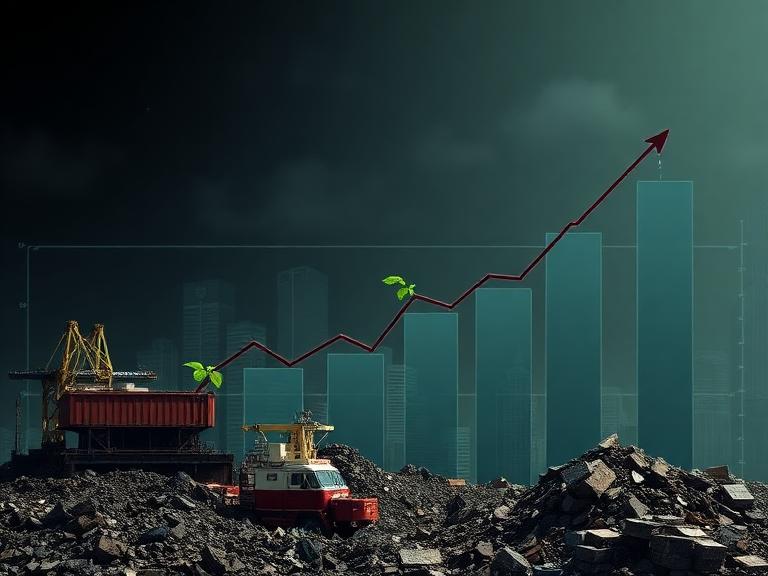
Economic growth in 2025, pace Yes, quality No
The Albanian economy closed 2025 with a real GDP growth of 3.79% compared to 2024, according to official data published by INSTAT on March 26, 2026. Quarterly growth was 3.39% in Q1, 3.51% in Q2, 3.75% in Q3 and 3.80% in Q4. This macroeconomic performance confirms stability, but remains significantly below the 5.5–6.5% level needed for real convergence with the economies of the European Union.
From preliminary calculations, the nominal size of the economy in 2025 approached around 31.7 billion USD (or around 27.1 billion euros according to some estimates).
For comparison and logic of continuity and assessment, according to INSTAT data, GDP at current prices for 2024 was 2,517,821 million lekë (about 2.518 trillion lekë). GDP for 2023 was 2,364,275 million lekë (about 2.364 trillion lekë).
If real growth in 2025 were close to the optimal potential (5.5–6.5%), GDP would have reached about 33–34 billion USD, compared to the current about 31.7 billion USD, creating an annual gap of approximately 1–2 billion USD and cumulative losses that could reach 5–8 billion USD in the medium term.
The growth structure continued in 2025 with the dominance of consumption and non-productive sectors.
Growth continued to be supported mainly by domestic demand. Household consumption increased by +2.99% in Q4 (similar contribution during the year). Gross fixed capital formation (investment) marked +6.73% in Q4, but mainly concentrated in:
Construction with +7.36% growth (+1.17 percentage points contribution in Q4)
Real estate with +6.25%.
Public administration, education and health also made a positive contribution (+1.02 percentage points in Q4, with +8.30% growth). On the other hand, negative contributions came from:
agriculture with -0.27 percentage points (-2.19% growth)
industry/energy with -0.16 percentage points.
Consumption still accounts for 75–80% of GDP, while investment 25–27%. This configuration makes the current model more consumer than producer.
The trade deficit is the “hole” through which the economic growth of 2025 came out.
In 2025, the trade deficit became the “hole” through which part of the economic growth passed. The data show that exports fell by –6.1% compared to 2024, while imports decreased by only –0.79%. This combination indicates a structural imbalance: our economy continues to buy much more from abroad than it can sell abroad.
In simple terms, even though the economy is growing, a significant part of the money circulating within the country “flows” abroad through imports, diluting the real effect of growth.
This situation affected daily life and the real economy. The first effect was the increase in consumption and investment within the country. But a large part of the goods and services that were used were imported. The result of this economy was that part of the economic growth does not stay within the Albanian economy
The main consequences are the fact that we have seen in many years with economic growth that is less effective, because part of the value created “goes abroad” and does not contribute to domestic development.
This dictates the economy and families to continue to depend on external factors, as they need to cover this gap. And now with the balance of payments indicators for 2025 we see that remittances have increased by about 72 million euros more. Likewise, tourism is the boat that is carrying part of the burden of the economy in 2025 as well as foreign investments, which have a noticeable increase with foreign exchange flows that are going to real estate (561 million euros during 2025) now holding the main part of foreign investments instead of shocking production and related activities.
All this keeps the economy more vulnerable to risks that are recurring with greater frequency than in previous years. Any shock to global markets, remittances or tourism, could significantly affect economic performance.
So even though GDP is growing (around 3.79% in 2025), a significant portion of this growth is not translating into sustainable domestic development.
The problem of our economy is already being seen to lie not in the pace, but in the quality of growth. This quality is precisely related to the lack of utilization of the country’s potential that must be mobilized and coordinated with all the necessary resources and capacities.
The Albanian economy operates below its potential due to unproductive investments (mainly in sectors with low returns), but also due to limited labor and capital productivity, as well as what we mentioned earlier, which is the high deficit in the external goods sector.
The current model can be described as an economy that grows through consumption, is partly financed from abroad, and invests without significantly increasing long-term productivity in export sectors.
What does a sustainable economy require?
To close the gap with real potential and ensure long-term development, a profound reconfiguration is needed.
Consumption should be given a more measured role, aiming for a gradual reduction of its share towards 65–70% of GDP,
Investments should increase and be oriented towards value-added and export sectors, i.e. the growth of productive investments should reach up to 30%+ of GDP,
While the trade deficit should be curbed through policies that highlight competitive production and increased exports
The year 2025 confirms macroeconomic stability, but not structural transformation, and it seems that the same path will continue in 2026, based on the main documents approved for economic development and investment.
Indicators remain positive, but the real challenge for policymakers is not only to maintain the pace of growth, but to change its source, directing it towards domestic production, exports and productivity growth.


Leave a Reply
You must be logged in to post a comment.