


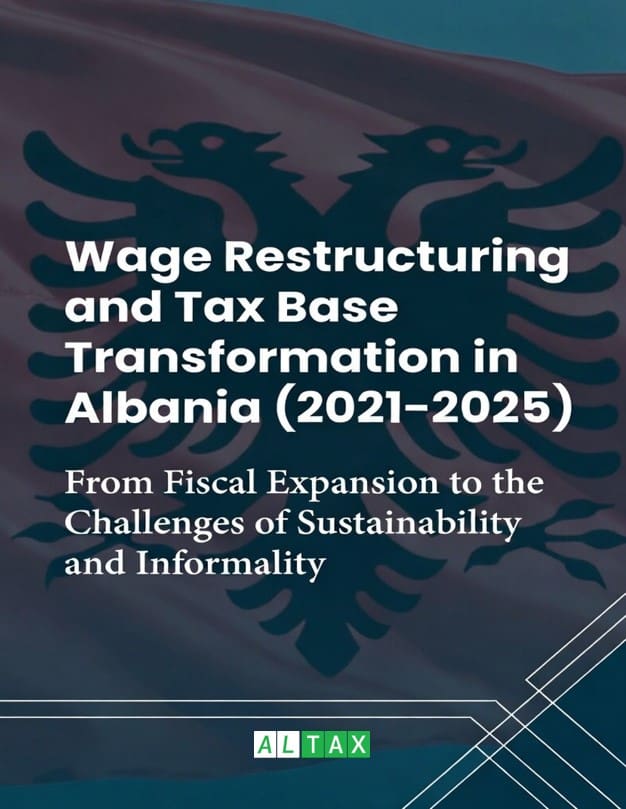
Labor market in Albania 2021–2025 is profoundly transformed with a doubling of incomes and a structural shift in wages
A new analytical study on labor market developments in Albania for the period 2021–2025 highlights a profound structural transformation, which has directly impacted the growth of budget revenues, the formalization of work, and the redistribution of labor income.
According to the analysis, the Albanian economy has gone through a clear phase of wage restructuring, where the share of low-wage employees has been significantly reduced, while the middle and high-wage segments have expanded significantly. The share of employees with minimum wages or below 40 thousand lek has decreased from 44% in 2021 to 12.6% in 2025, while employees with wages above 95 thousand lek have increased from 8% to 27.6%.
This structural change has brought about a significant expansion of the tax base. Personal income tax revenues have doubled over the period under review, increasing from 39.3 billion lek in 2021 to 82.5 billion lek in 2025. The increase has been driven mainly by the shift of employment towards higher wage brackets and the effects of fiscal progressivity.
The study highlights that the increase in revenues is not only the result of nominal wage increases, but mainly a structural effect called “climbing the ladder”, where employees move to higher tax brackets. The effective wage tax rate has increased from around 8% in 2021 to 12–13% in 2025.
Meanwhile, there is a divergence between wage taxes and social contributions, which have grown more slowly due to their proportional nature and capping. This situation creates medium-term pressures on the sustainability of pension schemes.
The study identifies public policies as a key factor in this transformation. The increase in the minimum wage from 30 thousand to 40 thousand lekë and further to 50 thousand lekë (from 2026), as well as increases in the public sector, have acted as drivers of formalization and wage growth in the private sector.
In parallel, the strengthening of fiscal administration and the digitalization of tax control have contributed to the reduction of fictitious declarations and the increase in the declared wage base.
The study presents three scenarios for the future:
The optimistic scenario predicts a reduction in the burden on labor and an increase in taxation on assets, generating additional formalization and an increase in formal employment by 4–6%.
The baseline scenario suggests a stabilization of informality at around 30%.
The negative scenario warns of an increase in informality above 35% in the absence of structural reforms.
Although wage and tax revenue growth is strong, the study highlights that in some sectors wage growth has outpaced productivity growth, creating pressure on business costs and the risk of wage inflation.
Labour productivity still remains low compared to the EU average, making a shift from growth based on formalization to growth based on economic efficiency and human skills necessary.
The study proposes a package of reforms that include:
- revision of tax thresholds and contribution ceilings,
- policies to increase productivity and digitalization,
- strengthening the link between contributions and social benefits,
- measures to curb emigration and repatriate the workforce,
- fiscal administration based on advanced data analytics.
The study concludes that Albania has entered a new phase of labor market transformation, where the increase in fiscal revenues is real and measurable, but long-term sustainability requires a transition from a model based on formalization and fiscal progressivity, towards a model based on productivity, innovation and structural economic growth.
The implementation of a National Plan for Formal Employment and Fiscal Convergence 2027–2030 is considered key to consolidating these achievements and aligning with European Union standards.


Leave a Reply
You must be logged in to post a comment.