


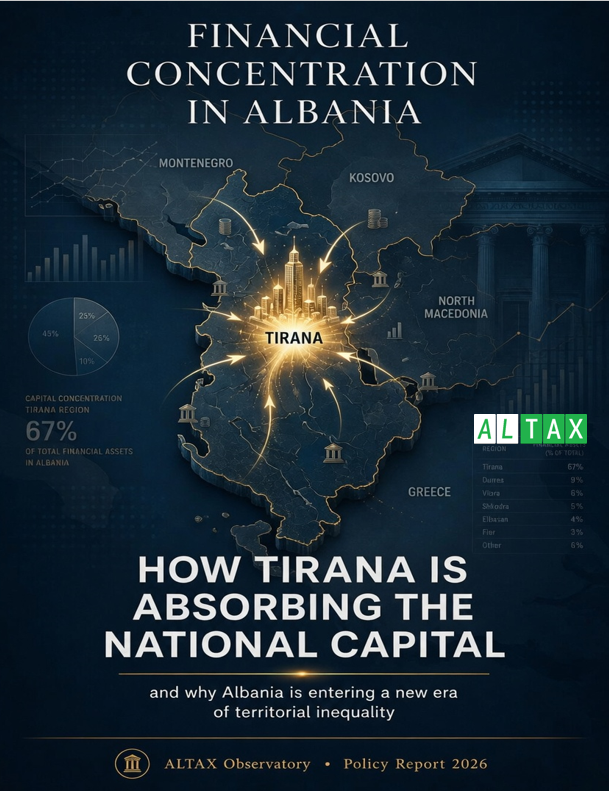
When capital begins to leave the territory, the economy changes the financial map and the balance of the country’s future.
ALTAX Observatory publishes the in-depth analysis “Territorial Financial Concentration in Albania”, a policy document that raises one of the most important economic alarms of the decade: Albania is gradually entering a development model where economic growth, financial capital, lending and investments are being disproportionately concentrated in the Tirana-Durres metropolitan axis, while the rest of the country is losing critical economic and human mass.
The study, based on data from the Bank of Albania and INSTAT for the period 2010–2026, highlights that the country is no longer experiencing just ordinary urbanization, but a profound structural transformation of the national economy.
For the first time, territorial financial concentration has crossed the critical thresholds of a balanced economy.
Today, Tirana controls 54% of national bank deposits, while the Tirana-Durres area has reached 61% of the total financial capital deposited in the country. At the same time, the territorial financial concentration index (HHI) has increased to 3,150, clearly entering the “high concentration” zone. This is a signal that the Albanian economy is moving towards a “core-periphery” model, where the center attracts capital, credit, investments and talent, while the periphery gradually loses the ability for autonomous development.
The analysis highlights that bank lending is increasingly being recycled within the metropolis. While deposits are collected throughout the country, investments and loans are mainly directed towards Tirana and the sectors related to construction and real estate. Regions outside the metropolis are facing a decline in lending, business contraction and continued emigration of young people. The 15–29 age group alone has fallen by around 45% since 2011 in many areas of the country.
The report argues that Albania is entering a “dual economy trap”, i.e. an economy with two speeds and different development standards.
On one side stands the metropolis, with its rapid financial growth, higher wages, rising property prices and concentration of modern investments.
On the other side stand the regions, where the economy increasingly relies on remittances, pensions and public employment, while opportunities for productive development weaken.
According to the ALTAX Observatory, the risk is not only related to territorial inequality. An economy based on a single center becomes even more fragile to economic shocks. The more capital and economic activity are concentrated in Tirana, the more a crisis in the construction or real estate sector can be transmitted to the entire national economy.
Faced with this reality, the report proposes a new approach to territorial economic rebalancing. Recommendations include the creation of state guarantee schemes for productive lending outside the metropolis, differentiated fiscal policies for regional investments, the development of specialized economic poles in Fier, Shkodër, Durrës and Vlorë, as well as the gradual construction of territorial financial instruments.
ALTAX Observatory emphasizes that inaction is not a neutral choice. Each year that passes without structural intervention deepens territorial divisions and makes the return to a balanced and resilient economy more costly.
Read ALTAX Observatory’s full Policy Paper and Brief Policy Paper on Albania’s territorial financial transformation and the new challenges of national economic development.



Leave a Reply
You must be logged in to post a comment.