


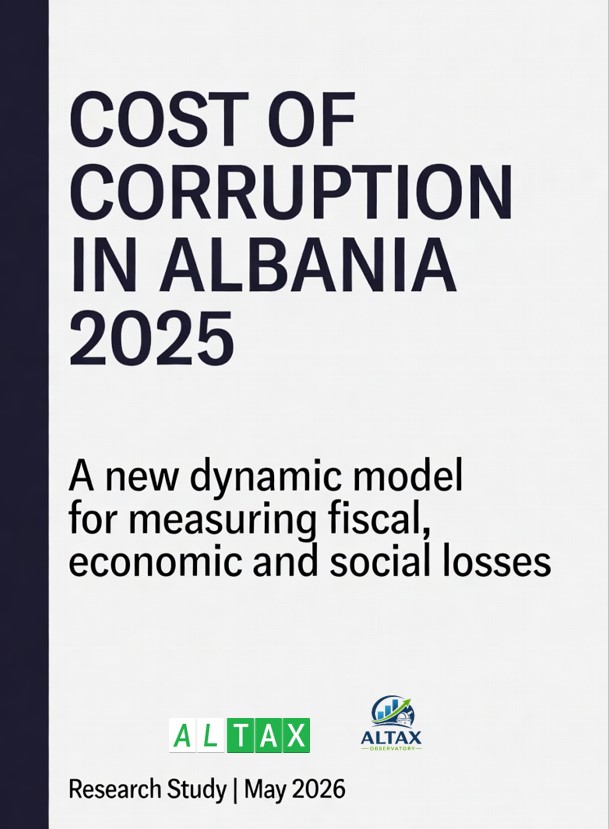
Corruption is costing Albania up to €1.1 billion annually, new ALTAX study reveals
A new dynamic model estimates annual economic and social losses of up to €1.1 billion
ALTAX has published its latest research report titled “Cost of Corruption in Albania 2025 – A New Dynamic Model for Measuring Fiscal, Economic and Social Losses”, introducing an advanced integrated assessment of the fiscal, economic, and social impact of corruption in Albania.
The study estimates that corruption costs the Albanian economy between €852 million and €1.115 billion in 2025, equivalent to 3.1%–4.0% of the country’s nominal GDP. According to the report, these losses go far beyond direct financial abuse and tax evasion, affecting economic growth, investment confidence, institutional credibility, and the quality of public services.
Key findings show that:
- direct fiscal losses amount to €650–810 million annually;
- corruption reduces Albania’s real economic growth by up to 1.1 percentage points every year;
- up to 29% of the effectiveness of social, health, and education spending is undermined by corruption and governance inefficiencies.
The report warns that if corruption levels remain unchanged, Albania could lose cumulatively between €2.8 billion and €4.8 billion by 2030. Conversely, reducing corruption by 25–30% could generate up to €7 billion in additional cumulative GDP over the next five years.
The analysis places Albania significantly below the European Union average in corruption perception indicators and stresses that anti-corruption reforms are not merely political or ethical obligations, but a strategic economic necessity for sustainable development and EU integration.
The report recommends a priority reform agenda focused on:
- full digitalization of public procurement;
- strengthening anti-corruption and prosecution institutions;
- improving fiscal transparency;
- reducing tax evasion;
- setting measurable national targets for improving corruption perception indicators by 2030.
According to the authors, corruption operates as a “hidden tax” on citizens and businesses, reducing opportunities for higher pensions, better healthcare and education services, and more productive economic investment.


Leave a Reply
You must be logged in to post a comment.