Bashkohuni me ekipin tonë. A jeni gati të rrisni biznesin tuaj? Mëso më shumë


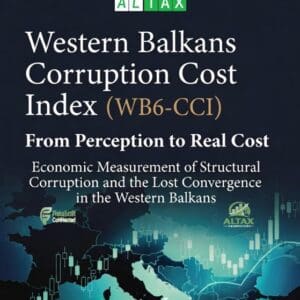
Cost of Corruption in Albania 2025
0 €
This report introduces a new hybrid and dynamic model for assessing the cost of corruption in Albania for 2025. By combining direct fiscal measurement (8–10% of public expenditure), the indirect effect on GDP growth, and the Welfare Loss Index (WLI), the study estimates that corruption costs the Albanian economy €852–1,115 million, equivalent to 3.1–4.0% of nominal GDP.
The analysis reveals a potential cumulative loss of €2.8–4.8 billion by 2030 if deep reforms are not implemented. The comparison with the EU average (CPI 64) and Western Balkan countries highlights the urgent need for institutional transparency, full digitalization of public procurement, and strengthened anti-corruption institutions.
The report provides realistic policy scenarios and concrete recommendations for reducing corruption, positioning it as a fundamental condition for Albania’s economic convergence with the European Union and the restoration of institutional legitimacy.
Keywords: corruption, cost of corruption, GDP, social welfare, Albania 2025, CPI, Western Balkans, European integration, public procurement, tax evasion, anti-corruption policy
JEL Codes: D73, H11, H83, K42, O17
- Description
Description
Corruption remains one of the most serious obstacles to Albania’s sustainable economic development and its European integration path. This report introduces a new hybrid and dynamic model for estimating the cost of corruption in 2025, integrating three complementary pillars: direct fiscal losses, indirect macroeconomic effects, and the impact on citizens’ welfare.
Key Findings
In 2025, corruption is estimated to cost the Albanian economy between €852 million and €1,115 million, equivalent to 3.1% to 4.0% of nominal GDP (€27.7 billion).
- Direct fiscal cost stands at €650–810 million, representing 8–10% of total public expenditure (€801.7 billion lek, or approximately €8.30 billion). Of this amount, €110–140 million stems from tax evasion and fiscal abuses.
- Indirect economic cost amounts to €202–305 million, driven by a reduction in real GDP growth of 0.73 to 1.10 percentage points annually due to weakened institutional trust, distorted competition, and lower foreign investment.
- The newly introduced Welfare Loss Index (WLI) reaches 22–29%, indicating that up to nearly one-third of the effectiveness of public spending on education, health, and social protection is eroded by corruption.
With a Corruption Perceptions Index (CPI) of 39/100 in 2025 (ranking 91st out of 182 countries and a decline of 3 points from 2024), Albania remains significantly below the EU average (64/100) and in the lower half of the Western Balkans (WB6).
Medium-term projections (2025–2030) show that if corruption levels remain unchanged, Albania could lose €2.8–4.8 billion in cumulative output. In an optimistic scenario with a 25–30% reduction in corruption (CPI rising to 52–55), the country could gain an additional €4–7 billion in cumulative GDP by 2030, with real growth increasing to 4.3–4.7% and an extra €200–300 million in output already in 2025.
Policy Implications
Corruption is not merely an ethical or legal issue — it functions as a hidden, regressive tax that distorts resource allocation, undermines public service delivery, fuels emigration of skilled youth, and erodes institutional legitimacy. Reducing corruption is therefore one of the highest-return investments Albania can make toward sustainable growth and successful EU integration.
This report provides concrete, evidence-based recommendations grouped by priority: strengthening anti-corruption institutions (particularly SPAK), full digitalization of public procurement, enhanced fiscal transparency, and ambitious medium-term targets to raise the CPI to 50–55 by 2030.
The findings underscore a clear message: decisive action against corruption is not only a European requirement but a strategic economic imperative for Albania’s future.
Related products
-
-
ALTAX PRODUCTS
Tax system and incentives for investments in Albania
Original price was: 12 €.8 €Current price is: 8 €. -
ALTAX PRODUCTS
Investment climate and tax system in Albania 2015
Original price was: 12 €.10 €Current price is: 10 €. -
ALTAX PRODUCTS
Economic growth in Albania: Influencing factors yesterday, today and tomorrow
Original price was: 22 €.20 €Current price is: 20 €.