


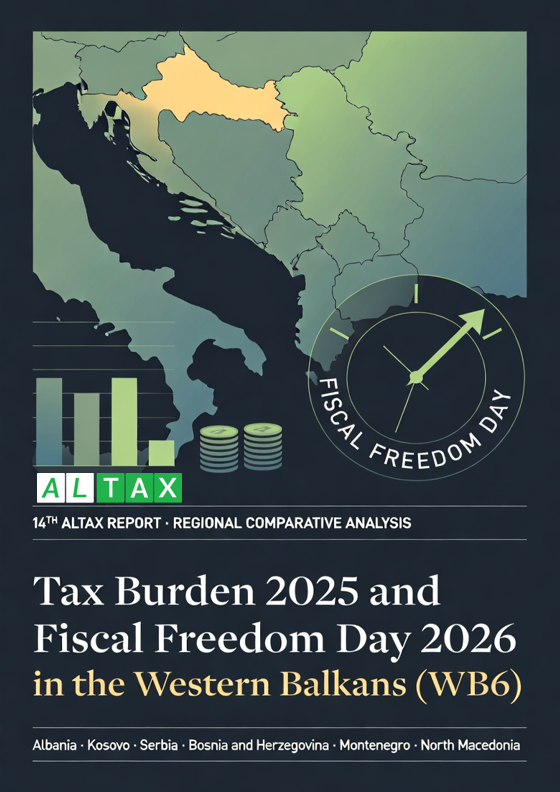
ALTAX Publishes its 14th Report on Tax Burden 2025 and Fiscal Freedom Day 2026 in the Western Balkans
ALTAX, a Fiscal and Economic Research Center in Albania today publishes its 14th annual report, an in-depth comparative analysis of tax burden and Fiscal Freedom Day in six Western Balkan economies.
The report “Tax Burden 2025 and Fiscal Freedom Day 2026 in the Western Balkans (WB6)” reveals that the main differences between countries in the region lie not in the total level of taxes, but in the way this burden is distributed between consumption, labor and capital.
In Albania, the tax burden remains moderate at 27.0% of GDP, but the fiscal system continues to be regressive due to the high reliance on VAT (34.1%) and social contributions (24.2%). This creates a heavy burden on labor (tax wedge 39–42%) and an extreme geographical concentration: over 69% of tax revenues come from Tirana and the Large Taxpayers Directorate alone.
The Fiscal Freedom Day 2026 for Albania is expected to fall on April 9, indicating that the average citizen works almost 99 days of the year just to pay taxes and contributions.
The comparative report shows that countries like Romania and Bulgaria, with similar tax burdens, have achieved a more progressive structure and less dependent on indirect taxes, offering a valuable model for Albania and the region.
To address these challenges, ALTAX proposes the “Formal Employment 2027” package, a set of balanced reforms that foresees a targeted reduction in social contributions for salaries up to 80,000 lek per month, differentiation of VAT (15% for basic goods and 22% for luxury products), as well as a gradual increase in wealth taxes.
Fiscal simulations show that this package could generate up to +14 billion lek in additional revenue, create 48,000–62,000 formal jobs, reduce informality by 6.2 percentage points, and reduce inequality (Gini coefficient) by 1.7–2.1 points, while maintaining short-term fiscal neutrality.
The report also includes a risk matrix for the implementation of the reforms, identifying political, administrative, and cyclical risks, as well as recommended measures to mitigate them.
“Fiscal reforms in Albania and the region should not only focus on increasing revenues, but on rebalancing the tax structure towards a more progressive, formal employment-friendly, and socially just system,” the report states.
The full report, along with all tables, figures, fiscal simulations, and the data dataset, is now available for free download on the official ALTAX website.
Download the full report here.
ALTAX remains committed to providing independent, data- and evidence-based analysis to help design better public policies for Albania and the Western Balkans.


Leave a Reply
You must be logged in to post a comment.