Bashkohuni me ekipin tonë. A jeni gati të rrisni biznesin tuaj? Mëso më shumë


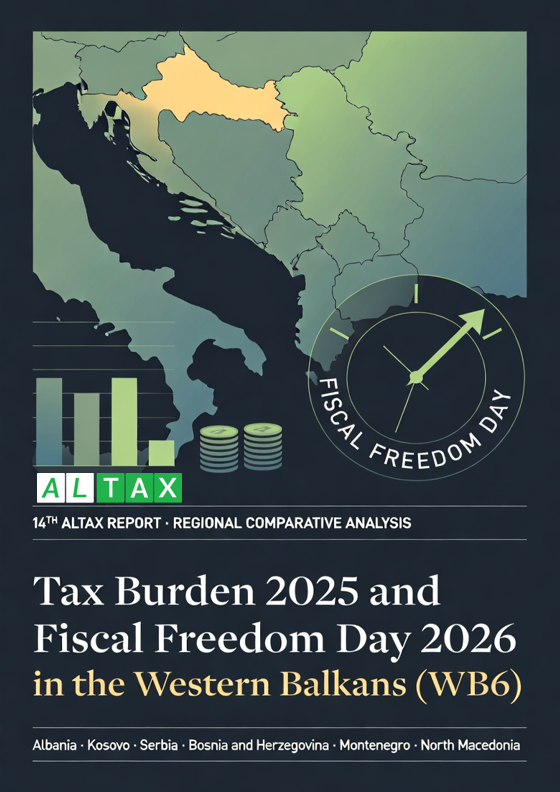
Tax Burden 2025 and Fiscal Freedom Day 2026 in the Western Balkans (WB6)
10 €
This 14th annual ALTAX report assesses the level, structure and impact of the tax burden in the six WB6 economies during 2025, also projecting the Fiscal Freedom Day for 2026. The regional comparative analysis shows that, despite the relative stability of total tax levels (ranging from 26.4% in Kosovo to 38.8% of GDP in Bosnia and Herzegovina, with a regional average of 32.2%, still well below the EU average of approximately 41%), the structural differences in the distribution of the burden between consumption, labour and capital are the main factor determining economic performance, formalisation and social justice in the region.
Key Findings
- Total tax burden in WB6 ranges from 26.4% (Kosovo) to 38.8% (Bosnia and Herzegovina), with a regional average of 32.2%.
- Albania, a moderate burden (27.0%), but with high dependence on VAT (34.1%) and social contributions (24.2%), creating a regressive system and a heavy labour burden (tax wedge 39–42%).
- Serbia and Montenegro present the highest burdens, driven primarily by labour taxation.
- All WB6 countries continue to have a relatively low share of direct taxes (PIT + CIT), with the exception of Serbia.
- Fiscal Freedom Day 2026 ranges from 6 April (Kosovo) to 22 May (Bosnia and Herzegovina). For Albania it falls on 9 April — the average citizen works almost 99 days solely for taxes and contributions.
Key Implications for Albania
Albania’s fiscal system is efficient in collection (428 billion ALL in net revenues in 2025, +11.7%), but deeply imbalanced geographically and socially. Over 69% of tax revenues come solely from Tirana and the Large Taxpayers Directorate, while peripheral regions contribute little but depend heavily on central transfers. This extreme concentration significantly increases fiscal vulnerability and deepens regional inequalities.
Policy Proposals
The report proposes a balanced reform package, fully synchronised with the Medium-term Revenue Strategy 2024–2027 and IMF recommendations, without increasing the total tax burden:
- Targeted reduction of social contributions for low and average wages (priority scenario “Formal Employment 2027”).
- Introduction of differentiated progressive VAT (15% for basic goods, 22% for luxury products).
- Gradual increase in real estate taxes and controlled fiscal decentralisation.
- Application of the global minimum tax of 15% for multinationals.
The fiscal scenario analysis shows that reducing social contributions by approximately 3 percentage points can generate an increase in formal employment of approximately 1.8%, while VAT differentiation for basic goods stimulates private consumption. The package as a whole produces cumulative positive effects for 2026–2028 of up to +14 billion ALL in additional revenues, +48,000–62,000 new formal jobs, a reduction in informality by 6.2 percentage points and a reduction in the Gini coefficient by 1.7–2.1 points, while maintaining short-term fiscal neutrality.
The comparison with Romania and Bulgaria, as countries with similar tax burdens but more progressive structures and lower VAT dependence, confirms that Albania has real space for intelligent reforms that rebalance the burden towards a system more friendly to formal employment and more socially just, without fiscal risk.
This report emphasises that Albania and the region have concrete opportunities to accelerate European convergence through evidence-based fiscal reforms. Their implementation requires bold, coordinated decision-making, supported by a careful approach to political, administrative and cyclical risk, beginning already in 2026.
- Description
Description
This report assesses the level, structure and impact of the tax burden in the six Western Balkan economies (WB6) during 2025, projecting the Fiscal Freedom Day for 2026. The regional comparative analysis shows that the main differences between countries do not lie in the total level of the tax burden (which ranges from 26.4% of GDP in Kosovo to 38.8% in Bosnia and Herzegovina, with a regional average of 32.2%, well below the EU average of approximately 41%), but rather in the structural distribution of this burden across taxes on consumption, labour and capital.
Albania presents a moderate tax burden (range 26.8 – 27.2% 27.0% of GDP), but with high dependence on VAT (34.1%) and social contributions (24.2%), creating a regressive system and a heavy burden on labour (tax wedge 39–42%). The extreme geographic concentration — over 69% of tax revenues come from Tirana and the Large Taxpayers Directorate — significantly increases the country’s fiscal vulnerability. The Fiscal Freedom Day 2026 falls on 9 April for Albania, meaning the average citizen works almost 99 days solely to pay taxes and contributions.
The comparison with Romania and Bulgaria (countries with similar tax burdens but more progressive structures and lower VAT dependence) shows that Albania has real space to rebalance the tax burden without increasing the overall level. Using static and dynamic fiscal simulations, the report proposes a priority reform package — “Formal Employment 2027” — which envisages a targeted reduction of social contributions from 27.9% to 23% for wages up to 80,000 ALL/month, offset by increases in property taxes and VAT differentiation (15% for basic goods, 22% for luxury products).
This package generates cumulative positive effects for 2026–2028 of up to +14 billion ALL in additional revenues, the creation of 48,000–62,000 new formal jobs, a reduction in informality by 6.2 percentage points and a reduction of the Gini coefficient by 1.7–2.1 points, while maintaining short-term fiscal neutrality. The report also includes a risk matrix identifying the political, administrative and cyclical risks of implementation, along with concrete mitigation measures.
The report emphasises that fiscal reform in the region should focus on rebalancing the tax structure towards a more progressive, more employment-friendly and more socially balanced system, without increasing the total tax burden. The proposals are fully synchronised with the Medium-term Revenue Strategy 2024–2027 and IMF recommendations.
Keywords: tax burden, tax structure, tax wedge, economic informality, regressive VAT, Fiscal Freedom Day, fiscal reform, Western Balkans, Albania, formal employment, social inequality, fiscal simulation.
JEL Codes: H20, H21, H24, H25, H26, H30, E26, E62, O17
Related products
-
ALTAX PRODUCTS, PUBLICATIONS
Tax Burden in the Western Balkans – Albania, Kosovo…Tax Freedom Day 2024
Original price was: 45 €.35 €Current price is: 35 €. -
ALTAX PRODUCTS
Albanian budget performance 1996 – 2016
Original price was: 65 €.55 €Current price is: 55 €. -
ALTAX PRODUCTS
Albanian partnership taxation regime
Original price was: 18 €.15 €Current price is: 15 €. -
ALTAX PRODUCTS
Tax freedom day and tax burden in Albania and Balkans, 2015
Original price was: 35 €.30 €Current price is: 30 €. -
ALTAX PRODUCTS
Tax notes for construction industry in Albania
Original price was: 15 €.14 €Current price is: 14 €. -
ALTAX PRODUCTS
Tax system and investment climate in Albania, 2016
Original price was: 12 €.9 €Current price is: 9 €. -
ALTAX PRODUCTS
Investment climate and tax system in Albania 2015
Original price was: 12 €.10 €Current price is: 10 €. -
ALTAX PRODUCTS
Tax system and incentives for investments in Albania
Original price was: 12 €.8 €Current price is: 8 €.