


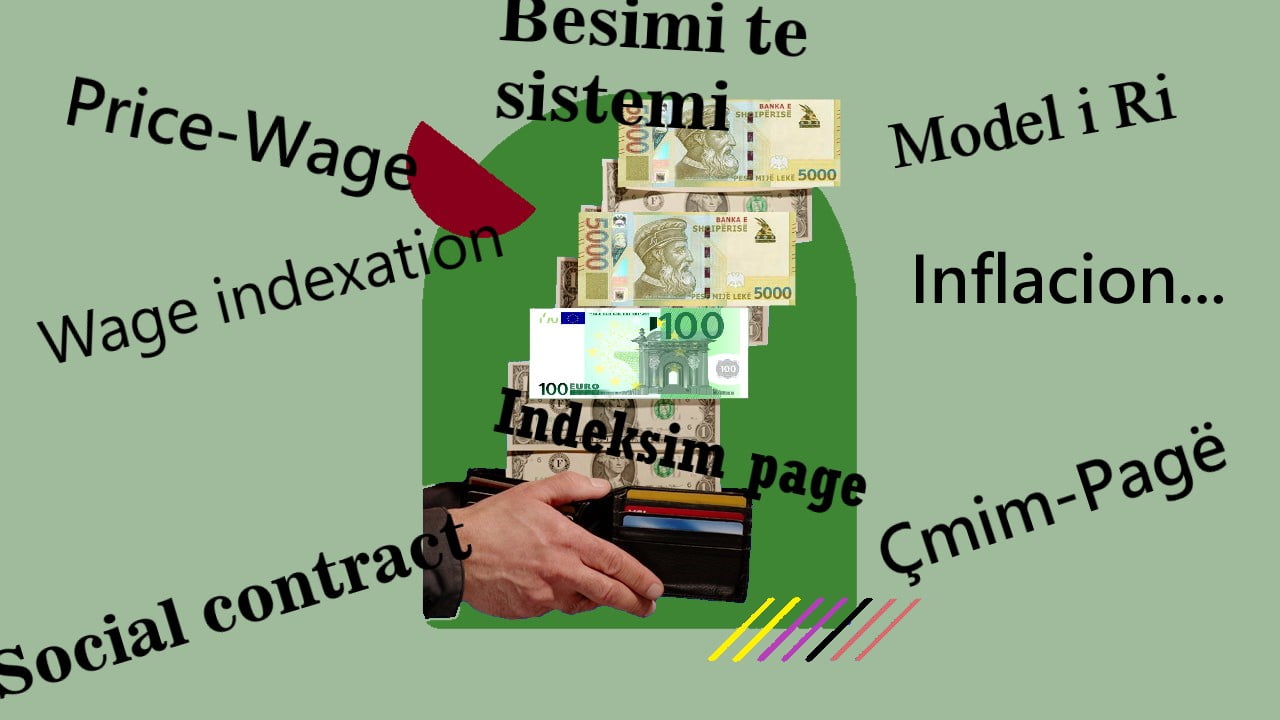
Wage indexation to increase confidence in the system and for a new challenging model
The relationship between wage setting and inflation has been closely monitored in recent years by the Bank of Albania and the former Ministry of Finance and Economy, as it was key to their success in achieving macroeconomic stabilization in an inflation regime targeted by domestic shocks. in an informal environment close to 1/3 of the economy. The government proposed a new law, which it approved in 2023, for setting the indexation of public sector wages according to inflation, after consultation with the proposals of experts, in a public consultation process that was not broad-based anyway.
After an inflationary blow, such as the increase in the price of daily products, as well as a large devaluation of the exchange rate of foreign currencies in the country, which account for up to half of the transactions for the country, it is seen that the employees are demanding higher wages for avoid loss of purchasing power.
Estimates of more models also suggest that domestic price inflation (Phillips Curve) shows a significant degree of behavior of previous periods, as a symptom of the low credibility of the market and its participants towards the institutions of the Bank of Albania and financial and economic policy institutions of the government.
As a result of these characteristics, inflation appears high (even though it is low) in its persistence in response to expected shocks as part of distrust in hasty declarations and policies and with pronounced problems of lack of transparency and accountability.
The increase in wages[1] in 2023 is affecting the production costs of businesses, exerting upward pressure on prices. However, keeping the exchange rate of foreign currencies low has managed to amortize this increase in prices. However, starting from the distortion of the supply in the market, it seems that this whole approach that had an effect until yesterday cannot last much longer and will stimulate demands for higher wages throughout the second 6 months of 2024 and the year in the following until the creation of a new equilibrium, price-wages.
The power of this influencing element is an important determinant of the sustainability of inflation and the speed with which it will again try to exceed the objective of the Bank of Albania, for keeping it below the 3% level.
All partner markets with the Albanian market seem to start raising prices after the increase in profits, but also in costs. Meanwhile, an increase in the demand for goods and services more than the supply in the market for the second 6 months, starting from the need for increased profits, may increase the pressure on prices.
Inflation may increase not only due to a fragile balance between supply and demand, but also due to the increase in employment costs, which is continuing and will not stop this year. It now seems that the concern of Albanian businesses is growing, that the high increase in wages will not yet stop the departures and absences of employees in the market.
All this will continue to lead to an upward price-wage spiral.
The practice of increasing demand for higher wages seems to come as a response to the lack of credibility towards the Central Bank and the Government, which have failed to properly justify the overvaluation of the Lek.
If there was an increasing level of trust in these two public structures responsible for the trust/distrust situation, then the declining and second-lowest inflation rate in the region would encourage the labor market to agree to reduce the pressure for growth of their salaries and costs.
In this spiral of uncertainty and lack of market confidence in policies and actions, we think that it is the best time for collective talks about strengthening the dialogue with labor market representatives.
This requires comprehensive preliminary preparation and a selection of a new model to create the missing dialogue between the government, trade unions and business, as a story that should awaken the political consciousness as the right time to start with the new social contract .
Also starting from the discussion on many topics related to work and the market is the need for each of the parties to prepare for a nationwide meeting (according to the vital sectors) to create “Salary Committees”, with the initial objective of determining the indexation of salaries without the need for government decision, but to be a contractual obligation in defiance of the old practice.
The salaries of the employees must be created on the contractual basis of flexibility and not remain hostage to the desire, agreements and political wills that seek to benefit from the chaotic situation of the Albanian market.
Wage negotiations are tripartite, involving trade unions, employers and government, with agreements negotiated at the sectoral level. The National Tripartite Labor Council is the body responsible for the coordination and governance of labor relations.
Currently there are 12 sectors and numerous subdivisions of them that need to revise the salary indexation model not by government decisions, but in the format defined in individual and collective contracts using semi-automatic mechanisms of the form of growth, without waiting for any party to receive the merits of the value due to the employees.
The government must play its important role in the various stages of the process. Each round of negotiation must be initiated by the executive power, instigating on its own initiative or at the request of one of the parties. The government should undertake a thorough analysis and a feasibility study for the future aiming at the suggested wage increase as well as other relevant aspects of wage policy related to decent work and gender equality.
To capture the real effects of monetary policy, the model must include the scaled determination of prices and wages. This model should also include the response to the impacts, which were strongly encountered in 2023 (but even before) related to:
(a) internal credit markets and fluctuations in the foreign exchange market, which led to a decline in confidence in the Euro and other currencies with an effect on the volatility of the labor value;
(b) the prices of products and services that must be in the local currency only and this will be fully transmitted to the free exchange rate, which until today has not been under such a regime. This approach of dominating the Lek in every transaction can reduce the negative effects of the exchange rate and devaluation of the value of exports;
(c) indexation rules for determining prices and wages that can reinforce the protective effects of price and wage inflation shocks;
(d) private and sovereign borrowing spreads that allow for the quantification of the effects of foreign currencies on the exchange rate.
The harmonized assessments of the influencers as above confirm the role of nominal wage adjustment and its delayed indexation to annual inflation in the wage formation process.
It is important to note that the missing practice of wage indexation shows us the urgent need to pass this backward model in the labor market and the transition to the wage indexation model according to the model defined in the reformatted labor contracts. This is a new development that needs to be done in the need for a more developed and more reflective market model to inflation and exchange rate fluctuations. This policy, which must be carefully thought out, must respond to the current challenges of the economy, which develops in the conditions of a partially free market, which often loses its operative force and becomes very vulnerable to be manipulated by political movements. day and speculation from external influences.
Finally, we suggest specifications where labor productivity growth should replace the unemployment rate and this variable should be a driving force for nominal wage growth.
[1] the average wage growth rate reached about 14% during the fourth quarter of the year, reflecting wage growth in the private sector (about 12%) and in the public sector (about 18%)


Leave a Reply
You must be logged in to post a comment.