


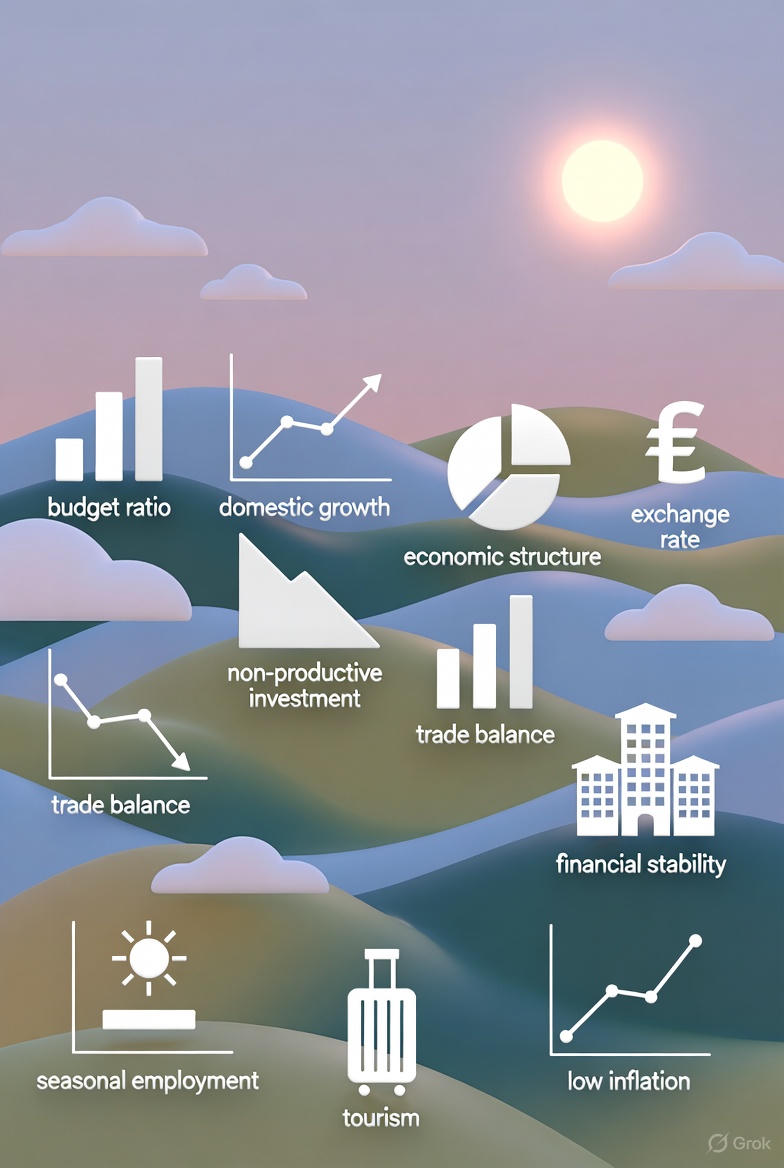
The need for a more realistic Budget Report, based on in-depth economic analysis
The Albanian Economy, as Presented in the Draft Budget Report for 2026, is depicted as a story of sustained success in the face of multiple crises over the past decade from the 2019 earthquake and the global pandemic to inflationary and geopolitical shocks.
The dominant narrative emphasizes macroeconomic stability, supported by “prudent fiscal and monetary policies” and “a continuous increase in domestic demand.”
However, a realistic assessment of this depiction requires examining several dimensions that the text downplays, such as the structure of growth, the quality of investment, the sources of consumption, the role of the exchange rate, and the long-term sustainability of this trajectory.
1. Economic Growth and Its Sources
The 2024–2025 budget report presents a real growth projection of 3.6–4.0%, consistent with INSTAT and Bank of Albania data. Yet, a deeper analysis shows that this growth is mainly driven by domestic demand, particularly household consumption and public investment. This structure reflects a fragile growth model, one not yet anchored in stronger productive sectors, innovation, or expanded goods exports leaving the economy exposed to seasonal and external shocks.
Although service exports, especially tourism, have increased, manufacturing and agriculture have contributed negatively to GDP, revealing a structural imbalance that undermines medium-term sustainability. Moreover, the 13% increase in public consumption highlights the government’s intensified role in maintaining growth momentum suggesting that part of this growth is politically induced rather than productivity-based.
In essence, despite positive GDP figures, growth remains quantitative rather than qualitative. It does not yet reflect an expansion of productive capacities or a structural transformation of the economy. The Albanian economy thus remains dependent on external factors and fiscal stimulus, posing a challenge for budgetary policies that must balance short-term stability with medium-term resilience and the development of a genuine productive base.
2. External Trade and the Exchange Rate
The report highlights a narrowing trade deficit and an improved export-to-import coverage ratio (45.4%). However, this improvement does not reflect a genuine strengthening of export capacity, but rather stems from two external and temporary factors reduced imports and the appreciation of the Lek.
The average Euro/Lek exchange rate fell from 101.5 to 98.2, which helped contain inflation but simultaneously hurt export competitiveness, especially for low-margin manufacturing sectors.
This indicates that the improvement in the external balance is monetary and temporary, not the result of stronger export capacity or industrial expansion. If the exchange rate corrects or foreign inflows decline, the current positive effect could quickly reverse, posing risks for the productive sector, future trade balances, and overall economic stability.
For policymakers, this underscores the need for long-term strategies to enhance real competitiveness, diversify exports, and support sectors with sustainable contribution potential, rather than relying on short-lived monetary effects.
3. Foreign Direct Investment and Its Structure
Data for 2025 show a slight increase in Foreign Direct Investment (FDI) of +1.1%, but the composition remains deeply non-productive, concentrated in sectors with low multiplier effects:
- 34% in real estate
- 17% in financial services
- 11% in hydrocarbons
Only a small portion of FDI flows into productive or innovative sectors, which could enhance long-term productivity and competitiveness.
This structure suggests that rising FDI does not necessarily translate into modernization or sustainable development. On the contrary, much of it fuels speculative capital accumulation and short-term profit concentration, without strengthening the real economy or reducing dependence on non-productive sectors.
For policymakers, this points to the need to redirect FDI toward strategic sectors, like manufacturing, technology, and renewable energy, so that foreign investment becomes a catalyst for sustainable, quality-driven growth.
4. Employment and Labor Market Quality
Data from the first half of 2025 show an increase in employment from 67.7% to 68.5% and a decline in unemployment to 8.5%. While these figures appear positive, a closer look reveals that they do not necessarily reflect structural improvement in the labor market:
- Most new jobs are in low-productivity service sectors such as tourism, trade, and public administration.
- Emigration and declining working-age population have contributed significantly to the drop in unemployment, producing a statistically favorable but substantively hollow result.
- Wage growth reflects a shortage of labor rather than productivity gains, raising costs for businesses without improving efficiency.
Thus, focusing on aggregate employment figures risks overstating progress, as the labor market remains fragile, seasonal, and demographically constrained, questioning the medium-term sustainability of employment growth.
5. Financial Stability and Inflation
The banking sector remains solid, with non-performing loans (NPLs) at 4%, a historically low level. However, the rapid rise in total credit (10.9%), particularly consumer loans (17.1%), raises concerns of overheating if interest rates or the exchange rate shift.
Inflation at 2.2–2.4% reflects apparent stability, but this is largely due to external factors, lower global food prices and a strong Lek, rather than internal policy success or industrial capacity.
6. Regional Comparison: Relatively Positive but Not Exceptional
Compared to other Western Balkan countries, Albania stands around the regional average in growth (3.6–4.0%) and enjoys a lower external deficit. This indicates progress in macroeconomic balance, but not a structural competitive advantage.
While countries such as Montenegro and Kosovo depend more on imports and remittances, Albania has a more stable service-based foundation, though it has yet to make meaningful advances toward a digital or industrial economy.
From a realism standpoint, the Budget Report accurately reflects official data and macro trends, but fails to capture the full complexity of Albania’s economic reality. The analysis appears complete in figures but understates three fundamental weaknesses affecting growth sustainability:
- High dependence on non-sustainable sectors, such as tourism, construction, and remittances drive growth but remain exposed to external shocks.
- Decline in agricultural and industrial production, reducing export capacity and long-term growth potential.
- Lek appreciation, which improves short-term external and inflation indicators but weakens competitiveness in production and exports.
In essence, the Albanian economy is macroeconomically stable but structurally fragile. Growth remains largely dependent on transitory factors, tourism, exchange rate strength, and low global inflation, rather than on internal transformation that would ensure qualitative and sustainable expansion.
This extended commentary highlights the need for economic policies built on realistic assumptions, recognizing existing risks and structural limitations. Only through such realism can policymaking move beyond optimistic projections and allow for more adaptive budget revisions throughout the year, ensuring both fiscal credibility and sustainable economic management.

Leave a Reply
You must be logged in to post a comment.