


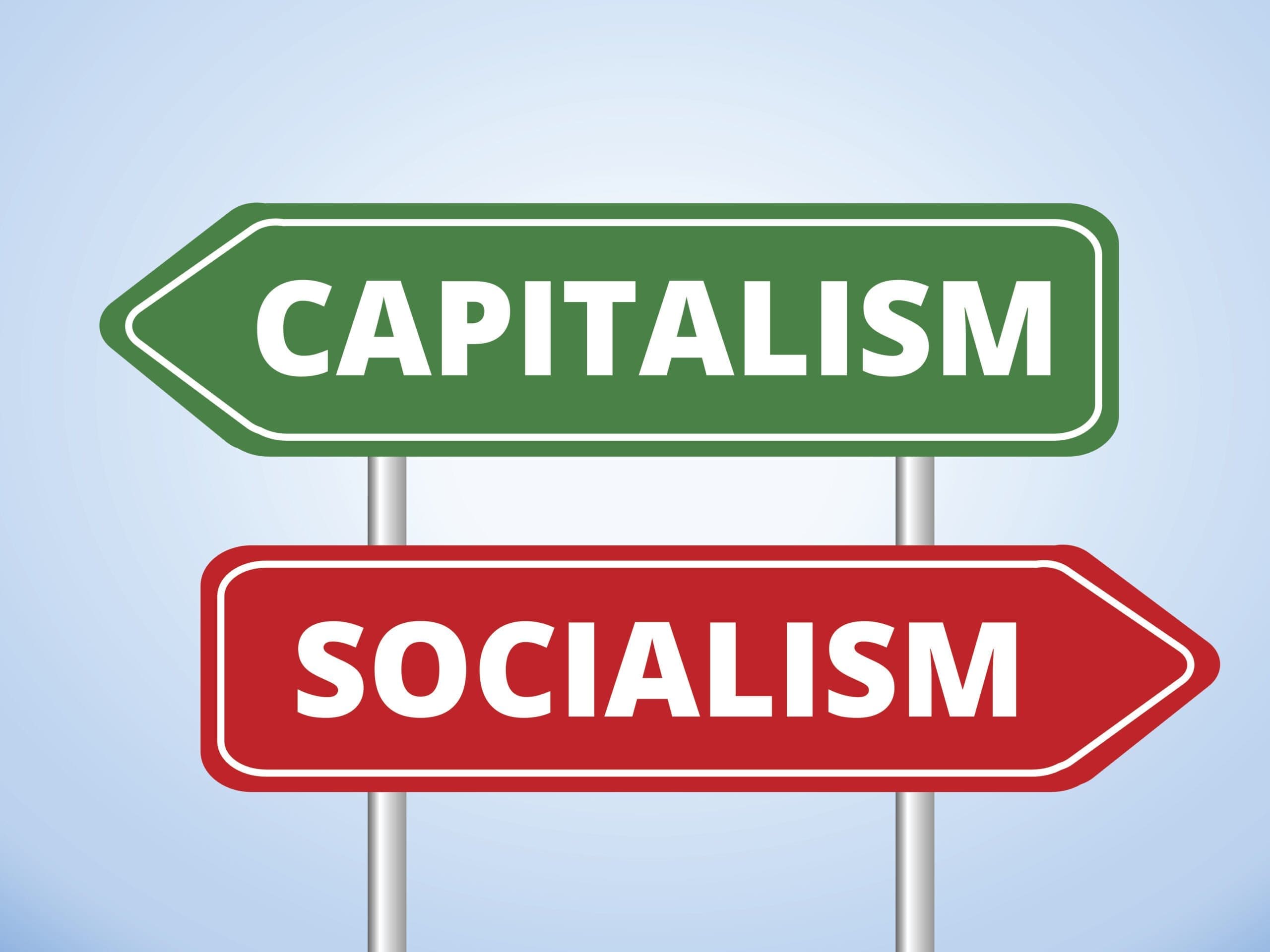
Politicians in capitalism, citizens in socialism
In a capitalist economy, the government acts as a regulatory and supplementary body. Whereas, in a socialist economy, the government plays a comprehensive role in all economic activities, such as production, distribution and consumption of a country. These are responsibilities and duties that she performs.
At a theoretical level, both represent respective schools of economic thought. One of the most fundamental differences between the systems of capitalism and socialism lies in the extent of government intervention within an economy.
In this context of the capitalist system, if we go into the description of what is happening in Albania, we see that at least in the last years we are no longer in a system where the role of the government is limited. At the same time, we are also not in a system dedicated to protecting the rights of citizens as well as maintaining an orderly environment that facilitates the proper functioning of the market. The degree to which these pillars operate distinguishes different forms of capitalism.
Following this presentation, capitalism in our country (but in fact also in the countries of the region) is not serving as a tool to produce wealth by guaranteeing political freedom, as well as the maintenance of responsible political institutions to have an educated workforce. with her basic rights fulfilled.
No!
The Albanian working class, but also many of those who are not working class still do not have all these guaranteed and for this we can refer to many of the indices that reflect the situation in which the economy, competitiveness, labor market, education and qualification are of the workforce, guaranteeing space for the funded operation of civil society, strengthening trade unions, allowing space for the government to include de facto organizations and business representatives in decision-making, as well as allowing space for new political organizations to be financed , just like the governing parties facing challenges in the election of representatives in local and central government.
All of the above are direct and indirect duties for the government and the political and economic ruling class.
But, in fact, where are we with these rights?
According to Freedom House’s latest publication[1] Albania in 2023 (32 years of transition) is categorized as a hybrid regime for reasons of:
- the electoral process that is just over half of the points needed to be called effective according to liberal democratic principles[2]
- a government that does not pass more than half of the necessary points to be labeled as democratic[3],
- assessment of a little more than half to consider the activity of the local government democratic[4],
- the obvious shortcomings of the independence of the judiciary, which received less than half of the possible evaluation[5]
- the functioning of civil society, business organizations, trade unions[6], which received a little more than half of the points, but far from being functional according to the definitions for the effectiveness it should have
- evaluation of media independence[7] to half of the possible points, being considered as a still half-fulfilled function
- corruption, which received less than half of the available points[8]
Taking into an analysis all the assessment points for:
- our hybrid justice system (direct responsibility with proper names of active politicians),
- the hybrid electoral process (direct responsibility with specific names of active politicians),
- hybrid central and local government (direct responsibility with proper names of the governing cabinet and leaders/appointees of local government in municipal councils and heads of municipalities)
- the hybrid situation of the functioning of civil society, labor organizations, private and public media (direct responsibility with individual names of the government and the leaders of the current opposition)
we have a truly clear assessment of all the above-mentioned. They no longer have justification to continue with the same way and the same instruments of management of political organizations and functions in the administration.
In all these years, if we also analyze the fulfillment of promises in the last 20 years, it seems that in addition to not realizing them or realizing them less than half, it is seen that the politicians have served badly for the strengthening of Albanian capitalism.
Even in many cases, in the name of protecting the public interest, they have limited economic freedoms through market intervention, favoritism and a neo-paternalistic approach, positioning themselves directly against the freedom of the market in the right to carry out activity freely and without restrictions.
This approach has even had a negative impact on the market strengthening environment confirmed in unison by all organizations representing the interests of local and foreign businesses.
The non-fulfilment of duties by politics and government regarding all that we mention has an even deeper impact, as it does not educate people with the positive values that a capitalist system should convey to a socialist one. This has forced people to be unable to separate themselves from the values of the past system, adversely affecting the motivation to look forward.
Meanwhile, the government, with the increase in expenses on its own account and by making decisions with financial costs, which undo the political morality in its beginnings 10 years ago for a small government, has managed to overcome the justification that the budget is being used for the purposes of social protection.
The data in this regard show the opposite.
In a comparison of social transfers in Albania and comparing it with neighboring countries, it is observed that:
- Transfers of money from the budget to diverse groups of the population, such as pensioners, the unemployed, the unemployed and those in need, etc. constitute from 10.6% to 24.1% of budget expenditures in the countries of the Western Balkans, respectively for the years 2021 and 2022. Meanwhile, government transfers to EU countries have an average of 20.1% of GDP[9] [9] it can be seen that BP6 countries have maintained levels that average 14.2% of GDP, where North Macedonia makes a big difference with this average as it has maintained a redistribution level of up to 24.1% of GDP towards the social classes and the revitalization of consumption by performing this action at the time of properly and for the important policy goals of keeping consumption and production at high levels.
- Albania shows an increase from year to year in this direction, but in the amount of expenses distributed for social protection it is as much as 12.1 and 12.8% of budget expenses, respectively for the years 2021 and 2022 and holds the fourth place in the region, leaving behind Mali Montenegro and Kosovo.
Based on the low level of support for social protection, as well as the low level of support for the administration, we have two functional parallel social classes in our country.
The first parallel is the political class and the people associated with them. This class does not constitute more than 0.04% of the resident population.
The second parallel is the working class, public and private sector employees, professionals, residents of rural areas, pensioners and all those who are considered taxpayers, where once every two years they are also voters. This class, parallel to the first, constitutes 99.56% of the entire population of the country.
While the class that belongs to the first parallel owns more than half of the material goods and is a regular beneficiary of more than half of the state budget and all the benefits that come with the material goods, while the class that is in the second parallel, not only has it never been able to converge with the former, but it is even moving further and further away from the chances of benefiting from the redistribution that the capitalist system should enable.
The political mechanization of the operation seems to need to be replaced, since if we must continue to be guided by populism, which really allows us to show our discontent, but without affecting the dysfunctional system, then the immoral show that we are paying for with our taxes will continue the same.
We need to make sure that the institutions are acting with the goal of influencing a good political and economic environment and are accountable for the money they spend. This functionality is what we need and not the other way around.
From all that we have included in this analysis and similar ones before, it can be observed that the politicians and the class they belong to are living on the benefits of the capitalist system. The rest are still living on the contribution side, where in many moments they are not really benefiting from the redistribution of material goods and are living the bad part of socialism.
[1] https://freedomhouse.org/country/albania/nations-transit/2023
[2] the quality of the national executive and legislative elections, the electoral framework, the functioning of the multiparty system and popular participation in the political process are evaluated
[3] the democratic character of the government system, the independence, effectiveness, and accountability of the legislative and executive institutions are evaluated
[4] the democratic character of the government system, the independence, effectiveness, and accountability of the legislative and executive institutions are evaluated
[5] the protection of constitutional rights and human rights, the independence of the judiciary, the status of the rights of ethnic minorities, the guarantees of equality before the law, the treatment of suspects and prisoners and the respect of court decisions are evaluated
[6] the organizational capacity and financial stability of the civil sector, the legal and political environment in which it operates, the functioning of trade unions, the participation of interest groups in the policy process and the threats posed by anti-democratic extremist groups are evaluated
[7] assesses the current state of media freedom, including laws on defamation, harassment of journalists and editorial independence, the functioning of financially sustainable and independent private journalism, and the functioning of public media
[8] assesses public perception of corruption, the business interests of key policymakers, financial disclosure and conflict of interest laws, and the effectiveness of anti-corruption initiatives
[9] https://ec.europa.eu/eurostat/statistics-explained/index.php?title=Government_expenditure_on_social_protection

Leave a Reply
You must be logged in to post a comment.