Blog

Future pension reforms need exhaustive discussions and public debate

In a discussion to answer the question "Will the retirement age increase?" in the Box to Box show, among other things, beyond the clarification in respect of the analyzes carried out by the ALTAX center for the reform of...
The tax burden in Albania and its neighbors depends on consumption and labor taxes

The tax systems in the Western Balkans (BP6) still have the greatest dependence on VAT and taxes on work (tax on income from work and insurance contributions). In the five of BP6 countries (excluding BiH), VAT payments carry a weight of...

Tax rates and the impact of direct and indirect taxes, 2022 – 2024

This specificity of the weight carried by direct, indirect taxes and social contributions, etc., if we look at it according to the Tax Norms 2022 - 2024 in Statistics, it is observed that: 1. Regarding direct taxes, countries such as Albania...

Summary from Tax Burden in the Western Balkans – Albania, Kosovo and Fiscal Freedom 2024

Economy and fiscal situation In 2023, the population of the Western Balkans (WB6) is 16.98 million inhabitants from 17.34 million inhabitants two years ago, with a decrease of 2.1% (360,000 people). In relation to the total population it seems that: - Serbia lacks...

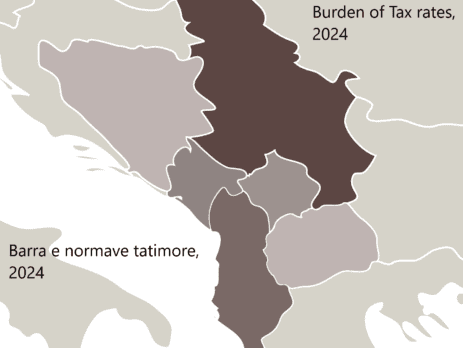
Tax burden, structure, and tax rates in Western Balkans 2024

The tax burden includes taxes on consumption (indirect for the form addressed to individuals and businesses), direct taxes addressed directly to personal income from work, capital gains to individual and corporate income, and general taxes (including all forms of national...

Economic and fiscal performance in the Western Balkans, 2021 – 2023

In 2023, the population of the Western Balkans (WB6) is 16.98 million inhabitants from 17.34 million inhabitants two years ago, with a decrease of 2.1% (360,000 people). The biggest decrease is felt in Serbia with 220,000 individuals less, in Albania...

Why should labor taxation be based on equality and efficiency against informality?

The treatment of employment tax between equity and efficiency is at the core of modern ways of taxing employment income. On the one hand, the government wants to improve social welfare through a fairer distribution of disposable income (tax equity). On...

Primary balance, credit rating agencies and long-term sustainability

According to the definition presented by the OECD[1] for the government's primary balance, the most appropriate explanation is that "The primary balance is the difference between the amount of revenue a government collects and the amount it spends...

error:
Privacy Overview

This website uses cookies so that we can provide you with the best user experience possible. Cookie information is stored in your browser and performs functions such as recognising you when you return to our website and helping our team to understand which sections of the website you find most interesting and useful.