


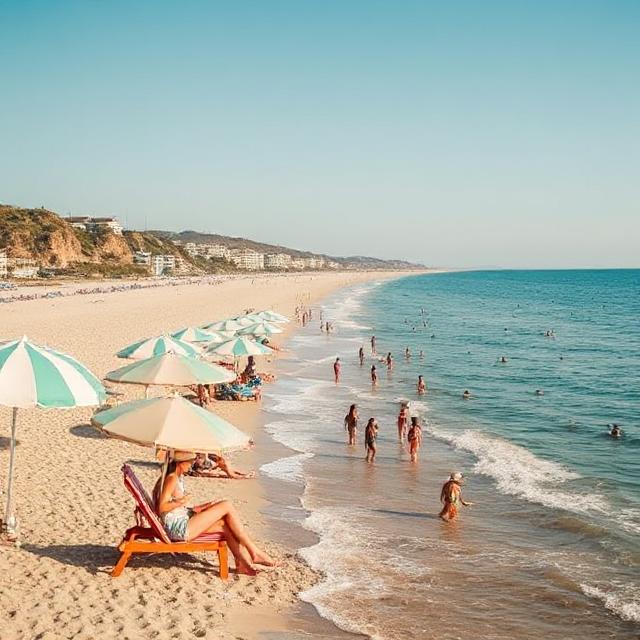
Will prices increase in the 2025 summer season?
Summer in Albania is no longer just a season.
It is a stress test for an economy that, although masked by seasonal GDP growth, exposes its deep wounds, endemic informality, territorial inequality, and a state that too often acts as a spectator rather than a regulator.
This summer, more than any other, will precisely show how fragile the architecture is on which the country’s economic model has been built.
The Albanian economy heavily relies on the service sector and seasonal tourism, with low productivity and fragile supply chains, especially in coastal areas. This model increases dependence on cash flows and results in price formation that does not follow classic competition rules but rather the scarcity of formal supply.
By relying almost entirely on tourism as the growth locomotive, Albania has produced an economy with rapid consumption rhythms but weak foundations, lacking a genuine productive sector and with a labor market distorted by informal payments and absence of labor standards.
Instead of asking whether prices will rise this summer, we should ask: how has Albania built an economy that cannot control prices during the season?
Cash economy and informality are among the fundamental reasons why prices rise without market logic. “In-hand” payments do not correspond to service quality and create the illusion of a lively economy, when in fact it is simply an uncontrolled economy.
This phenomenon increases price speculation, minimizes the impact of monetary or fiscal policies in curbing price rises, and makes it difficult to realistically monitor profit margins and prices for the final consumer.
The state’s weak monitoring capacities are well known. In many tourist areas, there are no real price controls, no efficient inspections on working conditions, and no continuous analysis of formed prices. Institutions seem more present at press conferences than on the ground.
Another systematically increasing influence during recent summers are government decisions aimed at good intentions but with immediate impact on the Albanian market.
For example, in 2025, the decision on indicative wages in the tourism and service sector is an important step toward formalization, but it comes with short-term costs that the distorted market cannot absorb without passing them on to consumers. For many operators functioning informally, the decision will be interpreted as an additional cost, automatically translated into price increases for vacationers.
During the summer season, this decision may push businesses to compensate for increased labor costs by raising prices for the final consumer, especially in restaurants, hotels, and beach areas.
In coastal zones, mainly in the south, prices are approaching the levels of countries with much higher per capita incomes, but without offering the service, infrastructure, or security that these destinations provide.
What happens in practice?
- The surge in demand concentrated in a few summer weeks faces an informal, temporary, and often speculative supply;
- Prices are controlled not by real costs but by expectations of quick profits;
- The lack of sustainable policies for price control and formalization fuels chaos and hinders fair competition.
Instead of building a sustainable market where competitive operators improve quality and hire regularly, we are creating an environment where only the strongest informal players survive.
Another dimension influencing price formation is territorial development asymmetry. All policies and tourist flows are concentrated in a few southern points, creating a “price bubble” effect where artificial demand growth for limited service causes immediate price spikes.
Meanwhile, northern areas, urban peripheries, and rural inland zones remain underdeveloped, unsupported, and outside investment schemes. Thus, territorial competition that would bring more balanced prices does not exist.
Analyzing the above factors, price increases in the 2025 summer season are expected and almost unavoidable, especially in:
- Coastal areas from Vlora to Saranda and elite coastal segments;
- The accommodation and food sector;
- Transport, entertainment services, and fuel prices in tourist zones.
The increase will not be uniform. We are dealing with selective and unequal growth that:
- Favors operators working informally;
- Hurts local consumers and mid-budget tourists;
- Damages fair competition and long-term investments.
What further increases pressure on prices?
- Overcapacity tourism. The lack of spatial and urban planning in tourist areas has led to infrastructure overload, water shortages, energy deficits, and lack of basic services, making high prices seem “normal” and justified.
- Rising import costs. Since Albania imports most food and consumer products for tourism, any exchange rate fluctuation or international price increase is directly reflected in the market.
- Localized markets and lack of competitive domestic markets. The absence of well-structured local supply chains pushes prices up, as operators rely on few sources and face high logistical costs.
Who benefits from price increases? Not the consumer. Not long-term tourism. Not development.
Price increases without control, unrelated to quality or a well-structured market, harm:
- Local consumers, who find it impossible to afford quality vacations in their own country;
- Middle-segment foreign tourists, who perceive lack of value for money and turn to destinations with more quality and stability;
- Formal operators who face unfair competition from informal entities;
- Businesses wanting to invest long-term but confronted with unclear rules and unsuitable markets.
Yes, prices in the 2025 summer season are expected to rise. This is not only a consequence of seasonal supply-demand logic but of a service economy structure operating in a distorted, unequal, and often state-uncontrolled manner.
What needs to change?
Four urgent steps:
- Implement indicative wages, but with dynamic monitoring of their effects on prices and informality. Without this, any formalization effort will be a meaningless gesture against parallel structures.
- Establish a Tourism Price Observatory, updating average prices by zones and publishing anomalies. Transparency is the best form of indirect control.
- Strengthen combined fiscal and labor inspections, temporarily involving other structures like tax authorities, consumer protection agencies, and local units to halt uncontrolled price increases.
- Promote geographic dispersion of tourism and encourage alternative destinations to reduce pressure on a few zones and create a healthier balance between demand and supply.
The tourist season does not create problems. It only exposes those existing year-round: lack of competition, informality, a non-regulating state, and an economic model generating rapid consumption but not sustainable development.
Prices will rise, and this is neither a sign of a free market nor a tourism success. It is an alarm signal of a system exploiting the season to mask its failures.
The time for intervention is not July.
It is now. Otherwise, we will continue producing “tourism for the wealthy and informality for the rest.” A country where vacations are a luxury, while development remains just a sentence in PowerPoint presentations at conferences.


Leave a Reply
You must be logged in to post a comment.