


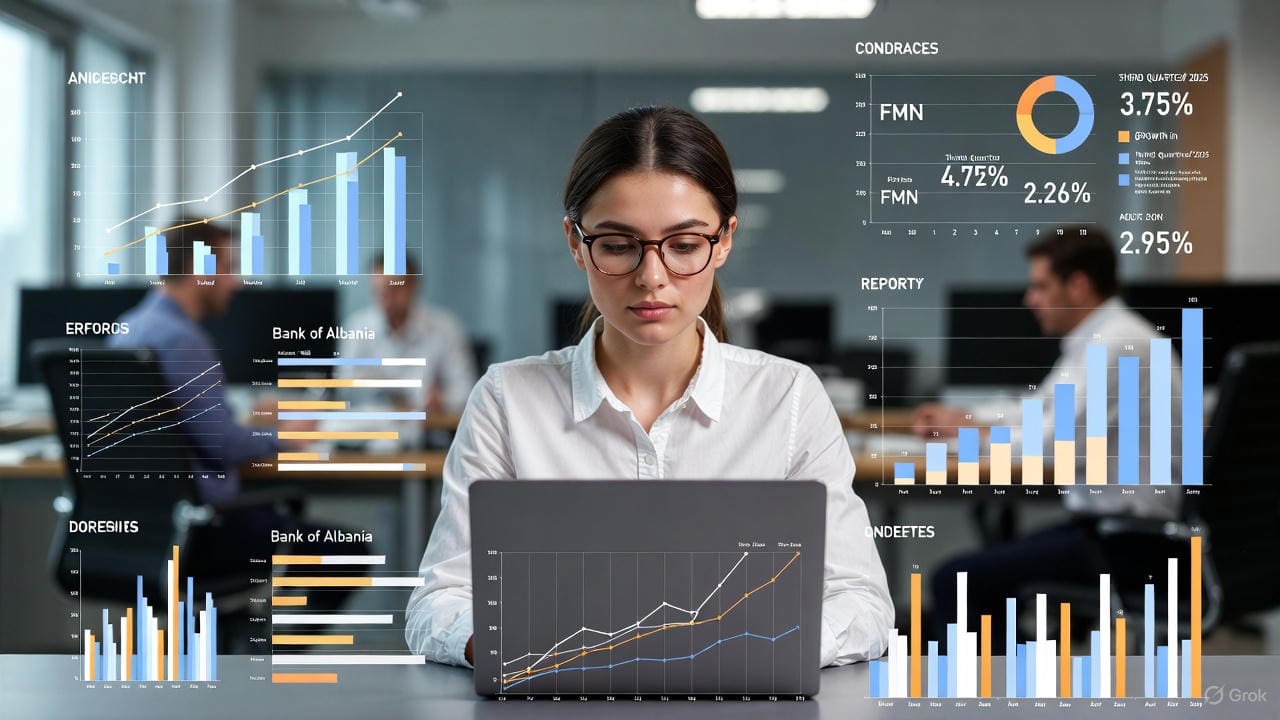
Why is Albania growing economically at high rates, but its development potential remains untapped?
In 2025, Albania recorded sustained economic growth, with projections by the IMF (International Monetary Fund) ranging from 3.4% to 3.5% of real GDP, while the World Bank estimates a moderation between 3.2% and 3.7%. Meanwhile, in the third quarter, economic growth reached 3.75%. This growth has been supported by factors such as tourism and private consumption, but structural challenges such as low productivity and emigration have hindered deeper development.
However, what we aim to analyze are the reasons behind this situation, by integrating facts from international reports such as those of the IMF and the World Bank.
First, the current growth of GDP in Albania is mainly cyclical, not potential.
According to the IMF report for Albania in 2025, after an average of 4.3% in the post-pandemic period, GDP is expected to grow by 3.5% in 2025, mainly driven by private consumption and tourism. This shows that the economy is benefiting from a temporary recovery, but is not investing sufficiently in long-term capacities such as technology or industry, leaving its structural potential underutilized.
It relies on factors that boost short-term demand (tourism, consumption, public spending), but not on increasing the economy’s long-term productive capacities.
This means that the economy is growing faster than the regional average, but its structural ceiling remains unchanged and development rates will decline. For example, the World Bank highlights that growth of 3.3% in 2024 was driven by tourism and construction, but without fundamental changes in economic supply, creating a risk of slowdown if cyclical factors weaken.
Second, tourism has been the main contributor to growth, but it has low productivity.
In the first nine months of 2025, foreign tourists spent around €4.4 billion, according to data from the Bank of Albania. According to the World Travel and Tourism Council (WTTC), the sector is expected to contribute nearly ALL 608.5 billion to GDP in 2025, reaching up to 20% of the economy in some estimates. However, this sector remains limited in its long-term effects, because although it increases GDP, brings in foreign currency, and boosts seasonal employment, on the other hand it has relatively low productivity, creates few value chains with other sectors, and is sensitive to external shocks.
As a result, tourism increases economic volume, but not the transformative capacity of the economy. For illustration, the WTTC report shows that while tourism generates 38% of exports, it depends on seasonal work and is not sufficiently integrated with industry or agriculture, making the economy vulnerable to global changes such as inflation or energy crises.
Third, productivity in Albania remains low.
In its December 2025 Article IV report, the IMF notes that Albania has one of the highest growth rates in Europe, but low productivity hampers convergence[1] with the EU. Investments in real estate and services dominate, leaving innovative sectors behind, as shown by Albania’s ranking in the 2025 Global Innovation Index, where it ranks 40th in infrastructure but 61st in business sophistication.
Investments are more concentrated in real estate and services, less in industry, technology, and innovation, and human capital is not improving at the required pace.
Without productivity growth, economic growth does not translate into higher long-term real wages, and convergence with the EU stalls[2].
This situation is illustrated by the fact that, despite GDP growth, average wages in Albania remain among the lowest in the region, fueling emigration and creating a negative cycle where productivity does not increase due to the lack of a skilled workforce.
Fourth, the economy is growing while, according to the latest census and the World Bank’s 2025 report on International Migration in Albania, the working-age population is shrinking by 1.2% per year, reaching 2.36 million inhabitants in January 2025.
Emigration of skilled labor continues, with 44% of Albanians expressing a desire to emigrate—the highest level in the region according to Gallup surveys. This has created labor market shortages, pushing wages up faster than productivity.
The working-age population is shrinking, skilled labor emigration continues, and labor shortages are raising wages faster than productivity.
This creates inflationary pressures, risks to competitiveness, and growth that is not supported by a real expansion of supply.
For example, the IMF warns that demographic aging and emigration could reduce the labor force, making current growth unsustainable without reforms in education and vocational training.
Fifth, investments are sufficient in quantity, but not in quality. While public and private investments have increased:
According to the European Bank for Reconstruction and Development (EBRD) Strategy for Albania 2025–2030, investments in infrastructure such as roads and energy have boosted short-term GDP, but the share allocated to education, R&D (research and development), and technology remains low. The World Bank report shows that total investments reached €5.3 billion in tourism and infrastructure projects, but only a small portion goes to innovation, as reflected in Albania’s low ranking in the 2025 European Innovation Index.
Most investments go to physical infrastructure and real estate, and less to education, skills, R&D, and technology.
This boosts short-term GDP, but not long-term productive potential.
This imbalance in investments explains why Albania has improved in infrastructure but lags in human capital development, hindering more inclusive growth.
Sixth, the role of the state is stabilizing rather than transformative. In the IMF 2025 report, the monetary policies of the Bank of Albania have kept inflation at 2.3% and public debt on a downward path toward 50% of GDP, achieving a positive primary balance. In fiscal statistics, the 2025 budget focuses on consolidation, but structural reforms such as those in energy and agriculture remain fragmented, cautious, stabilizing, and focused on risk management.
However, policies have not yet created strong transformative impulses, and so far structural reforms have been gradual and fragmented.
This keeps the economy stable on the surface, but not dynamic in depth. For example, the latest monetary decision of December 2025 by the Bank of Albania highlights rising consumption and employment, but warns of the need for deeper reforms to avoid demographic risks.
Seventh, institutions and the business climate act as silent constraints. According to the U.S. State Department’s 2025 Investment Climate Report, Albania has a liberal regime for foreign investment, but challenges in governance and legal certainty persist. The EBRD highlights improvements in the business environment, but institutions still favor activities with quick returns.
Governance, legal certainty, and real competition remain factors that discourage long-term productive investments and favor activities with quick returns but low value added.
These obstacles explain why, despite growth, Albania ranks low in innovation indices, hindering a business climate that attracts high-quality investments. In conclusion, current growth shows that the economy functions and is resilient, but its potential remains constrained by structural limitations. Unless there is a deliberate policy shift toward increasing productivity, human capital, and institutional quality, high growth will remain a statistical achievement rather than a developmental transformation.
[1] because productivity growth determines the economy’s ability to generate higher income per capita without creating inflationary pressures or losing competitiveness. In conditions where labor and capital productivity in Albania remain significantly lower than the EU average, economic growth is driven mainly by the expansion of low value-added sectors. This constrains real wage growth, slows capital accumulation, and keeps income per capita far below EU levels, even during periods of high GDP growth rates.
[2] It means the gradual process through which a country approaches the economic, social, and institutional level of the European Union, not only in formal terms (membership), but above all in living standards and the functioning of the state.
In practice, convergence with the EU implies:
• Closing the gap in income per capita with the EU average (wages, well-being, consumption).
• Increasing productivity, so that the economy produces more value with the same resources.
• More functional institutions, with stable rules, rule of law enforcement, and effective governance.
• A business climate and labor markets comparable to those of EU countries.
• Sustainable public policies aligned with EU fiscal, financial, and social standards.
Therefore, convergence is not simply about “growing fast,” but about growing in a qualitative way, making growth sustainable, inclusive, and comparable with EU economies.

Leave a Reply
You must be logged in to post a comment.