


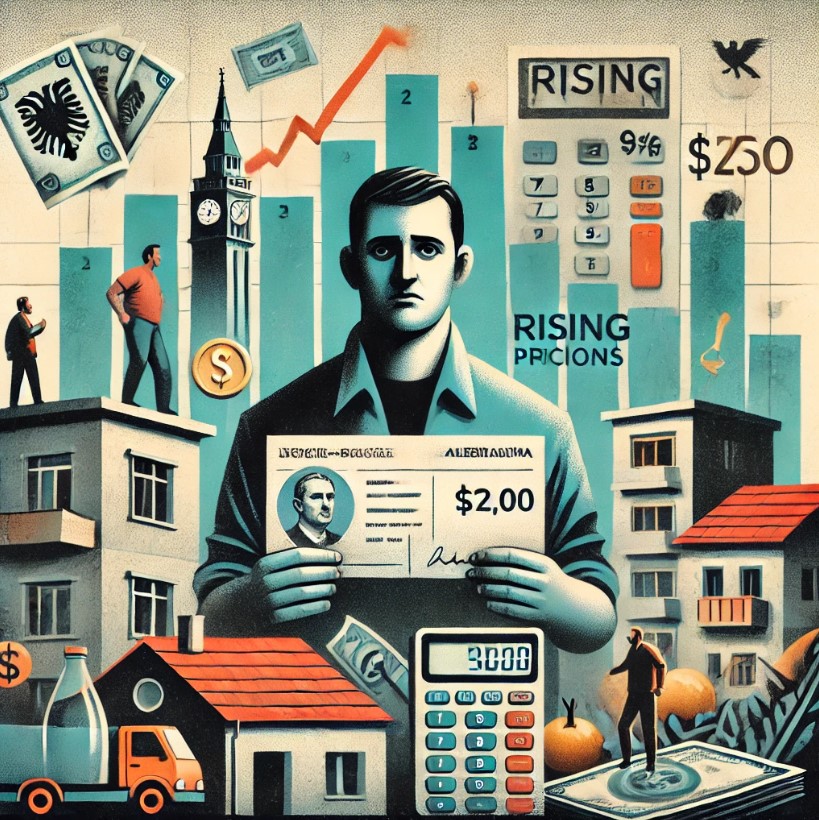
The reality of minimum wage increases in Albania and the risks for businesses and citizens
Raising the minimum wage is a complex decision that must consider the balance between workers’ welfare and businesses’ capacity to bear it. If the minimum wage increases without being based on productivity or economic growth, it may cause issues such as rising informality, unemployment, and inflation. For this reason, consultation with businesses and trade unions is essential to determine an optimal minimum wage level.
The increase of the minimum wage is influenced by several economic, social, and political factors that determine whether a raise is sustainable or not. These factors can be grouped into several main categories:
1. Economic Factors
a. Labor productivity.
The minimum wage should increase in line with productivity growth, meaning how many goods and services a worker produces in a unit of time. If wages rise faster than productivity, businesses may face higher costs and be unable to cover them.
b. Inflation and cost of living.
When inflation raises the prices of basic goods and services, governments may decide to raise the minimum wage to maintain workers’ purchasing power. But if the wage increase does not match inflation, then workers’ purchasing power falls.
c. Economic growth and the state of the labor market.
If the economy is growing rapidly, businesses have more capacity to pay higher wages. In a labor market with low unemployment, workers have more bargaining power to demand higher wages.
d. Labor market structure.
If the market is dominated by low-wage sectors (such as construction, tourism, agriculture), then increasing the minimum wage may be more difficult. Labor shortages and emigration may increase the pressure to raise the minimum wage.
2. Fiscal and Budgetary Factors
a. Tax and social security policies.
Raising the minimum wage increases revenue from taxes and social security contributions but can also raise costs for businesses and the state budget. Reducing the tax burden on businesses can help offset the additional costs from the minimum wage increase.
b. Impact on public spending.
If the minimum wage increases, it may also affect the rise in pensions and social assistance, creating more pressure on public finances.
3. Social Factors
a. Purchasing power and worker welfare.
Improving the living standard for low-paid workers is one of the main reasons to raise the minimum wage. If workers earn more, consumption increases, which can stimulate the economy.
b. Emigration and competition for workers.
The departure of the workforce to higher-wage countries (such as Germany, Italy, or Greece) forces the increase of the minimum wage to retain workers in the country.
4. Political and Institutional Factors
a. Government policies and electoral commitments.
Political decisions often influence minimum wage increases, especially before elections. Pressure from unions and worker organizations can influence the government to raise the minimum wage.
b. Legislation and international standards
EU directives and international institutions may require a certain level of minimum wage to ensure fair labor standards.
Harmonization with other countries in the region can influence the minimum wage level to avoid unfair competition.
An increase of the minimum wage from 400 to 500 euros may have positive effects on purchasing power, but without analysis and consultation with businesses, it could cause disruptions in the labor market, pressure on businesses, and increased inflation. A more cautious strategy, with consultation with economic actors, would be necessary to balance the benefits and risks of this measure.
To get a full picture of the possible effects, we can analyze every potential aspect of this measure, dividing it into major groups and highlighting the most important elements of the discussion.
Effects on Businesses
Higher labor costs.
One of the immediate effects of the minimum wage increase is the rise in labor costs for businesses. This is especially important for small businesses and those operating in low-margin sectors such as agriculture, construction, and services. For these businesses, it may become difficult to cope with these increased costs without impacting their financial sustainability.
Risk of business closure or contraction.
The increase in labor costs may lead some businesses, which cannot afford the minimum wage hike, to close or reduce their workforce. This may negatively affect employment and cause an increase in informality, as some businesses may seek to avoid high wage costs by turning to the informal sector.
Impact on prices.
Another potential effect is the rise in prices for goods and services, as businesses may be forced to pass the added labor costs onto consumers. This effect can lead to an increase in inflation, making the cost of living higher for citizens.
Effects on employment
Increase in unemployment and informality.
If some businesses cannot afford the rising labor costs, they may respond by reducing the number of employees or shifting to informal wages. This would contribute to the growth of informality in the labor market and could have negative consequences for social security and workers’ rights.
Pressure on foreign investors.
For foreign investors, labor costs are a key factor in investment decisions. A sudden increase in the minimum wage may prompt some investors to seek cheaper alternatives in other markets, leading to a decline in foreign investment in Albania.
Effects on public finances and the fiscal system
Increased revenue from taxes and social security.
The minimum wage increase may bring higher revenues to the state, as income taxes and social security contributions will rise. This can help fill the state budget and improve public finances.
Additional costs for the state budget.
If the minimum wage increase affects the public sector, the state may need to allocate more funds for public administration employees. This could create additional pressure on the state budget, especially if this sector is sensitive to wage changes.
Chain effect on pensions and social benefits.
The increase in the minimum wage will also impact the pension and social benefit systems. This may lead to higher payments for pensions and economic assistance, increasing the fiscal burden on the state.
Social effects and consumption
Increase in purchasing power.
A positive effect of the minimum wage increase is the improvement in purchasing power for low-wage workers. They will have more opportunity for consumption, which may stimulate demand for goods and services in the economy, supporting short-term economic growth.
Potential inflation.
On the other hand, if businesses pass the increased labor costs to consumers, there may be a rise in inflation. This effect could neutralize the purchasing power gains of workers, as prices for goods and services will increase.
Why must the political decision be consulted with businesses?
Consultation with businesses is a crucial step to ensure that the minimum wage policy is sustainable and implementable. Since businesses are the primary actors affected by wage changes, it is important to understand their capacity to cope with these changes without risking closures or increased informality. Furthermore, such consultation can lead to a more sustainable and prudent plan, where the minimum wage can be increased gradually, in line with productivity growth and economic development.
Minimum wage increase and productivity
The increase in the minimum wage should align with productivity growth to avoid negative effects. If productivity has not increased proportionally to wages, this can harm the economy by creating pressure on businesses, employment, and inflation. Therefore, wage policy must be based on an analysis of economic reality rather than purely political or social decisions.
But how closely is the €100 wage increase from 2023 to 2025 linked to productivity?
The increase of the minimum wage by €100 from 2023 to 2025 must be assessed in relation to labor productivity. A wage increase without sustainable productivity growth may create economic tensions.
In Albania, labor productivity has experienced modest growth. Assuming an average GDP growth of 3.9% during 2023–2024, this should also be reflected in productivity increases. Previous analyses show that labor productivity increased by no more than 0.6% for an average wage increase of 5–6%.
In the case of the minimum wage, there’s a declared 25% increase in 2026 compared to 2025. However, if the increase in minimum wage surpasses productivity growth, businesses will inevitably face higher costs without equivalent output gains.
In conditions where productivity remains low, this increase will put pressure on businesses and may lead, in the short term, to:
(a) reduced employment,
(b) increased prices to compensate for rising costs, and
(c) increased informality.
Thus, this political decision may continue to sustain informality, just like the decision to raise the minimum wage to 40,000 ALL in 2023.
Based on the arguments below, the increase of the minimum wage to €500 appears more like a political decision with electoral motives than a policy based on productivity growth and economic conditions. To justify this analysis, we must assess the main factors that support sustainable minimum wage increases and determine whether they are met.
Clarifications in the form of key questions and arguments
1. Does labor productivity justify this increase?
In recent years, productivity has grown, but not enough to justify such a significant increase in the minimum wage. With an economic growth of 3.9% in 2023–2024 and a labor market dominated by low value-added sectors (agriculture, construction, tourism), the 25% increase (from €400 to €500) exceeds labor productivity growth. Without productivity growth, businesses will either raise prices (inflation), reduce employment, or move into informality.
🔴 Conclusion: The condition is not met, as the wage increase is not backed by productivity gains.
2. Do inflation and cost of living justify such an increase?
Inflation in Albania has been high, especially for food and rents, reducing the purchasing power of the population. In this regard, an increase in the minimum wage can help low-income workers maintain consumption levels. However, this will not be effective if prices rise even more as a consequence.
🟡 Conclusion: This condition is partially met. But if businesses pass costs to consumers, real purchasing power may not improve.
3. Do economic growth and labor market trends support this decision?
Although economic growth is moderate (3.9%), it is not driving structural transformation to justify such a large minimum wage increase. Additionally, for such increases to be justified, there should be a critical labor shortage acknowledged by the market, not politically induced. Unemployment, though decreasing, is not low enough to create wage pressure, suggesting that labor demand is not yet high enough to necessitate a mandatory wage hike.
🔴 Conclusion: This condition is not met; the economy does not support such a sharp wage increase.
4. Can the Albanian economy afford it (fiscal effects and business capacity)?
Small businesses, which form the bulk of employment, will be hit hardest, as such an increase may be unaffordable. The public sector will also face increased costs for salaries, pensions, and social assistance, potentially requiring higher taxes or debt. If businesses cannot cope, we may see increased informality and reduced formal employment.
🔴 Conclusion: This condition is not met; the economy lacks a stable base to absorb the increase without negative side effects.
5. Is this an electoral decision based on political context?
The political decision comes in an election year (2025), when the government seeks to secure support from low-income groups. Large increases in minimum wage without clear economic analysis are often populist strategies. This decision and statement have not involved broad consultation with businesses and unions, suggesting that it is not the result of a thorough economic assessment.
🔴 Conclusion: This condition is not met; the decision clearly follows an electoral logic.
Summary of the Five Conditions
✅ Only one (inflation) partially justifies the wage increase.
❌ The other four conditions highlight that:
- There is insufficient productivity growth to justify the increase.
- The labor market does not exert pressure for a mandatory wage increase.
- The increase may harm businesses and increase informality.
- The decision has a clear electoral motivation.
Lessons from the 2023 Experience
The increase of the minimum wage to 40,000 ALL in 2023 offers valuable lessons for evaluating the new €500 (50,000 ALL) electoral promise for 2026. This past experience helps understand the social and economic effects of a rushed and forced wage increase.
- The 2023 increase led to forced formalization of low wages, pushing many workers from 32,000–35,000 ALL to 40,000 ALL.
- However, many small and micro-enterprises turned to informality or part-time employment to avoid rising social insurance costs.
- The projected €500 minimum wage in 2026 could deepen informality, especially for businesses that were already struggling in 2023.
- Undeclared labor and fictitious employment may rise, particularly in low-margin sectors like agriculture, construction, and services.
- In 2023, many businesses raised product and service prices to offset wage increases, indirectly contributing to inflation.
- Small businesses were hit hardest, lacking leverage with suppliers or the ability to automate work processes.
- A €500 minimum wage in 2026 would strike even harder, forcing businesses to either raise prices or reduce staff.
- Increased fiscal burden and insurance obligations may deter investment and job creation.
On the fiscal side:
- The 2023 increase boosted revenues from social insurance and payroll taxes.
- On the other hand, pensions and social benefits linked to the minimum wage rose, creating additional budget costs.
- In 2026, the €500 increase is expected to raise social insurance revenues but also public spending—especially on pensions, economic aid, and public administration salaries. If tax revenues don’t cover these increased costs, the government could face a higher deficit and rising debt.
It is true that in 2023, consumption increased following the wage hike, but not enough to offset the negative impact on businesses. Price increases neutralized the benefits of higher wages for many consumers.
Likewise, a €500 minimum wage in 2026 may temporarily boost consumption, but if businesses respond by increasing prices, real purchasing power may not improve. Inflation could erode the benefits of the wage hike.
A politically driven decision, not economically grounded
Even in 2023, the minimum wage increase was a political decision lacking thorough consultation with businesses. SMEs opposed it, but the government imposed it without supportive measures.
As in 2023, the €500 minimum wage promise for 2026 is not based on comprehensive economic analysis and was not discussed with businesses to assess its real impact. The promise comes in an election year, indicating a strong electoral motive rather than a long-term economic strategy.
What could be done differently to avoid negative effects?
Based on the 2023 experience, the government should adopt several measures to enable a sustainable increase in the minimum wage:
- The wage increase should be gradual and linked to productivity. Instead of an immediate €100 increase, it could be phased in with economic growth.
- To avoid unemployment and informality, the government could temporarily reduce social insurance contributions for small businesses.
- To address inflation trends, there should be policies to prevent speculative price increases by businesses exploiting wage hikes.
- Most importantly, there must be an inclusive productivity-raising approach, such as:
- investment in vocational education,
- technology, and
- innovation,
to raise the value of production and support long-term wage growth.
In conclusion, a decision to increase the minimum wage must be balanced and take into account all these factors. Raising the minimum wage can bring significant benefits for workers, but it must be part of a comprehensive policy that includes productivity growth, investment incentives, and enhanced competitiveness. Without these elements, the consequences may be undesirable and could cause more harm than good.



Leave a Reply
You must be logged in to post a comment.