


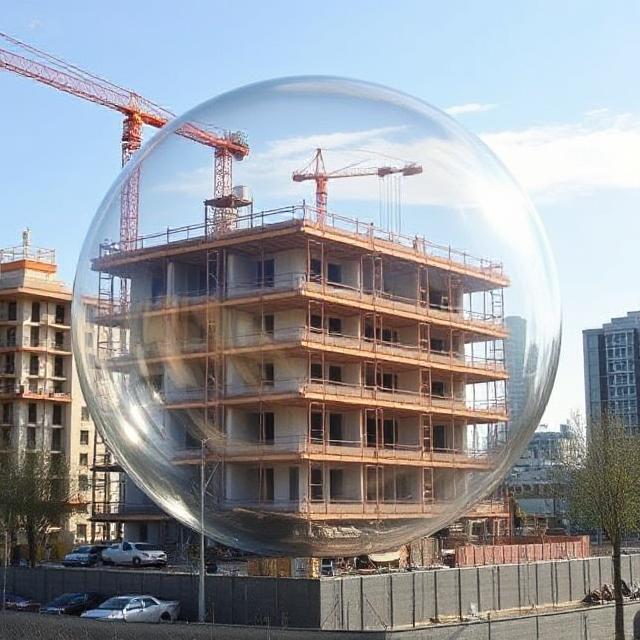
The bubble rising with bricks as a real threat in Albania’s construction sector
If you walk today through the streets of Tirana, Durrës, or Vlora, it’s not hard to sense a paradox in the air: on one hand, new towers are rising each month with marathon-like speed, while on the other hand, people complain they cannot afford to buy an apartment to live in.
This contradiction is not just a matter of perception – it’s the clearest sign that Albania is facing a potential bubble in the construction market, one that risks turning from a driver of growth into a source of crisis. It points to a housing market no longer built on shelter needs, but driven by speculative investments that could lead us toward a silent crisis – a bubble inflating without a plan and without control.
In Tirana, construction is happening as in the world’s largest metropolises, but wages remain like those in the poorest peripheries of Europe.
In recent years, construction has become the most visible symbol of growth in Albania. High-rise towers, luxury projects, and record-breaking prices each month create the impression of a dynamic and booming market.
Yet beneath this seemingly successful image, signs of a financial bubble are becoming increasingly evident — one that is swelling on shaky foundations and disconnected from the country’s economic and social reality.
Construction is not building prosperity
Albania is one of the few countries in the region where construction has turned into a “self-fulfilling” industry — building not due to real housing demand, but because there is capital looking for a place to park, often without regard for economic logic.
Apartments are not bought to live in, but to “protect money,” “preserve value,” or even worse, to launder it.
In such a climate, the price per square meter has surpassed any connection to the real economy. Average incomes have not grown at the same pace.
Albanian families live on the same wages, with only inflation-linked adjustments and limited opportunities. Yet, they face a market where a standard apartment now costs as much as in developed European cities — without offering the same standard of living.
This is no longer merely about accessibility — it’s a brutal separation of the market from the population it supposedly serves, and a gap between prices and purchasing power. We are dealing with a construction market that serves investors, the diaspora, and large capital, but no longer ordinary Albanian families.
A market without economic logic, driven by speculation
Facts show a major shift from housing construction for living to construction for investment and capital gain. Thousands of housing units are bought but remain uninhabited, sold multiple times before completion, while hundreds of new permits are approved monthly — even in areas lacking social infrastructure and urban services.
Buyers rush into early floors hoping to resell at a higher price later. Brokers advertise “guaranteed return” investments. Meanwhile, ordinary citizens see the dream of owning a home drifting further away.
What’s actually happening is that construction is creating a parallel reality, with supply targeted at a small elite market — for emigrants seeking a homeland property, or investors who never intend to live in the apartment. The majority of the population is excluded from this market.
We are witnessing a phenomenon where value is created artificially, disconnected from real demand, leading to a speculative cycle: prices rise because they are expected to rise — a spiral that is unsustainable.
🚨 The risk of a bubble bursting without warning
Looking back, global history has taught us that markets built on speculation, rather than real need, end in deep crises. The 2008 financial crisis in the U.S. was triggered precisely by an uncontrolled construction bubble. Albania may not have the same scale, but the symptoms are familiar:
- Continuously rising and unjustifiable prices, even in areas without infrastructure or real demand.
- A proliferation of luxury projects, mismatched with the needs of the local population.
- Large cash investments outside the banking system, with unclear origin.
- Lack of transparency on the real stock of vacant apartments, making risk assessment nearly impossible.
These are the signs of a bubble inflated by financial illusions, not by social necessity.
If diaspora inflows slow down, or a financial shock disrupts the external capital chain flowing into Albania, we could face a sudden blow to the country’s most important domestic investment sector.
How much time do we have left?
Bubbles have a peculiar trait.
They don’t announce when they will burst, but they do show symptoms.
In Albania, the risk is real — even if it may seem distant. If the diaspora slows its purchases, if interest rates rise, or if a crisis hits emigrants’ host countries, many buildings will be left empty, and many loans will go unpaid.
This would trigger a domino effect — not only in construction, but also in banking, employment, public spending, and ultimately, national well-being.
The solution is not to stop construction, but to curb unplanned development and the logic of “build now, fix later.” Albania needs a balanced construction policy, rooted in urban planning and social justice — not permits handed out as rewards or a thriving gray market.
What should be done before it’s too late?
This is the moment to intervene with smart policies, before the market self-corrects painfully:
- The state must abandon the “let them build, we’ll fix it later” mindset.
- Idle properties and speculative construction should be taxed.
- Social housing with affordable costs for real families must be promoted.
- Every transaction must be fiscalized, and real sale prices published.
- Urban development must be aligned with real social needs.
Are we building cities or bubbles?
The truth is that construction can be a powerful engine of development — but only if based on real needs, urban planning, and social equity. If we build just to profit today without thinking about tomorrow, then we are not building cities — we are building the problems of the future. The construction bubble is like a balloon inflating silently — until it bursts loudly. We still have time to stop this cycle, but only if we admit that growth without equity is destruction masked as success.



Leave a Reply
You must be logged in to post a comment.