


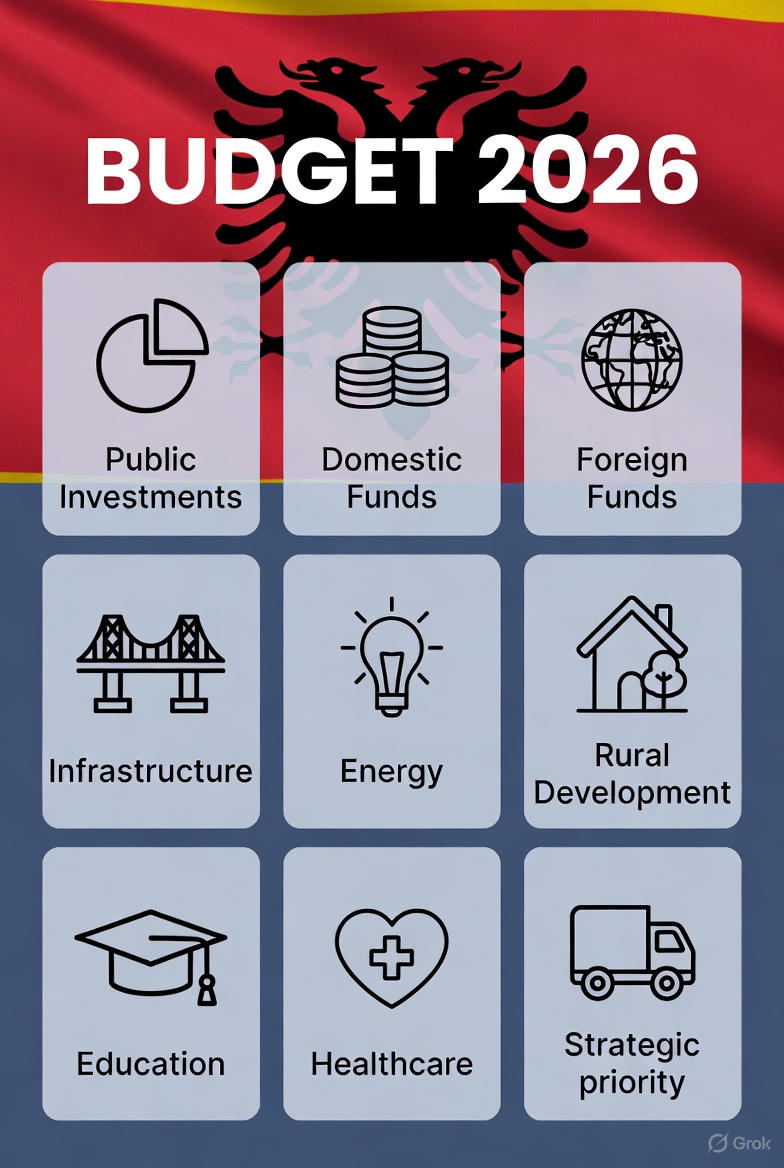
Overview of Public Investments and Priorities in light of the draft budget for 2026
The public investment budget for 2026 is structured around a combination of domestic and foreign funds, primarily supporting infrastructure, energy, and urban/rural projects.
The following analysis shows that real priorities are often dominated by the continuation of existing projects, while the need for new investments in social and innovative sectors remains limited.
Overall Investment Structure
| Funding Category | Total Value (mln ALL) | Share of Total | Main Sources |
| Domestic Funds | ~153,000 | 66% | State budget, transfers, reserve fund, Albanian Development Fund |
| Foreign Funds | ~79,000 | 34% | KfW, EIB, EBRD, World Bank, JICA, EU, Saudi Fund |
| Total | ~232,000 | 100% | Mix of loans, grants, and budgetary funds |
The budget structure shows that over two-thirds of public investments are still funded domestically, while foreign funds focus on sectors requiring technology, standards, and international institutional support.
Sectoral Allocation
| Main Sector | Domestic Funds (mln ALL) | Foreign Funds (mln ALL) | Total | Share % |
| Infrastructure & Transport | 67,000 | 37,000 | 104,000 | 45% |
| Energy & Natural Resources | 12,500 | 18,000 | 30,500 | 13% |
| Water Supply, Sewerage & Environment | 8,800 | 14,500 | 23,300 | 10% |
| Education & Health | 21,400 | 2,600 | 24,000 | 10% |
| Agriculture & Rural Development | 9,200 | 2,300 | 11,500 | 5% |
| Tourism, Culture & Urban Development | 10,700 | 5,900 | 16,600 | 7% |
| Reconstruction, Emergencies & Housing | 8,200 | 1,200 | 9,400 | 4% |
| Justice, Administration & Digitalization | 15,200 | 2,000 | 17,200 | 6% |
This allocation clearly shows the relative priorities of the 2026 investment budget and the distribution between domestic and foreign funds.
1. Infrastructure and Transport
| Sector | Total Investment 2026 (000 ALL) | Domestic Funds | Foreign Funds | Comment |
| Roads / Bypass | 9,347,253 | 4,493,323 | 4,853,930 | Most funds continue existing projects; new networks are limited. |
| Railways | 21,731,000 | 7,092,202 | 14,638,798 | Main priority is rehabilitation of Durres-Tirana, Vore-Hani i Hotit, Rrogozhinë-Pogradec lines; high continuity of ongoing projects. |
| Maritime Transport | 10,000 | 0 | 10,000 | EU projects for port management, with limited impact on new urban priorities. |
Investments in national roads, bypasses, railways, and multimodal hubs dominate the infrastructure budget. Total sector allocation is ~104 billion ALL, with 67% funded domestically and the rest via foreign loans and grants (WBIF, EBRD, EIB, KfW).
This indicates that:
(a) existing networks require continued financing, projects started in previous years cannot be interrupted, requiring additional funds for completion;
(b) new strategic investments, including green transport or urban hubs are often delayed.
The increasing weight of rail transport financed by EIB, EBRD, and WBIF reflects efforts toward sustainable transport.
The sector remains fundamental to the country’s economic infrastructure, but carries the risk of concentrating public capital in long-term infrastructure with slow returns, leaving limited space for social, environmental, and innovative projects.
2. Energy and Energy Efficiency
| Sector | Total Investment 2026 (000 ALL) | Domestic Funds | Foreign Funds | Comment |
| Electricity Network & SCADA | 1,628,779 | 1,070,000 | 558,779 | Investments in smart meters, SCADA, substations, and network balancing. |
| Hydropower / PV | 1,800,000 | 300,000 | 1,500,000 | PV Belshi, rehabilitation of Fierze and Vau i Dejës; large physical investments dominated by foreign funds. |
Most energy investments are continuations of existing projects (hydropower, OSHEE network). KfW, AFD, and CDP projects1 focus on network modernization, energy efficiency, and smart meters, while domestic funds complement interventions for energy security and infrastructure rehabilitation.
Priority is on diversification and decarbonization, but there is no dedicated fund for private renewable energy, so the government emphasizes the public grid rather than promoting small-scale producers.
Green energy and innovative projects are limited by existing priorities.
3. Water Supply, Sewerage, and Environment
| Sector | Total Investment 2026 (000 ALL) | Domestic Funds | Foreign Funds | Comment |
| Municipal Infrastructure / RWS | 3,756,325 | 538,100 | 3,218,225 | Municipal projects in Himara, Tirana; foreign funds dominate to meet EU standards. |
| Sewerage Tirana | 95,948 | 20,000 | 75,948 | Investments to complete urban network. |
| Environmental Projects “Blue Sea” | 100,000 | 0 | 100,000 | Limited but strategic focus. |
Foreign funds are essential for meeting EU standards and sustainable environmental projects, including urban network modernization, wastewater management, and digitalization of water services.
Domestic funds mainly cover rural networks and maintenance.
This sector is closely linked to EU integration requirements, focusing on environmental standards and quality of life.
However, continuation of existing water and sewerage projects consumes most of the budget, leaving limited space for new initiatives.
4. Tourism, Urban Development, and Regional Integration
| Sector | Total Investment 2026 (000 ALL) | Domestic Funds | Foreign Funds | Comment |
| Tourism / Urban Integration | 2,828,000 | 1,200,000 | 1,628,000 | Projects linked to tourism development, “Alps Gateway,” and multimodal hubs; partially continuation of existing projects. |
Funds are divided between ongoing projects and new initiatives. Domestic funds are used for city and historical center upgrades, while foreign funds support integrated sustainable tourism programs (EBRD, WB, EU).
The sector supports economic diversification, with investments aimed at increasing territorial value via tourist infrastructure.
Although the sector has potential for expansion, co-financing with existing projects slows new priorities.
5. Education and Health
| Sector | Total Investment 2026 (000 ALL) | Domestic Funds | Foreign Funds | Comment |
| Education / Dormitories | 606,953 | 306,953 | 300,000 | Energy efficiency projects and dormitory rehabilitation, mostly continuations. |
| Health | 0 | 0 | 0 | No major new investments in 2026 budget. |
Education funds are limited and tied to previous projects. Health depends on operational funds and receives little capital investment.
Domestic funds are used for school infrastructure, regional hospitals, and medical equipment, with minimal international support except for digitalization and emergency equipment projects.
This underfunding highlights a development model focused on physical rather than human capital.
6. Agriculture and Rural Development
| Sector | Total Investment 2026 (000 ALL) | Domestic Funds | Foreign Funds | Comment |
| Agriculture & Rural Development | 11,500,000 | 9,200,000 | 2,300,000 | Domestic funds cover most projects, funding rural infrastructure and sustainable development programs; foreign funds support specific rural roads and tourism development. |
Despite agriculture representing up to 16% of GDP, funds for this sector are ~11.5 billion ALL, less than 5% of total investments.
The main reason: existing infrastructure projects require continued financing, leaving little space for new or innovative agricultural investments.
Support continues in 2026 for national schemes and irrigation investments, with foreign loans and grants used for water network modernization and agricultural processing.
The sector has strategic potential, but limited funds hinder economic diversification and innovation.
7. Administration & Digitalization
| Sector | Total Investment 2026 (000 ALL) | Domestic Funds | Foreign Funds | Comment |
| Administration & Digitalization | 17,200,000 | 15,200,000 | 2,000,000 | Investments mainly in public service modernization, digital processes, and IT systems. |
Domestic funds cover most projects, while foreign funds are limited, restricting adoption of advanced technologies.
Projects focus on communication networks, online services, ERP systems, smart meters, and SCADA.
This reform-oriented sector aims to reduce administrative costs and corruption, though infrastructure project continuity limits funding for large digital improvements.
Planned investments for 2026 clearly reflect a trend linked to limited fiscal capacity. Approximately 65–70% of funds are allocated to ensure continuity of existing projects, which maintains stability and development momentum, but limits flexibility for new or emergent priorities.
Infrastructure and energy dominate due to strategic importance, while social sectors like education, health, rural development, agriculture, tourism, and technological innovation receive a modest share, indicating that long-term priorities lack sufficient funding for transformative impact.
Foreign funds are essential, especially for capital projects and EU-aligned initiatives, but are largely tied to ongoing projects, leaving limited room for new innovative projects that could strategically enhance domestic capacity.
The 2026 investment framework reflects a common dilemma: the need to complete ongoing projects and fulfill international commitments limits opportunities for pursuing new priorities.
While continuity is necessary, to maximize long-term impact, the government should seek flexible funding models that allow investments in emerging priority sectors, without tying all resources to ongoing projects.
- Domestic funds are used for regional roads, reconstructions and maintenance, while foreign funds are used for strategic corridors (railways, bypasses, international connections). ↩︎



Leave a Reply
You must be logged in to post a comment.