


On tariff policy in Foreign Trade and Albania’s regional influence
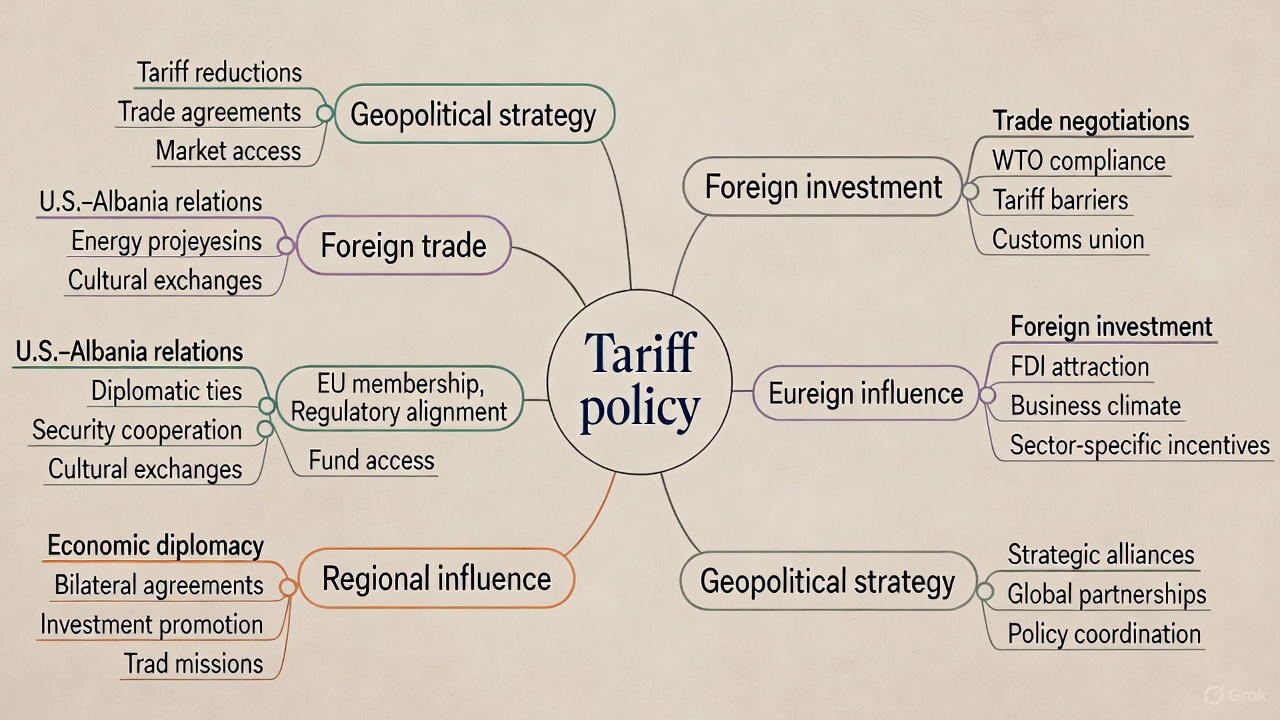
The approach the Albanian government has begun to consider in its trade negotiations with the United States represents an attempt to move toward a more dynamic level of international economic relations. Against the backdrop of global trade tensions in 2025, the idea that Albania could negotiate trade tariffs with the United States as a mechanism to attract European investment is a bold yet complex strategy, one that connects directly with the country’s geopolitical position and its European integration aspirations.
This approach aims to merge economic diplomacy with the strategic advantages of a small nation that holds growing geographic and political importance.
In April 2025, when the Trump administration reinstated high tariff policies to exert pressure on trade partners, Albania was included among the countries subject to a baseline tariff of 10 percent, alongside Kosovo and Montenegro.
Unlike neighboring countries such as Serbia and North Macedonia, which were hit with much higher rates, Albania retained a milder level due to its stable political relationship with the United States. This positions Albania relatively favorably, creating a foundation it can use as leverage in future negotiations.
Nevertheless, the immediate economic impact remains limited.
Albanian exports to the U.S. amount to roughly 70 million euros annually, mainly in textiles, minerals, and agricultural products, while losses from the 10 percent tariff are estimated at only 7 million euros per year. Thus, the direct impact is symbolic, but the diplomatic potential is significant.
In the global context, the U.S. continues to use tariffs as an instrument to strengthen bilateral agreements. For Albania, which does not yet have a Free Trade Agreement (FTA) with the U.S., such negotiations could serve as a strategic test for building stronger ties with American investors and for creating a “bridge” to the European Union through joint industrial and energy projects.
The feasibility of this idea is estimated at 60 to 70 percent,— not an immediate priority, but a valuable medium-term opportunity if aligned with Albania’s EU integration goals.
Although ambitious, the idea is far from unrealistic. Albania lacks a free trade agreement with the U.S. but has maintained strong cooperation since the 1990s. Based on the experience of other small countries that have successfully negotiated tariff reductions through bilateral talks, Albania could follow a similar path. Its progress would depend on coordinated economic diplomacy involving U.S. trade representatives and Albanian diplomatic structures.
A limited trade agreement focused on selected sectors such as renewable energy, tourism, or agricultural products would represent a realistic, low-cost, and long-term beneficial step.
This initiative would gain greater momentum if paired with the wave of investments coming from the European Union.
Albania could serve as an “entry gate” for American capital seeking access to the European market. Under this model, a U.S. company could establish production capacity in Albania and export to the EU without additional tariffs, leveraging the country’s candidate status.
The visit of European Commission President Ursula von der Leyen in October 2025, during which she pledged six billion euros for regional integration and an additional four billion from the private sector, further reinforces this potential. Albania could thus position itself as a transatlantic hub for hybrid U.S.-EU investments.
In this context, the Albanian diaspora in the United States can play a decisive role.
Nearly half a million Albanians living in America represent a major potential force for lobbying, investment capital, and business linkages that could help open new trade channels.
This is a strength that Albania has yet to fully utilize, though programs such as Connect Albania have begun to deliver tangible results in construction and services. The cost of implementation remains low, as the effort is primarily diplomatic and strategic rather than fiscal. However, the outcome depends on the willingness of the U.S. administration and Albania’s capacity to present a concrete package of mutual benefits.
Beyond U.S. relations, Albania’s broader economic policy has already demonstrated the ability to attract investments through other mechanisms.
The Law on Strategic Investments, which provides fiscal incentives for key sectors such as energy and tourism, has generated over 16 billion euros in foreign investment by 2025. In 2024 alone, foreign direct investment flows rose by more than 5.6 percent, reaching 1.58 billion euros compared to 1.499 billion in 2023. The strongest growth occurred in the energy sector, where EU-based companies like Raiffeisen and Enel are helping transform Albania into a regional hub for clean energy production.
In this broader perspective, trade negotiations with the United States should not be seen as an alternative to European integration but as a complement that strengthens Albania’s economic resilience.
The country’s economic scale is modest compared to its major partners, with a GDP of 18 billion euros and exports under 7 billion, yet for a small economy, even a targeted trade agreement could produce tangible impact. A mere 100 to 200 million euro increase in exports annually could translate into thousands of new jobs and greater international credibility.
At a time when U.S.-EU trade tensions are creating uncertainty across supply chains, Albania has the chance to leverage its neutrality and stability to become a useful partner for both sides. This approach does not require political alignment or polarization but rather a smart policy that uses diplomacy to maximize national benefit.
As small countries in West Africa and the Balkans have already managed to negotiate tariff reductions to attract investment, Albania has no reason to remain outside this movement. Inaction would mean missed opportunities for growth and regional positioning.
On the contrary, swift and coordinated action could turn Albania into a success story that combines trade policy with European integration strategy.
Ultimately, the success of this policy is not measured by market size but by the ability to use geopolitics as economic capital. Negotiating tariff arrangements with the United States is a rare opportunity for Albania to transform its small size into a strategic advantage.
Despite its modest economic weight, a GDP of 26 billion euros and a population of 2.4 million, Albania’s diplomatic agility and economic flexibility could make it an example of a “small economy with expanded influence.”
If implemented with seriousness and precision, this strategy could reduce dependency on the EU by 10 to 15 percent within three years and increase foreign investment by 0.5 to 0.7 percent of GDP annually, creating a regional cooperation model with impact across the Balkans.
At its core, tariff negotiations with the United States are not merely an economic issue but a new strategy for international positioning, one that could transform Albania from a passive policy-taker into a smart actor within the global balance of trade and investment.
A bold diplomacy linking Washington and Brussels through Tirana would be a wise step toward a more mature and stable economic role in the region.


Leave a Reply
You must be logged in to post a comment.