


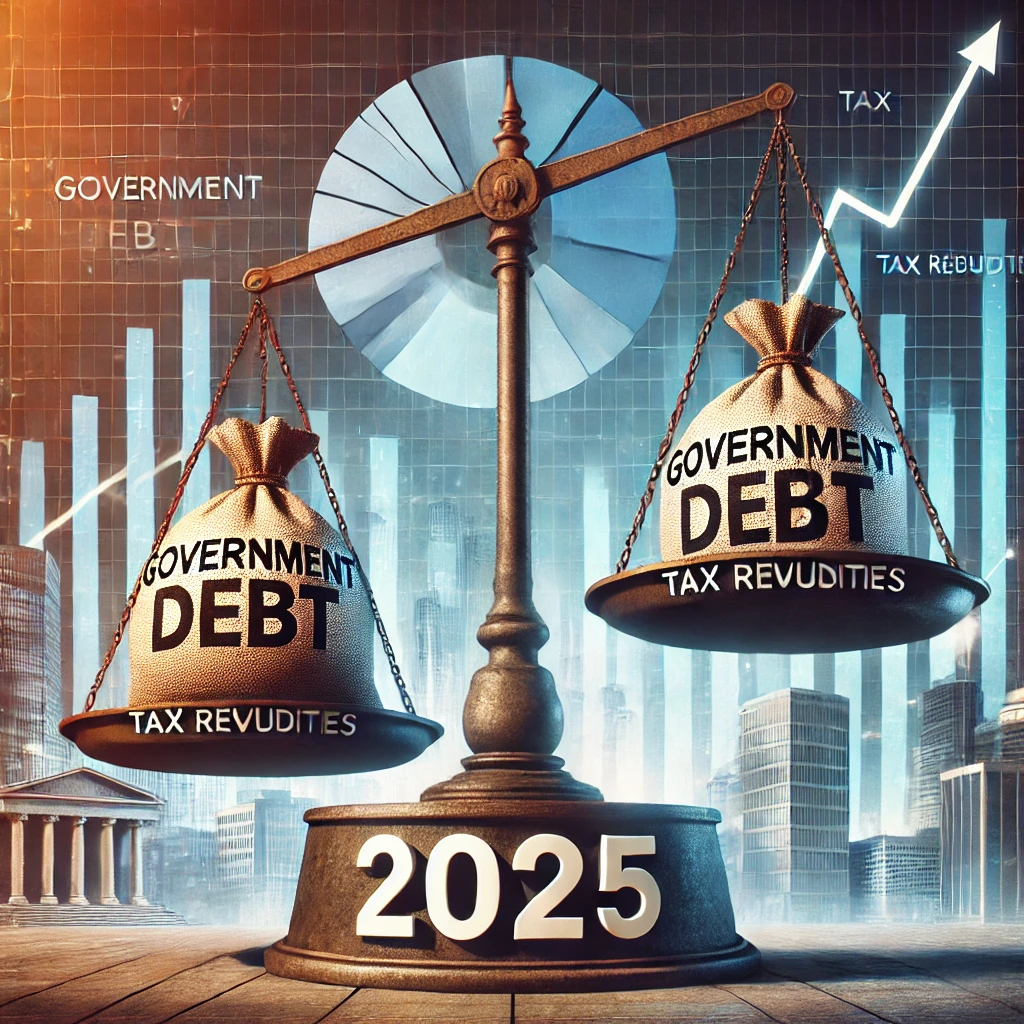
Is Albania in 2025 in a situation where it is borrowing significantly more than it has in revenues?
In 2025, Albania plans to take on additional loans to finance the budget deficit and refinance existing debts. According to data from the Ministry of Finance, budget revenues for 2025 are projected at 754.6 billion ALL, while budget expenditures are planned at 822.7 billion ALL, resulting in a deficit of around 68.1 billion ALL.
To cover this deficit and repay previous debts, the government plans to take new loans. At the beginning of 2025, the issuance of a Eurobond worth 650 million euros is expected, as part of a total planned borrowing of 1.1 billion euros from domestic and international markets.
However, it is important to emphasize that public debt as a percentage of Gross Domestic Product (GDP) is expected to decrease in 2025. According to the Ministry of Finance, public debt is projected to fall below 55% of GDP, down from around 60% in 2024.
This indicates that although Albania will take on additional loans in 2025, economic growth and fiscal management aim to keep public debt at sustainable levels in relation to GDP. Nevertheless, it is essential that the government continues to carefully monitor and manage borrowing and spending to ensure the country’s long-term financial stability.
But doesn’t this debt reduction seem contradictory in Albania’s case?
The reduction of the public debt-to-GDP ratio in Albania in 2025 may appear contradictory for several reasons, considering the level of the budget deficit and increased borrowing.
How is the debt-to-GDP ratio decreasing explained?
The growth of nominal GDP has influenced this direction. The public debt-to-GDP ratio can decrease if nominal GDP grows faster than debt. This can happen as a result of:
- Economic growth (real increase in consumption, without increased production).
- Inflation, which raises the nominal value of GDP.
In fact, inflation has declined, and in this case, the replacement factor is precisely the strengthening of the lek, which has influenced the increase in nominal GDP.
The government is expected to borrow at higher interest rates than in previous years, but repays part of the debt under more favorable terms, a financial burden that may be reduced.
Where lies the contradiction in Albania?
If Albania is planning a deficit of about 68 billion ALL and considerable borrowing to cover the deficit and repay debts, this should theoretically increase public debt. This raises the question of how the debt-to-GDP ratio decreases?
In a country like Albania, where the euro has depreciated drastically by more than ¼ of its value in less than two years, the nominal increase in GDP is often more a result of the appreciation of the lek rather than real economic growth. This creates a “mathematical” reduction in the debt-to-GDP ratio without reflecting a real improvement in the economic situation.
Clarification
To assess its accuracy, we must understand that:
- If prices rise (e.g., due to currency appreciation), nominal GDP will increase automatically, even if there has been no real growth in production.
- A stronger currency can cause goods and services to be valued more in nominal terms, especially when export revenues and remittances are converted into higher values in lek.
- This strengthening may not reflect a real improvement in the economic capacity or output of the country.
In some cases, nominal GDP growth may be primarily the result of lek appreciation and inflation. This is more common in:
- Economies with high inflation, or
- When there is intervention in the exchange rate to artificially strengthen the domestic currency.
Conversely, if the economy experiences real growth in production and services, then nominal GDP growth will more accurately reflect real economic activity.
However, this is not always precise, as real economic growth may contribute more to nominal growth in healthy economies with price stability. The analysis must be based on concrete data to identify the sources of nominal GDP growth.
Risks associated with this approach
Even if the debt-to-GDP ratio decreases, the absolute debt may continue to grow. This means that the financial burden of repayment will remain high and may limit fiscal flexibility.
The issuance of the Eurobond and other borrowings in international markets expose Albania to risks of high interest rates, especially in a global environment where interest rates are rising.
If Albania fails to significantly increase budget revenues or reduce expenditures, debt will remain a long-term challenge.
Opportunities for a “sustainable reduction” of debt
To avoid contradictions and achieve a real reduction in public debt, the government should:
- Increase budget revenues through reforms in the fiscal system, fighting informality, and boosting economic productivity instead of relying on rates and fees.
- Limit borrowing for non-productive investments. The focus should shift to investments that create long-term economic growth.
- Improve fiscal transparency. Reporting on debt and financial management should be clearer and avoid the perception of statistical manipulation.
Does the fact that borrowing in euros is beneficial, due to the euro’s depreciation against the lek, have an impact?
The depreciation of the euro against the lek can be a factor influencing Albania’s choice to borrow in euros. However, this situation is complex and carries both benefits and risks.
Since the lek has strengthened significantly against the euro in recent years, the costs of repaying euro-denominated debt (both principal and interest) have decreased in nominal terms when converted into lek.
In international markets, borrowing in euros often carries lower interest rates compared to borrowing in lek in the domestic market. This is a major incentive for the government to prefer borrowing in euros.
By borrowing abroad, the government avoids “squeezing” the domestic financial market, allowing banks and other financial institutions to lend to the private sector.
However, if the euro strengthens in the future, the cost of repaying debt will increase significantly for Albania, creating a substantial financial burden.
A further and larger concentration of debt in foreign currency exposes the economy to external shocks and limits fiscal flexibility.
If inflation in the eurozone remains low and interest rates rise due to European Central Bank (ECB) policies, Albania could face higher borrowing costs in the future.
Why does Albania choose this approach?
The strengthening of the lek and the current lower cost have influenced the government to exploit the strengthening of the lek to reduce the costs of existing debt and new euro borrowing.
Albania has a persistent budget deficit, and part of the debt is used to cover investments and the deficit. Eurobonds and external borrowing offer a large source of financing at relatively low cost.
Euro borrowing is used for infrastructure projects or investments that the government considers strategic for economic growth, but this is taking longer than programmed and increasing the risks to the fiscal system and budget.
The euro’s depreciation may provide short-term benefits, but this situation is not sustainable. A possible future strengthening of the euro could create serious difficulties for debt repayment.
By borrowing mainly in foreign currency, Albania becomes more sensitive to global dynamics, including interest rate changes and capital market conditions.
A strong lek will negatively affect exporting sectors and stimulate imports, which will reduce the competitiveness of the Albanian economy.
The government’s approach to borrowing in euros and maintaining a policy that favors a strong currency like the lek can be seen as a choice that prioritizes the state’s short-term needs, often at the expense of citizens’ interests and specific economic sectors.
This creates a domino effect that may be perceived as institutional egoism, because:
- It harms citizens’ savings. The devaluation of euro savings for a population that heavily relies on euro savings (due to remittances and historical preference for foreign currency) means that the strengthening of the lek reduces the real value of their savings. This directly impacts their purchasing power and perception of economic well-being.
The lack of useful investment alternatives will push savers to have fewer incentives to keep savings in euros, facing the challenge of finding safe and profitable options for their money. - It hits competitiveness and exporters. A strong lek raises the cost of Albanian products and services in international markets. This penalizes exporters, who face difficulties competing with higher prices compared to regional and global rivals.
Increase in imports. A strong lek makes imported products cheaper in the domestic market, increasing competition for local producers and favoring imports to the detriment of local production.
Dependence on foreign markets. This policy reinforces Albania’s dependence on imports and reduces efforts to develop productive and export sectors. - The risk of unequal benefits. Such an approach seems to favor the interests of creditors and financial institutions more, which have greater access to international markets and benefit from lower interest rates. While some sectors (like importers and consumers who buy foreign goods) may benefit from the strengthening of the lek, domestic producers and exporters are significantly harmed.
4. Long-term social stability is undermined and economic inequality is affected.
Policies that harm exporters and savers in euros contribute to increased economic inequality and relative poverty, generating social tensions.
Economic insecurity.
The devaluation of savings and weakening of productive sectors make it harder for citizens to plan for a sustainable economic future.
In the long run, this leads to failure in building a resilient economy. A strong currency, in conditions where the economy lacks a solid industrial and export base, is a short-term strategy that does not support sustainable development.
Instead of pursuing a policy that focuses solely on short-term debt cost reduction, the government could:
- Diversify sources of financing:
Leverage domestic borrowing in lek to maintain balance and support the domestic financial sector. - Promote the export sector:
Monetary and fiscal policies should support increased production and exports, laying stronger foundations for economic development. - Maintain a balanced exchange rate:
A currency that is neither too strong nor too weak helps preserve international competitiveness and domestic stability.
To avoid the perception that these policies contradict social agendas, the government could consider:
- Supportive policies for vulnerable sectors:
Subsidizing exporters and assisting sectors negatively affected by a strong lek. - Diversification of borrowing:
Greater emphasis on lek-denominated borrowing to support domestic economic development and reduce exchange rate exposure. - Priority social investments:
Channeling debt towards projects that improve citizen welfare, such as healthcare and education.
The current policy of strengthening the lek and borrowing in euros may be a pragmatic choice to temporarily lower the debt burden, but it creates long-term challenges for the Albanian economy.
This approach favors the interests of the state and certain specific groups at the expense of savers, exporters, and domestic competitiveness, highlighting a form of institutional selfishness. A more balanced and inclusive policy is needed to ensure sustainable economic and social development.
Current borrowing and currency strengthening policies, while justifiable in the context of debt reduction and macroeconomic stability, have consequences that affect social equity and the well-being of vulnerable groups.
If the government maintains an expenditure growth rate lower than revenue growth and reduces the deficit, new borrowing may be minimal or limited to refinancing existing debt.
However, if other major investments are pursued, then new debt could reach significant levels.
Exact figures will depend on the 2025 budget and the government’s strategic objectives.


Leave a Reply
You must be logged in to post a comment.