


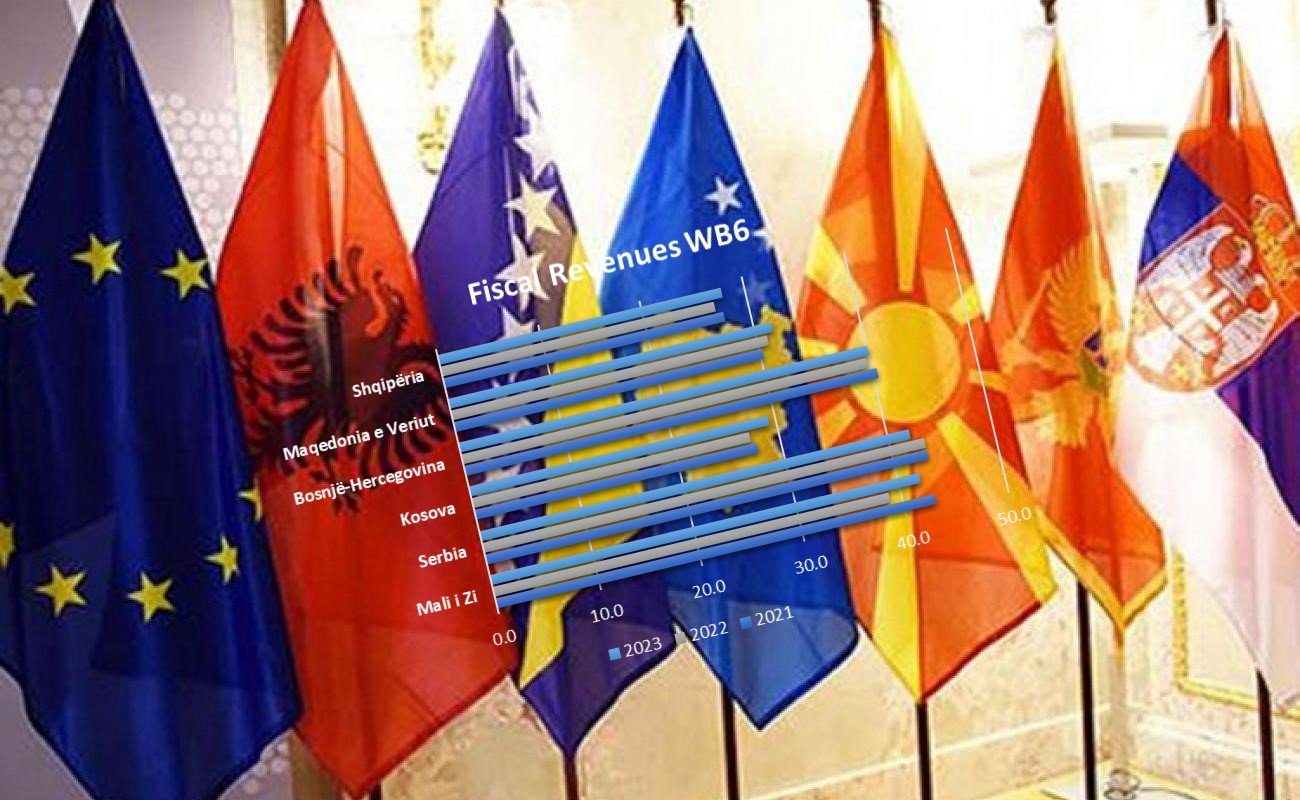
Fiscal and tax revenues in the Western Balkans, 2021-2023
Regarding the budget revenues in the countries of the Western Balkans (WB6), both in size and trend there are big differences between them. Bosnia and Herzegovina, Serbia and Montenegro manage to enter the budget (taxes and loans) over 40% of their GDP. While Kosovo, Albania and North Macedonia manage to put in their budget less than 1/3 of their GDP, with a difference that reaches up to 11 percentage points difference within the BP6 region.
While tax revenues are at high levels for the three countries (Bosnia and Herzegovina, Serbia and Montenegro) with a level of 36 to 37 percent of their GDP. The other three countries (Kosovo, Albania and North Macedonia) collect revenues at the levels of 25 to 28 percent of their GDP. So the difference in tax revenues is also high between the two groups within the region and reaches up to 9 percentage points lower in countries with low tax revenues.
Another way to measure tax revenue collected is on a per capita basis.
The Western Balkans collects an average of 5,700 EURO PPP. This represents about a quarter of the EU average. However, tax revenue per capita in the Western Balkans has grown faster than that of EU countries in the last decade.
Budget (fiscal) revenues [1] in WB6 (see Tab.) in 2023 compared to 2021 show an increase of 0.1% of the GDP of the six countries. In 2021, budget revenues reached the level of 35.4% of GDP and in 2022 at a lower level (34.5% of GDP), while in 2023 it is seen that there has been an increase in budget revenues , where Serbia, Montenegro and Bosnia-Herzegovina have closed the year 2023 with lower budget revenues than 2021. Budget revenues have increased as the average of BP6 and have the same level as the revenues of the period before the pandemic (35.5% of GDP).
| Budget revenues in WB6, 2021 – 2023 | % GDP | |||
| Countries | 2021 | 2022 | 2023 | Diff. 23/21 |
| Montenegro | 43.0 | 38.8 | 42.1 | -0.9 |
| Serbia | 43.3 | 43.3 | 42.1 | -1.2 |
| Kosovo | 27.7 | 27.2 | 29.3 | 1.6 |
| Bosnia-Herzegovina | 40.5 | 39.7 | 40.1 | -0.4 |
| North Macedonia | 30.3 | 31.0 | 31.7 | 1.4 |
| Albania | 27.5 | 26.8 | 27.8 | 0.3 |
| Western Balkans | 35.4 | 34.5 | 35.5 | 0.1 |
| Source: IMF, MF | ||||
This group with high budget incomes have another impact on their budgets since on the one hand they have not performed according to the economic objectives with exports and meanwhile tax revenues have also decreased in 2023, also being influenced by the inhibition of the economy for reasons for the increase in basic interest rates, as well as internal political influences
Kosovo, Albania and North Macedonia have budget revenue growth ranging from 0.3% of GDP in Albania, 1.4% of GDP in North Macedonia and 1.6% of GDP in Kosovo.
The group of countries with the lowest budget income has mostly structural impacts of their economy, but also impacts from internal changes influenced by population consumption and investment and spending projects for certain categories of the economy.
In 2023, tax revenues account for 89% of total budget revenues. In 2022, tax revenues make up 90% of budget revenues, as well as in 2021, where tax revenues make up 90% of budget revenues. Based on this ratio of tax revenues, it can be observed that WB6 countries have had a higher exposure to borrowing, but also a slight decrease in tax revenues in countries with higher budget revenues (see Tab.).
| Tax revenues in WB6, 2021 – 2023 | % e PBB | |||
| Countries | 2021 | 2022 | 2023 | Ndryshimi 23/21 |
| Montenegro | 37.9 | 34.3 | 36.2 | -1.7 |
| Serbia | 38.6 | 38.9 | 37.1 | -1.5 |
| Kosovo | 24.5 | 24.8 | 25.7 | 1.2 |
| Bosnia-Herzegovina | 36.8 | 36.0 | 36.1 | -0.7 |
| North Macedonia | 27.2 | 27.7 | 28.5 | 1.3 |
| Albania | 25.6 | 25.3 | 25.8 | 0.2 |
| Western Balkans | 31.8 | 31.2 | 31.6 | -0.2 |
The progress of tax revenues seems to have followed the same trend as budget revenues. Thus, BP6 countries that have a decrease in tax revenues in relation to GDP are also seen to have a decrease in budget revenues.
The same trend that shows the impact of tax revenues on budget revenues is seen in other countries that have an increasing performance in 2023, where the budget revenue is also increasing.
However, the downward trend of tax revenues in high-income countries is greater than the decline in budget revenues as a whole.
If we see how the tax revenues have evolved as a weight in the GDP for Albania, it can be seen that they have a stability at the level of ¼ of the GDP, which is considered a weak effectiveness of the tax policy and tax administration.
North Macedonia applies the same tax legislation and with similar tax rates, but it looks like we will see that it has a stable and measured tax policy, but also a better administration in the implementation of its mission.
Meanwhile, Kosovo can be seen as a case to be studied for its achievement in tax administration, where it has already come very close to the level of the tax burden of Albania, showing a policy designed in accordance with the economic environment and administrative capacities.
Tax revenues in countries with higher tax revenues are seen to have entered a period of stagnation, reflecting both problems with the performance of tax policies in transformation, but also their heavy dependence on labor and consumption taxes. At the moment that Serbia and Bosnia-Herzegovina also have a population decrease, this has also affected the labor market and, as a result, labor taxes.
[1] consists of budget revenues or otherwise fiscal revenues of the government (revenues from taxes, duties, fees and other revenues)



Leave a Reply
You must be logged in to post a comment.