


A Budget for Growth or for narrow priorities in 2026?
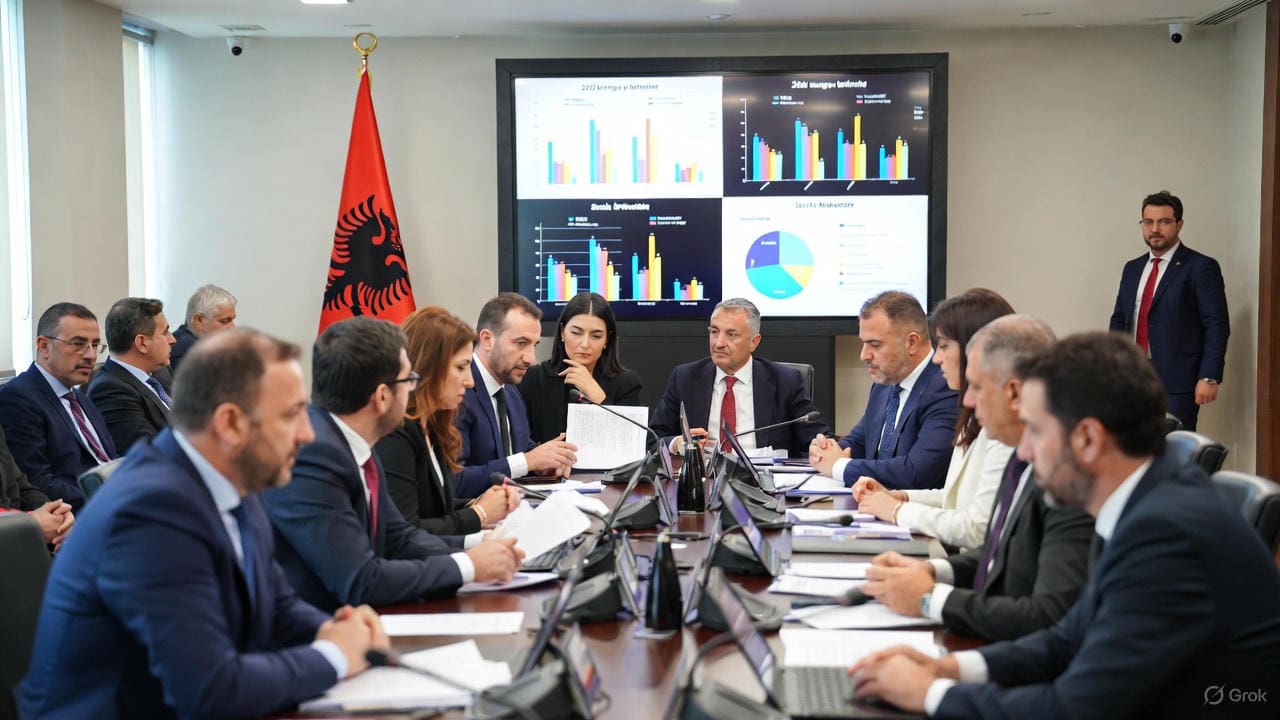
The Parliamentary Committee on Economy, Employment and Trade approved on December 9 the state draft budget for 2026, with a total value of 886 billion lek (around €8.2 billion), sending it to the plenary session of Parliament for final voting. The approval secured solely with the votes of the Socialist majority (7 in favor, none against), fully rejected all 60 amendments proposed by the opposition, overshadowing demands for salary increases and social assistance.
Meanwhile, our discussion also encompasses foreign direct investment (FDI), which reached a record €1.58 billion in 2024 and continues to rise in 2025, as well as priorities such as exports and green energy.
But is this budget a realistic roadmap for sustainable development, or merely an instrument that supports the government’s narrative while failing to address structural challenges such as the trade deficit and emigration?
A Swift but Contested Approval
The 2026 budget was approved article by article in the plenary session of the Albanian Parliament on December 12, as reported by the media, forecasting economic growth of 3.9% for the coming year.
The government presents it as a “stabilizing” document, focused on reducing the budget deficit below 3% of GDP and increasing tax revenues.
However, the approval process was tense.
Democratic Party (DP) MPs and majority MP Mr. Braçe proposed 60 amendments, calling for additional funding in healthcare (from 82 to 110 billion lek), education (from 64.8 to 92 billion lek), pensions (indexation from 1.6 to 5 billion lek), and compensation for flood damage in Vlora, Gjirokastra and Lezha (up to 2 billion lek for affected regions), as well as issues related to fiscal amnesty. All were rejected, leaving only the Commission’s proposals (such as €5 million for justice institutions). This fueled criticism from the opposition, which called it “a budget closed to citizens.”
The approval comes in a positive but fragile economic context.
According to the Institute of Statistics (INSTAT), Albania’s GDP grew by 3.5% in the first nine months of 2025, driven by private consumption and investment. Yet challenges such as emigration (over 20,000 departures in 2025) and the trade deficit (imports seven times higher than exports) demand a more balanced budget.
The 2026 budget allocates over 20% of funds to capital expenditure, focusing on sectors directly linked to economic development.
Meanwhile, with €1.58 billion in 2024, its highest historical level, and a rising trend in 2025, FDI remains essential for better implementation of the budget.
Prime Minister Edi Rama, at the Tirana Economic Forum, described FDI as “pillars of stability,” emphasizing that Albania is becoming a “north–south development corridor” with new airports, ports, and industrial zones.
Key sectors include real estate (31.2% of FDI), green energy (28.7% of FDI in 2025), finance (20.7%), and financial services, with much less in industry. The budget foresees 14 billion lek in foreign funds for infrastructure, aiming to attract more European investors ahead of EU negotiations.
Exports from January–October 2025 reached 291 billion lek, an 8% decline compared to the first 10 months of 2024, with decreases in all industrial sectors except food and machinery/equipment. Main partners were Kosovo (+81%), Greece (+9.3%), and Germany (+6.6%), with 67.4% directed toward the EU. However, the drop in textile and service exports reflects the impact of the euro and emigration.
The budget allocates 5 billion lek for export support (such as compensation for minimum wage increases), but critics argue this is insufficient to reduce the €600 million trade deficit recorded in May 2025.
The Ministry of Infrastructure and Energy receives 77.3 billion lek for 2026, mainly for capital investments (70.23 billion lek, 20% foreign funds). Key projects: the 400 kV Albania–North Macedonia line, expansion of SCADA in OSHEE, installation of €60 million smart meters (with AFD), and planning of offshore wind parks (with investors such as TotalEnergies and Statkraft).
The goal is to triple energy export capacity (+1500 MW) and achieve net exporter status by 2030, aligned with the EU Energy Treaty. This ties closely to renewable energy FDI, positioning Albania as “a regional energy hub.”
These priorities appear ambitious and align with the 2025 Reform Agenda, targeting GDP growth of 3.6–3.9% for 2026.
A “Green” Budget on Paper, but Fading in Practice
Although the budget promotes investment and green energy, criticism remains strong. The opposition accuses the government of “sliding the budget forward without obstacles” toward Parliament without accepting amendments, leaving sectors such as healthcare and education underfunded (only 4% of GDP for healthcare). DP MP Enkelejd Alibeaj stressed that “requests for birth bonuses (from 2.3 to 5.7 billion lek) and pension increases were ignored, aggravating depopulation.” The IMF, in its August 2025 report, warns that despite record inflows, FDI does not offset “hidden debts” from PPPs, while exports remain weak compared to imports.
Moreover, green energy, despite plans faces challenges: only €80 million of the EU’s €1 billion support package has been absorbed so far, and solar park projects suffer from bureaucracy. The World Bank projects modest 3.4% growth for 2025 but notes that “emigration and the trade deficit may hinder sustainable development.”
Positive Aspects | Critical Aspects
Summary Table of Key Points
| Positive Aspects | Critical Aspects |
|---|---|
| Record FDI with €1.58 billion, strong focus on green energy (77.3 bn lek) | Rejection of 60 opposition amendments, low allocations for healthcare/education |
| Export growth +2.3% (133 bn lek, Jan–Apr 2025) | Large trade deficit, dependence on minerals/energy |
| Concrete energy projects +1500 MW capacity, €60m smart meters | Delays in EU funds (only €80m absorbed out of €1bn) |
The 2026 draft budget presents a realistic vision for an economy driven by foreign investment, exports, and green energy, strengthening Albania’s position as a trusted partner of Europe.
The record FDI inflows and energy projects can create jobs and support sustainable growth, but without accepting amendments and while ignoring social challenges, the budget risks becoming a “façade.”
International donors and the opposition must exert pressure for proper implementation, unlike past years, while the government must ensure transparent execution. Ultimately, economic development is not measured only in figures, but in equitable well-being.

Leave a Reply
You must be logged in to post a comment.