


Summary from Tax Burden in the Western Balkans – Albania, Kosovo and Fiscal Freedom 2024
Economy and fiscal situation
In 2023, the population of the Western Balkans (WB6) is 16.98 million inhabitants from 17.34 million inhabitants two years ago, with a decrease of 2.1% (360,000 people).
In relation to the total population it seems that:
– Serbia lacks 3.3% of the population,
– Albania lacks 2.4% of the population,
– Bosnia-Herzegovina, North Macedonia, Montenegro and Kosovo lack 1.3% and 0.8%, respectively. 0.7% and 0.6% of the population of their countries.
The six economies in 2023 have economic growth ranging from 1% in North Macedonia to 6% in Montenegro, with an average growth for WB6 of 3%. The WB6 economy represents 13% of the European Union’s GDP.
If we look at the economic freedom in WB6 countries, it seems that none of them meet the criteria to be evaluated as a free economy, as they are considered partially free economies. Governments have applied tax burdens not according to fair taxation, where, among other things, the rules and acts they have passed have prevented people and businesses from buying or selling with people in other countries, reducing their freedom.
The flow of foreign direct investments (FDI) can be seen that on average for WB6 countries it is at the same values as in 2022. However, it follows that the first place for the inflow of FDI is held by Serbia (4.52 billion Euro) and the country Albania holds the second place (1.49 billion Euros). Other countries have an investment value below the 1 billion Euro level and have an inflow from 487 million Euros in Montenegro, to 650 million Euros in North Macedonia, followed by 816 million Euros in Kosovo and 874 million Euros in Bosnia-Herzegovina.
The average GDP per capita of WB6 is 14,250 EURO (PPP) in 2023 with an increase of 1,958 Euro/individual compared to 2021. This increase in absolute value is influenced by the change of 3,520 Euro/individual in Montenegro, with 2,530 Euro/individual in Albania, with 2,070 Euro/individual in Serbia and less in Bosnia-Herzegovina (1,780 Euro/individual), Kosovo (1,280 Euro/individual) and North Macedonia (570 Euro/individual).
Unemployment in 2023 in WB6 is on average 12% with an average decrease of 3% from 2021. The lowest level of unemployment is in Serbia with 9.5%, in Albania with 10.7%, in Kosovo with 12.4%. In North Macedonia and Montenegro, the unemployment rate is 13.1% and in Bosnia and Herzegovina the unemployment rate is 13.2%.
If we look at the employment rate at the end of the fourth quarter of 2023, it can be seen that Albania has the highest employment rate at 66.7%.
The average salary in WB6 throughout 2023 is on average 857 Euro/month with a nominal increase of 191 Euro (by 29%) from 2021. The highest average salary in 2023 is Serbia with 1,011 Euro/month followed by Bosnia and Herzegovina with 995 Euro/month, Montenegro with 987 Euro/month and North Macedonia with 892 Euro/month. The lowest average salaries in WB6 are in Albania with 648 Euro/month and in Kosovo with 610 Euro/month.
Inflation in 2023 in WB6 is on average at the level of 8% and according to the last views carried out by experts it results that high energy and food prices have kept inflation at high levels, in contrast to the EU and OECD countries. of. We see the biggest decrease in average annual inflation in Bosnia and Herzegovina with 7.9% less, in Kosovo with 6.7% less, in North Macedonia with 4.8% less, in Montenegro with 4.4% less. Albania has the smallest decrease year on year with 1.9% less
The budget deficit is at the average level for WB6 with minus (-) 2% of GDP with a decrease of 1% from 2021. The biggest decrease in the budget deficit is in Albania with 3.2% less than in 2021, followed by Montenegro with 3.1% less than in 2021, Serbia with 1.9% less than in 2021, Bosnia and Herzegovina with 1.3% less. Kosovo and North Macedonia have reduced the budget deficit, respectively by 1% and 0.5% less than in 2021.
Public debt, as a more complete indicator of fiscal policies in recent years, is seen with a decrease to the average indicator level for WB6 with 8% less. The average level of public debt for WB6 is in 2023 as much as 46% of the joint GDP. Albania (15% less debt), Montenegro (13.5% less debt) and Bosnia-Herzegovina (7.2% less debt) had the biggest impact on the apparent decrease in the average level of public debt in WB6.
We see a smaller decrease in public debt in Serbia (4.8% less debt), in Kosovo (3.9% less debt) and in North Macedonia (1.4% less debt).
The lowest level of public debt in 2023 is in Kosovo (17.2% of GDP), Bosnia-Herzegovina (26.7% of GDP).
Tax burden in the Western Balkans in 2021 – 2023
In the last two years 2021-2022, the tax burden in WB6 is at the level of 31.8% and 31.2% of the GDP of the Western Balkans. This share of the fiscal burden is decreasing by 0.6% of GDP.
In 2023, the tax burden is as much as 31.6% of WB6 GDP and shows an average decrease compared to 2021. However, the level of fiscal burden in WB6 countries is 9.4% percentage points below the burden level in the EU.
Tax burden in 2023:
– in Albania it is 25.8% of GDP with an increase from 2022 and 2021.
– in Kosovo it is 25.7% of GDP with an increase from 2022 and 2021.
– in North Macedonia it is as much as 28.5% of GDP with an increase from 2022 and 2021
– in Bosnia and Herzegovina, it is as much as 36.1% of GDP with an increase from 2022 and a decrease from 2021.
– in Montenegro it is 36.2% of GDP with an increase from 2022 and a decrease from 2021
– in Serbia it is 37.1% of GDP with a decrease from 2022 and 2021
The fiscal burden of WB6 consists of over 38% of VAT (except for Bosnia and Herzegovina which also includes excise), 12% of capital tax and 37% of labor taxes (TAP and contributions). The rest of 13% consists of national taxes, local taxes and fees, and customs and excise taxes.
Kosovo, Montenegro and Bosnia-Herzegovina are more dependent on the burden of VAT and Excise duty and less dependent on direct taxes (profit tax and personal income tax).
Albania, North Macedonia and Serbia are less dependent on the burden of VAT and Excise and more dependent on direct taxes.
Albania has the highest level of direct tax burden in 2023, where citizens pay taxes equal to 20.5% of GDP. The main weight in direct taxes is the profit tax (as much as 10.9% of GDP).
The citizens and businesses of Serbia follow, paying direct taxes of 18.6% of GDP. The main weight in direct taxes is carried by personal income tax (as much as 11.3% of GDP).
In third place are the citizens and businesses of Kosovo who pay direct taxes amounting to 18.3% of their GDP. The main weight in direct taxes is carried by personal income tax (as much as 10.5% of GDP).
The citizens and businesses of North Macedonia also pay at slightly lower levels, with a direct tax burden of 17.9% of their GDP. The main weight in direct taxes is carried by personal income tax (as much as 10.9% of GDP).
Meanwhile, the other two countries (Montenegro and BiH) are far from this level of tax burden as above and carry a direct tax burden of 14.1% of the Montenegrin GDP and 10% of the GDP of the BiH.
The main weight in the burden of direct taxes in Montenegro is borne by personal income tax (8.8% of GDP). While the main weight in the burden of direct taxes in BiH is held equally by both types of taxes (5% to 5% of GDP).
From the burden of direct taxes in 2023 in each WB6 country, we see that within this group that taxes labor and capital, we must also look at the weight of social security contributions.
The country with the highest burden in WB6 for payments of social security contributions is BiH with the level of 14.5% of the country’s GDP. In the same way, Serbia also belongs to the countries with a high burden of social insurance contributions, since the citizens receive an amount of payments equal to 13% of the country’s GDP.
North Macedonia, Montenegro and Albania have a moderate to low level compared to the two countries above in this regard.
North Macedonia collects insurance contributions as income in the state budget at a level of 10.2% of GDP, while Montenegro collects 8% of GDP. Albania is in the last place for the low burden of social insurance and health contributions, with a burden that is 6.2% of GDP.
Tax rates 2024
Regarding direct taxes, countries such as Albania and Serbia that apply higher profit tax rates than others in WB6 do not have the same productivity in direct tax collections, since the harmonization of rates with the expansion of bases and the fight against evasion and corruption, further strengthening the capacities for the optimal use of investments in technology.
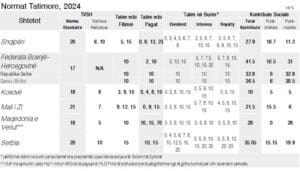
Tax rates for VAT are higher in Montenegro, Albania and Serbia, at 21% and 20%, respectively.
The lowest standard tax rates for VAT are in Bosnia-Herzegovina, Kosovo and North Macedonia, respectively with 17% and 18%.
All Balkan countries use reduced rates for VAT, except Bosnia and Herzegovina. Detailed tax rates can be found at the end of the Report.
Income inequality
Income polarization is lower in Albania, where the index shows that inequality has increased by 1.8 points. Meanwhile, other countries have a higher increase in inequality, ranging from 2.4 points in Montenegro, to 2.9 points in Bosnia and Herzegovina and 5.9 points in Serbia.
Corruption and tax burden
For 2023, the situation is as follows:
– in Montenegro, corruption is the lowest[1] and there is a higher tax burden than other countries, but also a lower informality.
– in North Macedonia, corruption is lower than the other four countries, but it has a lower tax burden than them, but meanwhile informality is lower.
– in Kosovo, corruption is lower than the other three countries, but it has the lowest tax burden, but there is also a level of informality that is at the high levels of the region.
– in Albania, corruption is higher than the three neighboring countries and has a lower tax burden than them, but meanwhile informality is higher.
– in Serbia, corruption is higher than the neighboring countries, but it has a lower tax burden than them, but meanwhile informality is also higher.
– in BiH, corruption is the highest among the countries of the region, but there is a high tax burden, as well as the highest level of informality
Budget expenditures in WB6
In each of the countries of the region, budget expenditures have a larger share in relation to budget revenues, on average 2.3% of GDP in the last three years. According to the indicators of the volume of expenditures by country, it can be seen that the highest level in relation to GDP is seen in Serbia (44.9% of GDP), in Montenegro (42% of GDP) and in BiH (as much as 41.6% of GDP).
These high expenditures in the region are in proportion to the high level of budget revenues.
We see the other three countries of the region with budget expenditures up to 15.7% lower (if we compare Serbia with Albania). North Macedonia has kept the same level of budget spending since 2022, which is 36.4% of GDP. Kosovo in 2023 has increased the level of budget expenditures by 4.2% of GDP more than in 2022. Albania has decreased the level of budget expenditures in 2023 by 1.2% of GDP, mainly due to the non-implementation of capital investments planned for 2023. Even for these countries it can be seen that they have a lower level of budget expenditures as they are dependent on the lower level of budget income.
If we analyze the budget on the part it distributes for social protection, it can be seen that Bosnia-Herzegovina and North Macedonia have allocated for social expenses, respectively, 15.7% and 14.9% of GDP, with consistent will in recent years.
Montenegro and Serbia have a high consistency of budget distribution for social policies with a level that is respectively 13.1% and 12.9% of their GDP.
Albania in 2023 has a decrease in the share of the budget for social policies with a level of 11.1% of GDP, but with 2.8% of GDP less than two years ago.
Kosovo, like Albania, has not distributed a large part of the budget for social policies (as much as 11.2% of GDP), but shows an increasing will compared to two years ago.
In WB6 countries, general government spending is on average 13.2% of their GDP, a level that is the same in recent years, but low compared to EU countries (less than 6.3 % in relation to GDP).
For government administration expenditures, Bosnia and Herzegovina has the highest level showing 10.6% of GDP, and Montenegro is at these levels with administration expenditures of 10% of GDP.
Serbia continues with the same level of spending as last year in 2023 as well, providing funds from the budget for the administration as much as 9.7% of the country’s GDP.
Even Kosovo has provided funds from the budget for the administration at a significant level or as much as 7.6% of the GDP, showing us a government with large dimensions starting from the level of expenses.
Meanwhile, Albania and North Macedonia have low levels of spending in relation to the average of WB6 countries and have respectively spent 4.3% and 4.2% of their GDP on administration, or at least 1.7-1.8% less than the average of EU countries’ spending on public services.
Tax burden in Albania in 2023
Income from taxes and customs, income from insurance contributions and local tax income (tax income) have a share of 25.8% of GDP, with 0.44% more than in 2021. The tax burden is the main part of fiscal revenues of the budget. In 2023, tax revenues constitute 92.8% of budget revenues, with a decrease of – 1.6% of their share from 2022 and – 0.1% from 2021.
In 2023, central tax revenues are as much as 70.6% of the total and with a lower weight to GDP from 2022 and 1% higher from 2021.
Meanwhile, the 61 municipalities together collected 5.3% of the total local tax revenue, with an increase of 0.2% from 2022, but with a smaller share from 2021.
Revenue from contributions is 20.8% of total tax revenue with an increase of 1.3% of GDP from 2022 and 2021.
The best performance in 2023 is dedicated to income from:
– social and health contributions (as much as 38% of income, more than ALL 53.7 billion),
– from corporate income tax (as much as 29% of income plus)
– from the tax on salaries (as much as 22% of income more)
– from consumption taxes (VAT and excise duty) with an impact of 10% of income more, where the main weight is from excise duties
– local taxes and fees have an impact of 7% more of the income.
VAT is the main and quite large dominator in tax revenues with 32% of them. Then insurance contributions hold a large weight, as much as 24% of tax revenues. Profit tax accounts for 11% of them, and personal income tax accounts for 10% of them.
A major problem in tax administration is the low burden of large taxpayers in total income and in relation to GDP.
The contribution and tax burden borne by large taxpayers in 2023 is as much as 34% of the income of the tax administration. This contribution has been consistent for at least the last three years.
If we calculate all taxes and central and local taxes together with insurance contributions, the tax burden per inhabitant is according to the map and ranking below.
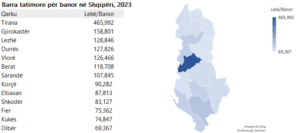
If we look at the tax burden only from local taxes and fees, then the calculations show that it is as follows.

Tax burden and distributed expenses for Tirana
Tax burden
Only 4 taxes in Tirana meet 67% of the tax burden (details in point 4.3.1. of the Report). In addition to these, another tax burden with an impact on businesses and families is the set of fees for environmental protection and greening, which are 15% of the total tax burden. The rest of the taxes and fees together account for 18% of the total tax burden.
In an analysis of the distribution of the tax burden by the Municipality of Tirana, it can be seen that there is a very large burden of taxes related to the construction process and product, from which more than 2/3 of the tax revenue is provided. This unequal distribution between citizens and business is a policy that aims to increase the burden not directly from the municipality’s tax policy, but by indirectly increasing this burden on citizens by taxing a narrow category of activities more heavily.
Distribution of municipal expenses
If we calculate the cost of governance of the municipality of Tirana in 2023, it reaches up to 1/3 of the total expenses.
The most important expenditure towards the community in 2023 continues to be for rural roads and urbanization, which receives 21% of the municipality’s expenditure in 2023.
Payments for the pre-school and pre-university education system account for 17% of the annual budget expenditures of the municipality.
Waste management, which has its main source of funding from environmental fees, consumes up to 8% of the municipality’s budget.
For social housing, the municipality’s budget directly spends up to 7% of all expenditures made by the municipality per year.
Social protection has a dedicated fund equal to 1% of the total municipal budget.
In terms of culture, art, it can be seen that the municipality spends 4% of its budget.
The support of the municipality for the economy of the city and for the protection of the consumer and the development of the markets for sale is dedicated 3% of the entire budget of the municipality.
Fire protection has a dedicated budget to be spent at the level of 4% of the total expenses of the municipality.
At the end of the expenses as dedicated funds are also those planned for agriculture, forests and pastures, which are as much as 0.2% of the total budget of the municipality.
Tax burden in Kosovo
The weight of tax revenues (central and local) is as much as 25.7% of GDP and has increased significantly by 1.4% of GDP from 2022 and at similar levels from 2021 as well.
The absolute value of total tax revenues is 2.6 billion Euros.
Central tax revenues account for 25.2% of GDP, while revenues from municipal tax revenues account for 0.5% of budget revenues.
The structure of tax revenues according to types of taxes, it can be seen that it consists mostly of VAT with 52%, but with a decrease from 2022 to 0.6% of GDP.
Excise duty accounts for 22% of total tax revenues with a slight decrease of 0.1% of GDP from 2022.
Corporate Income Tax accounts for 8% of total tax revenues, while Personal Income Tax accounts for 10.5% of total tax revenues.
Other revenues (customs and municipal fees) constitute 7.5% of total tax revenues.
In 2023, personal tax revenues have increased by 12.7% more than in 2022. In absolute value, personal tax revenues reach 66% of total municipal revenues.
In the analysis according to the calculation methodology for all incomes as above, it results that the average tax burden in Kosovo is 1,358 Euros per year per inhabitant.
The tax burden distributed on average during the year for Kosovo is 113.2 Euros per month for each resident.
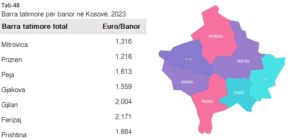
Central and local tax revenues, customs together with pension funds and which are revenues in the budget in 2023 in relation to the number of the population according to the regions, are presented in an order according to the graph and the table next to it that we look at below.
Tax Freedom 2024
The Tax Freedom Day for the Western Balkans for 2024 is its 114th day.
In 2024, this day falls earlier in Kosovo, Albania and North Macedonia.
In Bosnia-Herzegovina, Montenegro and Serbia, the day of Tax freedom is more than 1 month later than in the other three countries.
Even in 2024, this day has come without significant changes for the countries of the Western Balkans. The only change that has occurred between the two years is found in Kosovo, which in 2024 celebrates Tax freedom on the same day as in Albania.
In Albania, Tax Freedom Day 2024 is on the same day as in 2023.
Tax Freedom Day represents the taxpayers of a country facing their burden from the Tax administration for the collection of tax obligations for the budget.
This day is the indicative date to know, on which day of the year the burden on the state budget has been fulfilled or to show the taxpayers how many days they have to work in order to pay their part of the tax obligations on account of the budget.
After this day, the remaining income remains logically in the pocket of the business or individual, to pay individual, family or business expenses.
From the calculation of the days that are consumed in each country to pay the taxes that make up the tax burden, according to the data declared by each of the Tax revenue administrations and confirmed by the Ministry of Finance for each of the countries of the Western Balkans, it results that depending of the level of tax burden to GDP, Tax Freedom Day in 2024 in the Western Balkans comes on April 24, 2024
Tax Freedom begins its journey through the region by first knocking on Kosovo and Albania on the same day, April 3. Ten days later this day is celebrated in North Macedonia on April 13, 6 days later than 2023.
The month of April no longer has any date to be celebrated as Tax Freedom Day for each country, but symbolically April 24 is the day of Tax freedom in the entire region.
Tax Freedom Day follows the journey in the month of May, in Montenegro on May 11 and on the same day in Bosnia and Herzegovina. On May 14, the Tax freedom journey ends in Serbia.
The structure of this document consists of six parts.
The first part is the presentation of statistical and macroeconomic data for the Western Balkans, as well as the main economic indicators.
The second part is the tax revenues in the Western Balkans and the distribution of the burden according to the destination of the expenses in the 6 countries, analyzing the impact of competition and foreign investments as well as digitalization.
The third part is an analysis and commentary of the tax burden in WB6.
The fourth part is an analysis of the tax burden in Albania and the weight of each region in the tax burden per inhabitant and for local income, where Tirana is treated as a special point
The fifth part analyzes the tax burden in Kosovo and the ranking of regions, according to the level of burden per inhabitant.
The sixth part clarifies the methodology for calculating the Tax Freedom Index and presents the Tax Freedom Day Calendar of the Western Balkans and specifically of Albania and Kosovo along with the analyzes in order
[1] Higher scores indicate lower rankings for corruption

Leave a Reply
You must be logged in to post a comment.