


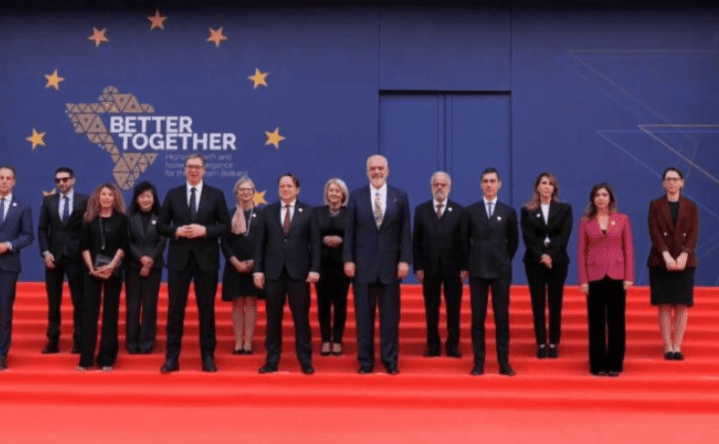
The summit of the Western Balkans with the EU gives hope
The Growth Plan presented at the end of last year and with a coordinating approach and discussions on challenges and developments, which dominated the speeches at the Western Balkans Summit with the EU in Tirana, is calculated by EU technocrats to have the potential to double the size of the Western Balkan economies within the next 10 years.
According to the interview given in the media on this topic, Mr. Gjokutaj said that the Growth Plan promotes the preparations of the Western Balkans for EU membership and the need to accelerate reforms, bringing forward some of its benefits for the growth and growth of economies and direct impact on the lives of the citizens of the Western Balkans, but also on increasing the speed of the expansion process. In order to finance all these cooperative measures and policies, the 6 billion euro financial instrument “Reform and Growth Facility” has been approved for the period 2024-2027, in average 1 billion euro in three consecutive years for each of western Balkan countries.
But for the plan to become viable, it will rest on four pillars:
– The Western Balkans closer to the EU Single Market, based on 7 priority actions, aligned with the EU acquis;
– Deepening regional economic integration within the Western Balkans, through the Common Regional Market, a step closer to the EU Single Market
– Speeding up reforms – every Western Balkan partner will be able to benefit from the single market if fundamental reforms are carried out at national level
– Increased financial assistance (conditional on the implementation of reforms) through the proposal for a new financing instrument “Reform and Growth for the Western Balkans” worth 6 billion euros, grants and loans.
After the meeting at the end of January 2024 in Skopje, the leaders of the Western Balkans opened a series of meetings with the same theme as the one that is taking place today. In joint conclusions 1 month ago, they reaffirmed their commitment to the EU Growth Plan for the region.
What I see as a very big challenge and with concern is precisely the program that the Rama 3 government should have drawn up regarding the acceleration of reforms, since from continuous monitoring they are still far from what is considered sustainable economic growth.
In fact, foreign funds (grants or loans) have been present in the investments and development policies of governments in the last decade. But, in a recent analysis carried out by ALTAX, where the data on the impact of foreign financing on state budget projects are presented, a decrease in their value and weight of influence over the last 12 years is seen, giving us also shown for the absorptive power of the economy and budget programs to benefit at levels that can reach 1-2 billion euros in the next three years.
All that has happened in the recent past is necessary to use as a critical point of in-depth reflection to understand that first, sustainable development is not and cannot be the authorship of the government alone, as it is the harmonization of resources and the interweaving of policies that through inclusiveness (that is, the opening of governance) can accelerate the rates of sustainable development, as well as secondly the new political will to carry out the unfinished tasks for a more resilient and formalized economy, also influencing the reduction of corruption that feels strong in this environment we live in.

Leave a Reply
You must be logged in to post a comment.