



The Albanian economy in 2025 between superficial stability and structural fragility
In the first quarter of 2025, the Albanian economy presents a technical improvement in external balances, but behind this balance lies a more complex reality. The latest data from the Bank of Albania and based on previous analyses show [1] that the current account deficit has narrowed from –902 million euros to –757 million euros compared to the same period in 2024. However, this reduction does not represent a victory of the economic model, but more a reflection of the decline in domestic demand and the seasonal fluctuation of tourism.
At the beginning of 2025, the Albanian economy presents a dual picture, where on the surface, macroeconomic indicators offer a tableau of monetary stability and sustainable external financing.
Meanwhile, in depth, the foundation on which this economy rests continues to be built on fragile pillars: seasonal tourism, remittances from the diaspora, and a structure of foreign investments dominated by construction and traditional energy.
A deeper analysis of the balance of payments for the first quarter of this year sheds light on the contrasts that characterize economic developments in Albania, as well as the challenges that demand urgent attention for a new orientation of the economic model.
Analysis of the current account – Is the deficit reduction a true success?
Let us analyze one by one the main trends of the balance of payments:
Goods balance – import reduction, not export growth
The goods deficit fell significantly from –1,546 million euros to –1,169 million euros. This appears positive, but if we dig deeper:
• Exports of goods did not increase significantly. On the contrary, most of the reduction came from the decrease in imports. This development is a consequence of the slowdown in domestic consumption, which in itself is a signal of economic deterioration at the start of economic year 2025.
• The drop in imports is also an effect of the strong exchange rate and lower imported inflation, which impacts the value of goods purchased from abroad but does not affect domestic productivity.
A deficit reduction based on a contraction of economic activity is a negative indicator in the long run, as it does not support productive transformation.
Services balance, where Tourism is found to be an uncertain engine
The services balance, despite its importance for the current account, has declined. Income from travel shows a drop of 228 million euros in the first quarter of 2025 compared to 2024.
This constitutes a warning signal for the Albanian tourism model, which:
• is overly dependent on the summer season,
• has not developed a sustainable and diverse tourism,
• and still does not create sustainable multiplier effects in other sectors (agritourism, artisanal production, technology, etc.).
The economy’s dependence on seasonal tourism cannot replace sustainable industrial or agricultural production and makes the external balance fragile to climate, security, or service disruptions.
3. Secondary income shows that remittances are under pressure
Remittances reached 301 million euros, but mark a decrease compared to 2024. This drop can be explained by:
• high inflation in host countries, which reduces the purchasing power of emigrants,
• lack of investment connection between the diaspora and the real economy in Albania,
• institutional unpreparedness to channel remittances into productive development.
The use of remittances for consumption does not constitute added value. The state should offer dedicated investment instruments for emigrants, such as diaspora bonds or microcredit funds with partial guarantees.
Capital account and external financing, a positive turn, but with limitations
Foreign Direct Investments (FDI)
Foreign investments increased, especially in construction and energy. However:
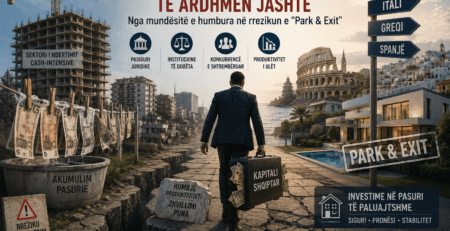
• They are concentrated in non-exporting sectors, excluding the potential for sustainable export growth.
• There is a lack of investments in medium/high-tech sectors.
• The geographic and social distribution of FDI is unbalanced: concentrated in Tirana and Durrës, with low impact on the rest of the country.
Albania needs selective attraction of investments, through stimulating fiscal policies for sectors with export and qualified employment potential.
Increase in foreign exchange reserves
Reserves rose to 5.1 billion euros, covering 6.6 months of imports, a positive development that shows the Bank of Albania has managed monetary risks well. But, the strength of the lek has dual effects:
• It improves external debt in terms of servicing, but harms exporters and domestic producers, who face high competition from cheaper imports.
A more flexible exchange rate policy could support the export sector and reduce dependence on domestic consumption.
Strong lek, weak exports
Another critical aspect is the exchange rate.
With a lek that continues to strengthen against the euro and other currencies, Albanian exporters face significant difficulties in being competitive in international markets. On the other hand, this strengthening of the lek makes imports cheaper, hitting domestic production and increasing dependence on foreign goods.
In this sense, the reported monetary stability through the increase in foreign exchange reserves to 5.1 billion euros and coverage of 6.6 months of imports, is a liquidity guarantee, but not necessarily a priority for the real sector.
An economy unprotected against shocks
If we analyze the structure of the country’s foreign exchange sources, the picture is concerning:
• Tourism is vital but remains deeply seasonal and concentrated on the coast.
• Remittances are stable but are not a source of internal development, nor are they linked to production.
• Processing services, like garment production, are in decline and unprotected from Eastern competition.
• Foreign investments, even if they increase, do not change the economic model.
All this shows that the Albanian economy continues to rely on non-self-generating components, which do not create sustainable value or economic transformation.
Structural trade deficit, a symptom of lack of competitiveness and systemic weakness
The deep trade deficit, where imports of goods are more than 3 times higher than exports, is an indicator that domestic production fails to replace imports, let alone compete in foreign markets.
Albania mainly exports goods with low technological content (textiles, raw materials, electricity in the summer season), while importing capital goods, food, and final consumption goods.
The structure of exports reveals a lack of deep industrialization, absence of value chains, and dependence on low value-added sectors.
This 3:1 goods-to-services ratio (compared to a more positive balance in services) creates a persistently sustained deficit structure over time, making the economy chronically exposed to international price and supply shocks.
Deep dependence on external sources highlights an economy vulnerable to exogenous shocks.
An economy where growth relies heavily on tourism, remittances, and foreign investments is inherently fragile.
Domestic consumption is financed not only by internal income but also by remittances accounting for over 9% of GDP.
Tourism represents an important source of foreign currency, but it is also cyclical and uncertain, especially in a world facing climatic, political, and security tensions.
Foreign Direct Investments (FDI) – despite a stable volume – are concentrated in sectors with limited horizontal linkages to the domestic economy (such as energy or real estate), reducing their multiplier effect on local development.
This triple dependence makes the Albanian economy highly exposed to geopolitical, trade, and financial shocks – as demonstrated during the pandemic and the war in Ukraine.
The structure of foreign revenues does not support the transition to a modern EU-aligned economy.
Albania is not generating foreign income through sectors that create value-added, technology, quality employment, and knowledge exports, which are essential for an EU-oriented economy.
While EU economies advance towards digital transformation, the green economy, and creative industries, Albania remains focused on traditional and low-innovation sectors.
Exports of services mainly consist of tourism and IT services (which are growing), but most remittances and FDIs do not translate into structural transformation.
This mismatch indicates that Albania is accumulating foreign currency through unsustainable means in the long run, without building the foundations of long-term competitiveness required for EU integration – such as productivity growth, industrial networks, and a specialized workforce.
What requires urgent attention?
The Albanian economy has entered a phase where superficial improvements must give way to deep structural transformations. Several areas require immediate focus, such as:
- Expansion and diversification of tourism, to create a year-round cycle and directly impact employment and local consumption.
- Diversification of foreign investments, to build productive sectors that feed exports and increase economic resilience.
- Mitigation of the Albanian lek’s volatility, through prudent monetary and fiscal policies that support competitiveness.
- Development of an export strategy linked to processed agriculture, light industries, and technological services.
- Formalization and restructuring of remittances, so they are channeled towards entrepreneurship rather than mere consumption.
At first glance, the balance of payments for Q1 2025 offers a technical consolation that Albania is moving towards a more sustainable equilibrium. However, a closer analysis of its components reveals that the internal economic structure has not changed significantly. It remains exposed to external risks, dependent on capital inflows that do not establish a sustainable development base, and lacks a clear industrial and export policy.
Only through a systemic approach, combining fiscal, monetary, industrial, and social policies, can Albania transform existing financial resources into a driving force for sustainable development and overcome the limits of illusory growth.
[1] This analysis is based on official data from the Bank of Albania for the first quarter of 2025 and analyzes it in comparison with 2020–2024 trends, in line with the ALTAX platform’s analysis on the country’s balance of payments and economic sustainability.

Leave a Reply
You must be logged in to post a comment.