


Balance of Payments Indicators for the period 2020–2024 and Outlook for 2025
To highlight the entirety of economic balances and to better understand the changes Albania has undergone in recent years, we will examine each indicator in detail, focusing on the factors that contributed to their development, as well as the contradictions or trends that may influence future conclusions. This in-depth analysis will help in understanding the values in the context of the economic situation, fiscal policies, and external factors.
| Year | 2020 | 2021 | 2022 | 2023 | 2024 | 2025 |
| Current Account Balance | -8.6 | -7.6 | -5.9 | -1.2 | -3.4 | -3.7 |
| Goods and Services (fob) | -14.4 | -13.3 | -10.3 | -5.4 | -9.0 | -9.6 |
| Goods (fob) | -22.3 | -25.1 | -23.5 | -20.7 | -24.1 | -25.3 |
| Exports | 5.9 | 8.3 | 10.7 | 8.4 | 7.2 | 8.1 |
| Imports | 28.2 | 33.4 | 34.2 | 29.0 | 31.4 | 33.4 |
| Services | 7.9 | 11.8 | 13.2 | 15.3 | 15.1 | 15.7 |
| Service Exports | 16.6 | 22.9 | 26.5 | 29.9 | 29.9 | 30.7 |
| Service Imports | 8.8 | 11.1 | 13.2 | 14.6 | 14.8 | 15.0 |
| Primary Income (net) | -1.6 | -1.4 | -1.7 | -1.3 | -1.0 | -0.7 |
| Compensation of Employees (net) | 1.7 | 1.9 | 2.4 | 2.4 | 2.7 | 3.0 |
| Investment Income (net) | -3.3 | -3.3 | -4.2 | -3.7 | -3.7 | -3.7 |
| Other Income (net) | 0.0 | 0.0 | 0.0 | 0.0 | 0.0 | 0.0 |
| Secondary Income | 7.5 | 7.1 | 6.2 | 5.4 | 6.6 | 6.5 |
| General Government (net) | 0.4 | 0.3 | 0.2 | 0.1 | 0.1 | 0.1 |
| Workers’ Remittances (net) | 5.0 | 5.0 | 4.6 | 4.2 | 4.8 | 4.8 |
| Other Private Income (net) | 2.0 | 1.8 | 1.4 | 1.1 | 1.7 | 1.7 |
| Capital Account | 1.1 | 2.3 | 0.1 | 0.2 | 0.0 | 0.0 |
| Financial Account | -11.2 | -10.2 | -4.5 | -4.5 | -4.6 | -6.0 |
| Direct Investment (net) | -6.7 | -6.4 | -6.5 | -5.7 | -6.0 | -6.0 |
| Portfolio Investment | -0.5 | -0.6 | 3.2 | 1.5 | 3.1 | 2.0 |
| Other Investments | -4.1 | -3.1 | -1.1 | -0.3 | -1.7 | -2.0 |
| Errors and Omissions | 1.2 | 1.2 | 0.7 | 0.7 | 0.0 | 0.0 |
| Net Balance | 3.7 | 4.9 | -1.3 | 3.5 | 1.1 | 2.3 |
| Reserve Assets (reserve loss = +) | -4.9 | -6.1 | 0.6 | -4.2 | -1.1 | -2.3 |
| Financing Gap | 0.0 | 0.0 | 0.0 | 0.0 | 0.0 | 0.0 |
| Export Value of Goods and Services (fob) | -29.8 | 57.3 | 41.7 | 24.9 | 11.4 | 12.0 |
| Import Value of Goods and Services (fob) | -19.8 | 37.0 | 26.8 | 11.5 | 21.4 | 12.4 |
| Export Volume | -27.4 | 41.4 | 28.3 | 23.8 | 6.3 | 10.1 |
| Import Volume | -19.5 | 23.7 | 11.7 | 10.6 | 16.6 | 9.4 |
| Terms of Trade | -9.1 | 17.5 | 8.7 | -7.9 | -5.1 | -2.5 |
| Reserves (million euros) | 3,942 | 4,972 | 4,952 | 5,847 | 6,137 | 6,748 |
| Reserves (months of imports of goods and services) | 9.6 | 8.8 | 6.9 | 7.3 | 6.3 | 6.2 |
| Reserves (% of ARA metric) | 188 | 215 | 197 | 213 | 131 | 135 |
| External Debt (million euros) | 8,549 | 9,755 | 9,766 | 10,147 | 10,337 | 10,769 |
| External Debt (% of GDP) | 63.9 | 64.0 | 53.9 | 46.2 | 41.0 | 39.8 |
| Nominal GDP (million euros) | 13,380 | 15,248 | 18,131 | 21,982 | 25,227 | 27,034 |
Below we have analyzed and explained the indicators by providing comments based on trend analysis and their effects on the country.
1. Current Account Balance
The current account balance improved significantly from -8.6% of GDP in 2020 to -1.2% in 2023, before worsening again to -3.7% in 2025.
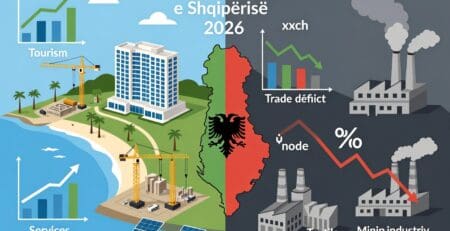
The reduction in the deficit from 2020–2023 results from the growth of service exports, mainly tourism and the IT sector.
The expected deterioration for 2024–2025 is linked to an increase in the trade deficit of goods, where imports have expanded more than exports.
Although there is a noticeable improvement, Albania still has a considerable current account deficit. This is mainly due to the imbalance between goods exports and imports, which remains an unchanged challenge for the Albanian economy.
The rise in imports, especially in energy and industrial goods, may have a continuous impact on the current account deficit. If exports cannot grow further due to global factors (such as economic crises or supply chain disruptions), this could increase pressure on macroeconomic balances.
2. Trade in Goods and Services (fob)
The trade deficit in goods is at high levels with no structural improvements:
- From 2020–2023, it remained in the range of -20.7% to -25.1% of GDP.
- For 2024–2025, the deficit deepens to -24.1% and -25.3%, due to increased imports, particularly in energy and consumer goods.
Service exports and imports are the strongest part of the balance:
- Service exports rise from 16.6% of GDP in 2020 to 30.7% in 2025, thanks to tourism, outsourcing, and financial services.
- Service imports increase more slowly, contributing to the positive service balance.
Despite the increase in goods exports in recent years, the Albanian economy has not yet succeeded in diversifying exports and reducing dependence on imports. This is a persistent problem that has negatively impacted the trade balance, especially due to rising energy and other material prices.
If Albania fails to diversify export sectors and improve the competitiveness of goods, including with state support for industry, this will negatively affect goods trade and maintain the deficit at high levels.
However, despite the goods trade deficit, service exports have continuously increased, from €16.6 billion in 2020 to €30.7 billion in 2025. Services—particularly tourism and financial services—have contributed positively to the stability of the current account balance.
3. Primary Income and Employee Compensation
The growth in employee compensation is an indicator of improved wage levels and working conditions. Compensation rose from €1.7 billion in 2020 to €3 billion in 2025. This increase signals an effort to improve working conditions and boost domestic consumption.
However, wage growth appears insufficient to cover living costs, especially when inflation on basic goods is high. Therefore, consumption growth may remain limited.
4. Investments, Capital Account, and External Debt
The capital account remains negligible after 2022, with almost zero values. Foreign direct investments (FDI) stabilize at around 6% of GDP.
Portfolio investments (speculative capital) move from a slight deficit (-0.5% in 2020) to a positive growth of 3.1% in 2024, before falling to 2.0% in 2025. Other investments (including foreign loans) remain at low levels, indicating a weakening of long-term financing.
Investments remain a stable source of capital, but there is a lack of new financing in strategic sectors.
Foreign exchange reserves rise from €3.9 billion in 2020 to €6.7 billion in 2025. This is a positive indicator of the ability to cope with financial crises and maintain stability in case of a negative global impact, such as the aftermath of the pandemic.
Import coverage months decline from 9.6 months in 2020 to only 6.2 months in 2025, indicating a reduced capacity to meet external needs.
External debt falls from 63.9% of GDP in 2020 to 39.8% in 2025, representing a significant improvement thanks to the rapid growth of nominal GDP.
Albania has reduced its reliance on external debt, but the decline in import coverage shows the need for more foreign exchange reserves.
Albania has reduced its dependence on external debt, but the decline in import coverage indicates the need for more foreign exchange reserves.
Even though external debt has decreased as a percentage of GDP, it remains a significant factor for the Albanian economy. External debt can impact the ability to finance new projects and may exert pressure on government spending, especially if interest rates increase.
Despite the increase in reserves, external debt remains a challenging factor. A high level of debt can restrict financing opportunities for other sectors and may harm the country’s financial credibility in international markets.
Nominal GDP has increased significantly, from €13.4 billion in 2020 to a forecast of €27 billion in 2025.
This trend represents an average annual growth of 14%, driven by:
- Foreign investments
- Growth in service exports
- Increase in domestic consumption
The structure of economic growth shows that:
- The economy remains dependent on services and foreign investments, while the trade deficit in goods remains problematic.
- The increase in imports suggests an economy that needs domestic industrial development to reduce import dependency.
- Although economic growth is visible, it is based on an unstable foundation due to the trade deficit and dependence on services.
At the end of this summary clarifying the balance of payments indicators, we can read as positive aspects:
✔ Improvement of the current account balance from -8.6% to -3.7%.
✔ Service exports have increased significantly, especially tourism and IT.
✔ External debt as a % of GDP has steadily declined.
And as negatives and risks:
❗ The trade deficit in goods remains high and is worsening.
❗ Foreign exchange reserves cover fewer months of imports.
❗ Investments are not leading to structural growth in strategic sectors.
From all this, sound economic reasoning continues to support an orientation towards diversifying exports, focusing on increasing industrial and agricultural production to reduce dependence on imports and the impact on the cost of living and the well-being of low-income and vulnerable groups.
Naturally, more prudent fiscal and monetary policies, as recommended by the IMF in its report, should aim to maintain the stability of foreign exchange reserves and improve the trade balance.
Most importantly, the increase in strategic investments is crucial as a push for both foreign and domestic investments that create added value and reduce speculative investments in the economy.Albania has experienced moderate economic growth, but with significant challenges in goods exports and imports and the long-term sustainability of the balance of payments.


Leave a Reply
You must be logged in to post a comment.