


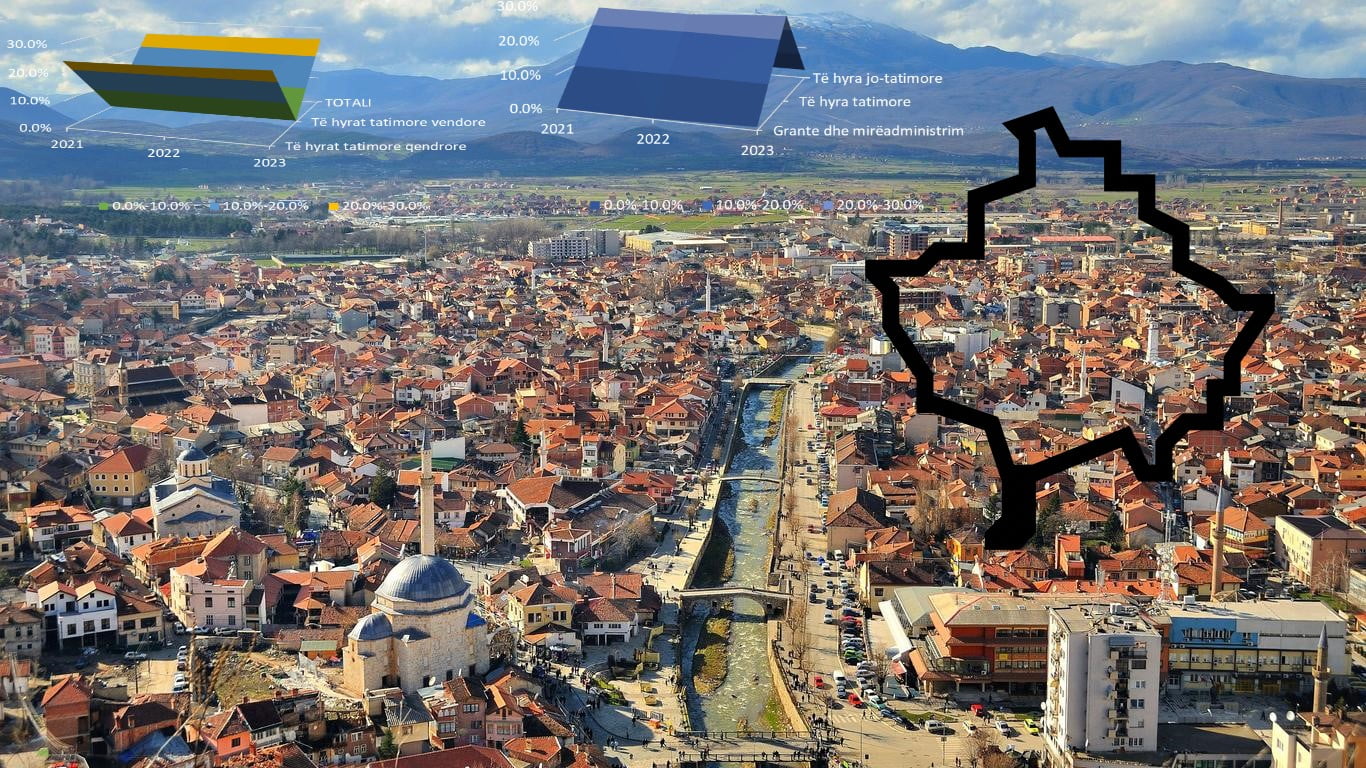
Tax burden in Kosovo in 2023
In Kosovo, the methodology is the same to calculate the fiscal burden and the tax burden, as it was clarified for Albania.
The burden of general (fiscal) revenues in Kosovo is the result of the contribution of 88% from tax revenues and 13% from non-tax revenues and grants and aids.
Kosovo’s budget performance
Kosovo’s budget revenues are 29.3% of GDP for 2023. Their absolute value is 2.9 billion Euros.
The weight of tax revenues (central and local) is as much as 25.7% of GDP and has increased significantly by 1.4% of GDP from 2022 and at similar levels from 2021 as well.
The absolute value of total tax revenues is 2.6 billion Euros.
Meanwhile, the level of non-tax revenues is 2.7% of GDP and is at the same representative levels in the budget as in 2022, but with a decrease from 2021. Their absolute value is 0.26 billion Euro.
The part of the budget from grants has a noticeable increase and constitutes 1% of the revenues of the fiscal burden. The increase from last year is as much as 0.7% of GDP and this has influenced the overall increase of the fiscal burden in 2023 by 2.1% compared to 2022. Their absolute value is up to 0.1 billion Euro.
| Budgetary Revenues to GDP in Kosovo, 2021 – 2023 | % GDP | |||
| 2021 | 2022 | 2023 | Diff. 23/21 | |
| Grants and good administration | 0.2% | 0.3% | 1.0% | 0.8% |
| Tax revenues | 24.5% | 24.3% | 25.7% | 1.2% |
| Non-tax income | 3.0% | 2.68% | 2.65% | -0.3% |
| TOTAL | 27.7% | 27.2% | 29.3% | 1.6% |
The structure of tax revenues in 2023 (Table above) mainly consists of central tax revenues with 98% of total tax revenues and local tax revenues with 2% of total tax revenues.
Central tax revenues account for 25.2% of GDP[1],, while revenues from municipal tax revenues account for 0.5% of budget revenues.
Central tax revenues in 2023 are up 0.8% of GDP from 2022 and 1.1% of GDP compared to 2021.
Local tax revenues are increasing by 0.1% of GDP from 2022 and the change is the same with 2021.
The low level and weight of municipal own revenues is an indicator of the low level of administration, but also a result of the culture of informality, despite the fact that the economy in some municipalities in the north of Kosovo is also dependent on political instability.
| Tax revenues to GDP in Kosovo, 2021 – 2023 | % GDP | |||
| 2021 | 2022 | 2023 | Diff. 23/21 | |
| Central tax revenues | 24.1% | 24.4% | 25.2% | 1.1% |
| Local tax revenues | 0.4% | 0.4% | 0.5% | 0.1% |
| TOTAL | 24.5% | 24.8% | 25.7% | 1.2% |
Tax revenues for the budget have historically followed the trend of economic activity dependent on imports, with a slight improvement in the direction of structuring the burden on production, mainly related to natural resources.
Although the base of these revenues continues to be low, thanks to the design and implementation of structural reforms there are positive signals for a more accelerated growth trend beyond that driven by increased economic activity (as a result of increased voluntary compliance and narrowing of the tax gap).
This heavy weight and dependence of revenues from customs is still not expected to change even though it is depending more on the reforms carried out in recent years in the direction of strengthening internal economic structural developments.
Data on sources of revenue for at least the last three years suggest that the shift in the tax burden from consumption to direct taxes on labor and capital is still persistent and likely to begin to reverse in the long run.
In this aspect, even in 2023, the main economic impact is based on trade and remittances from abroad, which have affected domestic consumption and private family investments.
On the other hand, the reduction of electricity production from fossil sources in order to protect the environment and the insufficient compensation from renewable energy sources can present shortages in production and thus affect the increase in energy prices[2].
In the total tax revenues in 2023, the main weight is held by customs revenues with 60.5% (Tab. 43).
Revenues from indirect taxes (net VAT and Excise), with 19.1% of the total tax burden, have remained at the same weight to GDP as in 2022, but because the level of refunds has increased by 0.1% of GDP.
The main weight in VAT revenues is influenced by the value of goods imports, as a result of prices in international markets.
Revenues from direct taxes (Corporate Income Tax and Personal Income Tax) are 4.7% of the total tax burden.
| Analytical tax revenues to GDP in Kosovo, 2021 – 2023 % GDP | ||||
| From Taxes and Customs | 2021 | 2022 | 2023 | Diff. 23/21 |
| Value Added Tax | 12.9% | 13.3% | 14.1% | 1.2% |
| Tax administration | 3.7% | 4.2% | 4.4% | 0.7% |
| Customs | 10.0% | 9.8% | 9.7% | -0.3% |
| minus VAT Refund | 0.8% | 0.7% | 0.8% | -0.02% |
| Value Added Tax (Net) | 12.9% | 13.3% | 13.3% | 0.4% |
| Corporate Income Tax | 1.4% | 1.8% | 2.0% | 0.5% |
| excise | 6.3% | 5.9% | 5.8% | -0.5% |
| Personal Income Tax | 2.4% | 2.4% | 2.7% | 0.3% |
| Municipal income | 0.5% | 0.4% | 0.5% | 0.0% |
| Customs fees | 1.57% | 1.50% | 1.41% | -0.2% |
| TOTAL (Net) | 25.1% | 25.3% | 25.6% | 0.5% |
The structure of revenues according to types of taxes, it can be seen that it consists mostly of VAT with 52%, but with a decrease from 2022 to 0.6% of GDP.
Excise duty accounts for 22% of total tax revenues with a slight decrease of 0.1% of GDP from 2022.
Corporate Income Tax accounts for 8% of total tax revenues, while Personal Income Tax accounts for 10.5% of total tax revenues.
Other revenues (customs and municipal fees) constitute 7.5% of total tax revenues.
This income structure is the result of the structural composition of the Kosovar economy, which has a dependence on imports and as a result results in a high trade deficit.
Let’s look at the tax items in more detail below.
In its structure, VAT consists of 31% of local VAT and 69% of border VAT (customs), a ratio which remains unchanged from 2022. In 2023, domestic and import VAT at its gross level it is as much as 14.1% of GDP, where internal VAT (collected from activities within the country) is as much as 4.4% of GDP and VAT from customs (import of goods) is as much as 9.7% of GDP .
Domestic VAT has increased by 0.2% of GDP from 2022 and by an increase of 0.7% of GDP from 2021.
Import VAT has decreased by 0.1% of GDP from 2022 and with a decrease of 0.3% of GDP from 2021.
The VAT refund for businesses is 0.8% of GDP in 2023, affecting the gross value of VAT, which after deducting the refund is 13.3% of GDP. Compared to 2022, reimbursement has increased by 0.1% of GDP, reaching the level of the share of reimbursements in 2021.
Corporate Income Tax revenues increased by an average of 0.2% of GDP, with a year-on-year change of 11.1%. Their absolute value is 0.2 billion Euro.
Revenues from Personal Income Tax have increased by an average of 12.5%, with a change of 0.3% of GDP from 2022. In absolute value, revenues are 0.26 billion Euro.
This increase is based on the developments of the private market that has resulted in salary increases in the face of the rising cost of living, as well as as a preventive measure in a shrinking tendency in the labor market, as an effect of the liberalization of entry visas in the EU and the attractive offer of the labor market in these countries.
These tax increases in the values above are also the result of the impact of economic structuring, reflecting an increase in the tax base (GRP-Indirect Taxes + Subsidies and Transfers) for each tax and the rest from the reduction of the stock of tax debt.
Revenues collected by Kosovo Customs in 2023 amount to 1.66 billion Euros. In cases of no change in tax rates, border revenues have historically followed the value and quantity of imports.
Revenues from excise duty in 2023 have decreased on average by – 1.7% year on year, although there is an increase in absolute value by 76 million Euros due to increased volumes in imports.
Customs duties have registered in the budget an average reduction of – 6% based on the reduction of the total volume of goods imports which are the tax base of these revenues, as well as the negative effect on revenues from the SAA and the Free Trade Agreement.
Non-tax revenues during 2023 reached the value of 0.29 billion Euro, or a slight decrease in the share of GDP by – 0.03%. In absolute terms, non-tax revenues in 2023 are up by 4.7 million Euros more than in 2022.
Own revenues from the municipalities experienced an increase in the share of GDP by 0.1% of it. In absolute terms, own revenues in 2023 reach up to 0.1 billion Euros and together with the budget transfer reach 0.65 billion Euros in 2023.
[1] Tax revenues also include mining rents and some taxes and charges from the central and local levels of government that are component items in non-tax revenues.
[2] https://kk.rks-gov.net/decan/wp-content/uploads/sites/9/2024/03/Ligji-Nr.-08-L-260-Ndarjet-Buxhetore-2024.pdf


Leave a Reply
You must be logged in to post a comment.