


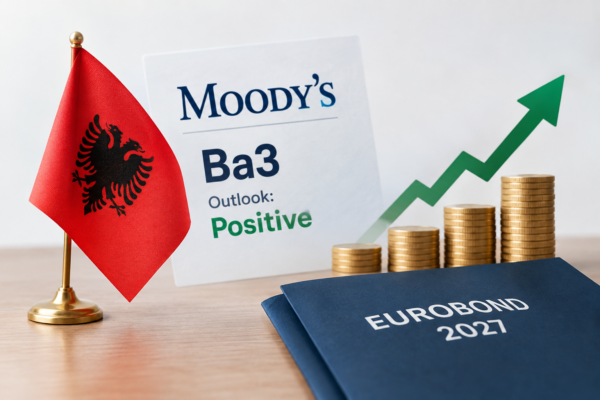
Moody’s and Albania, more than a rating, a signal for the next Eurobond
The latest change by Moody’s regarding Albania deserves to be read beyond the news that “Albania’s rating has been upgraded.”
In fact, the international credit rating agency has not yet changed Albania’s sovereign rating. It has confirmed the Ba3 rating, but has changed the outlook from “Stable” to “Positive”.
The distinction is important.
The Ba3 rating describes the country’s current credit position, while the “Positive” outlook signals that, if the trends that have led to this assessment continue, there is a possibility that the rating may improve in the future.
Therefore, Albania has not yet moved into another rating category, but has been placed on a trajectory that could lead toward a future upgrade.
This is the essential change also in relation to the previous assessment, and this is precisely where its economic significance lies.
Moody’s supports the positive outlook with several developments related to the strengthening of Albania’s fiscal and external position, as well as the acceleration of structural reforms within the framework of the European Union integration process. The agency assesses that economic growth remains relatively strong, while public debt is expected to continue declining. According to the published assessment, general government debt could decline from around 52.9% of GDP at the end of 2025 to around 50.2% in 2027. Albania has also recorded primary surpluses in recent years, while the fiscal deficit in 2025 was around 1.8% of GDP. The external position also appears stronger. The current account deficit has narrowed significantly, foreign exchange reserves have increased, and foreign direct investment remains an important source of financing for the economy.
These developments, combined with the EU integration process, create a more stable profile vis-à-vis international markets.
However, a positive outlook should not be interpreted as an unconditional certificate for the Albanian economy.
Moody’s continues to identify institutional and structural weaknesses. Therefore, its message should be read as an assessment of the improvement in several key indicators, but also as an expectation that this improvement will be sustainable and accompanied by further reforms.
For Albania, the significance of this assessment becomes clearer when it is placed in the context of public debt financing.
A sovereign rating is not only a reputational indicator. It is one of the elements that influences how international investors perceive the risk of a state and, consequently, the price at which that state can finance itself in international markets.
This directly links Moody’s assessment with the Eurobond.
Albania last entered the international market in 2025 with a €650 million Eurobond, with a 10-year maturity, a 4.75% coupon and a yield of around 5%. Investor interest was much higher than the amount offered. Meanwhile, the official debt management documents provide for the next entry into the international capital market to take place in 2027.
This timing coincidence is important.
If 2026 serves as a period during which Albania consolidates its fiscal and financial position and, at the same time, gains a “Positive” outlook from Moody’s, then 2027 could find the country negotiating its next financing from a potentially more favorable position than previously.
This does not automatically mean that the next Eurobond will have a lower yield. Its pricing will also depend on international interest rates, financial market conditions, investor demand, perceptions of emerging and frontier economies, as well as the structure of the issuance itself.
But an improvement in the perception of sovereign risk creates a potentially positive factor in determining the cost of financing.
In economic terms, the mechanism is relatively clear, understanding that if the perception of Albania’s risk declines, the risk premium that investors demand over the market benchmark rate may also decline.
If this happens, the state may finance the same amount at a lower interest cost or secure a longer maturity at a comparable cost.
This is why the improvement in Moody’s outlook has a value that goes beyond symbolism.
But here another important distinction must also be made.
A better rating should not be viewed as an opportunity for the government to take on more debt simply because the market is more willing to lend to it. On the contrary, the economic benefit of a better rating should be measured by the possibility of financing existing needs and public investments at a lower cost, with more appropriate maturities and with a more controlled risk structure.
This approach becomes particularly important in the case of Albania, because the next Eurobond may not serve only to finance new budgetary needs.
It may also have the function of refinancing and managing existing obligations.
In 2027 Albania faces the maturity of the €650 million Eurobond issued earlier. This creates a natural reason for a new market issuance to also be used to manage this maturity, alongside other financing needs. Such an operation would give the government the opportunity to extend the average maturity of the debt portfolio and avoid a large concentration of payments over a short period.
Therefore, the 2027 Eurobond should be viewed as more than an instrument to secure money, but as serving the debt management strategy.
In this sense, the improvement in Moody’s outlook has occurred at a suitable moment for the government. The official debt management documents have already provided for an entry into the international market in 2027.
Now Albania has also received a positive signal from one of the major rating agencies. If this signal is consolidated over the coming months and, at a later stage, also turns into an upgrade of the rating itself, then the government may enter the market with a more favorable credit profile.
This is precisely where one of the most interesting dimensions of the latest assessment lies.
Moody’s is not saying that Albania has already moved to a new credit level, but signals that some of the factors determining the country’s ability to withstand debt have improved sufficiently to change the future outlook.
In the language of financial markets, this means that the investor sees not only the current level of risk, but also the direction in which that risk may move.
This is why the distinction between “Ba3 Stable” and “Ba3 Positive” is not merely technical. “Stable” means that, in the agency’s assessment, there was not at that moment a sufficient argument to expect a change in the direction of the rating. “Positive” means that the balance of developments has shifted in a direction that could justify a future upgrade, if the positive factors continue to materialize.
At this point, Albania has a direct economic interest in proving that the improvement is not only cyclical, but structural.
Economic growth, tourism revenues, stronger foreign exchange reserves and increased foreign investment are important factors.
But for a sustainable improvement in the credit profile, the quality of institutions, fiscal management, productivity, the formalization of the economy, the capacity to generate broader and sustainable growth, as well as the ability to turn the European integration process into concrete reforms, are also important.
Therefore, the “Positive” outlook should also be viewed as a kind of test for the economic policies of the coming period.
If reforms and fiscal consolidation continue, then the positive outlook may turn into an upgrade of the rating itself.
If the improvement in indicators slows down or fiscal, external or institutional risks rise again, then the difference between a positive outlook and an actual rating upgrade remains open.
This is also why ALTAX reads this development not as an isolated success of the government, but as an indicator that should be tested through the actual cost of public financing.
What becomes more important is whether this improvement in the perception of risk will translate into better financing conditions for the Albanian state.
If Albania returns to the international market in 2027, the most meaningful comparison will not only be the amount of the new Eurobond, but also the relationship between the new yield and that of the 2025 Eurobond, controlling for changes in international interest rates and general market conditions.
Ultimately, this is also the true test of a better rating: not how good it looks in public communication, but how much less it costs to finance the Albanian state.
For Albania, the move from Ba3/Stable to Ba3/Positive is a positive signal regarding the potential direction of the credit profile, but not yet a change in the rating category.
If this signal is consolidated and translates into a future upgrade of the rating, then it could have a direct significance for the Eurobond planned for 2027.
From this perspective, Moody’s has not simply given the government a “better rating”. It has given the market a signal about Albania’s potential direction. The government’s challenge is to turn this signal into a real improvement in financing conditions, while the challenge for the economy is to ensure that debt obtained at a lower cost produces economic growth and future capacity to repay it. If the next Eurobond is to be part of this strategy, then the value of the rating does not lie in the possibility of taking on more debt, but in the possibility of obtaining cheaper, longer-term and more manageable financing.
This is the distinction between a simple improvement in perception and a real benefit for public finances.



Leave a Reply
You must be logged in to post a comment.