


What does the World Bank reveal about the economic growth model?
Albania confronts the Productivity test: From economic growth to quality development
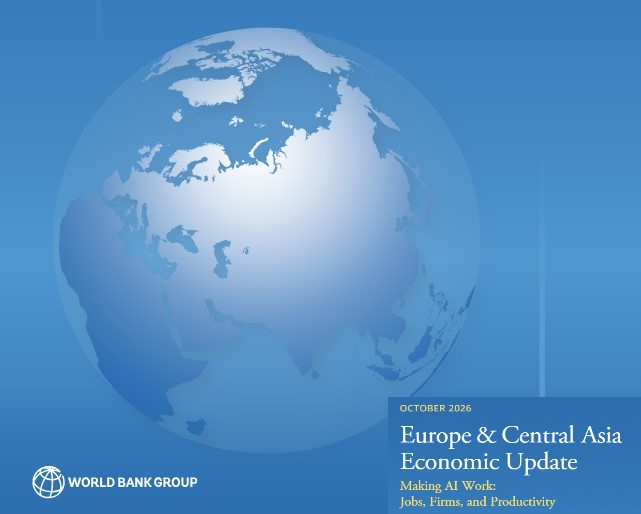
The World Bank report Europe and Central Asia Economic Update: Making AI Work: Jobs, Firms, and Productivity, published on 6 October 2026, places Albania’s economic development in a broader regional context, where economic growth, productivity, demographic changes, and the ability to use technology are becoming increasingly interdependent.
Unlike the spring report on the Western Balkans, the October 2026 edition addresses Europe and Central Asia as a broader economic area. This report examines not only the pace of growth, but also the potential for artificial intelligence to improve firm productivity, ease labour constraints, and create new sources of development.
According to the World Bank, Western Balkan economies are expected to grow by 3.1% in 2026, up from 2.6% in 2025. This improvement in the regional outlook coexists with a more uncertain external environment, characterised by high energy prices, weak growth in the European Union, and uncertainty in international trade.
For Albania, this context shifts the focus towards the approach it should adopt to achieve a more productive and competitive economy.
Tourism, construction, consumption, and investment can support economic activity. However, for these activities to translate into sustainable convergence with the European Union, more productive firms, workers with more advanced skills, more sustainable exports, and institutions that create predictable conditions for investment are needed.
From ALTAX’s perspective, this is the issue that should structure the analysis: not merely the performance of macroeconomic indicators, but also the ability of the Albanian economy to turn growth into productive capacity and long-term development.
1. The labour market, demographic constraints, and untapped potential
The World Bank identifies the shrinking working-age population as one of the main challenges facing Europe and Central Asia. Population ageing and emigration are reducing the labour supply, while some women, young people, and other individuals remain outside the labour market because of economic and institutional barriers.
In the Western Balkans, these developments are particularly significant. Labour shortages can constrain business expansion, increase recruitment costs, and put pressure on wages. At the same time, low labour market participation limits production potential and the base from which public services are financed.
The October report emphasises that if labour force participation rates in the region were to match those of comparable European Union countries, the number of people who could enter the labour market would increase significantly. For the Western Balkans, the dedicated spring report estimates a potential of more than 2.8 million additional workers if participation were to reach the levels of comparable EU countries.
This estimate should not be interpreted as a number of people who could be employed immediately. It indicates the scale of untapped potential, which requires policies addressing professional skills, childcare and elderly care, the adjustment of social benefits, and the creation of more favourable employment conditions.
For Albania, this means that employment policy must go beyond reducing unemployment. A simultaneous assessment is needed of labour market participation, formal employment, emigration, skills, and productivity.
Increasing the minimum wage and reducing contributions may contribute to formalisation, but they do not, in themselves, solve the problem of labour shortages. Their effect depends on firm productivity, labour costs, demand for skills, and the ability of individuals to enter and remain in the labour market.
2. Artificial intelligence as an opportunity for productivity, but not an automatic solution
The main innovation of the October report is the positioning of artificial intelligence at the centre of the discussion on productivity, firms, and employment.
According to the World Bank, around one in five workers in Europe and Central Asia works in occupations substantially exposed to artificial intelligence, particularly young and highly educated workers. However, fewer than one in ten firms in the region currently use this technology, primarily for basic tasks.
These indicators refer to the broader Europe and Central Asia region, not specifically to Albania. Nevertheless, they provide a useful framework for analysing the challenges facing the Albanian economy.
Artificial intelligence can help automate administrative tasks, analyse data, manage inventories, provide customer service, and improve production processes. For small and medium-sized enterprises, its use can reduce certain operating costs and improve their ability to compete with larger companies.
However, technology does not automatically generate productivity. The benefits depend on data quality, workers’ skills, internal organisation, digital infrastructure, and the ability to finance investments. Without these conditions, adoption may remain superficial, limited to isolated uses that do not fundamentally change how a firm operates.
For Albania, this issue is particularly important because of the significant role played by small enterprises, financing constraints, and the need to increase productivity without relying solely on increasing the number of workers.
An effective digital transformation programme must combine training, access to technology, investment financing, and improvements in management. Public support should be assessed against measurable results, such as lower costs per unit of output, higher sales, improved quality, and increased exports.
From our perspective, artificial intelligence should be treated as an instrument of productivity policy, not merely as a digitalisation topic. The key question is whether technology helps Albanian firms generate more value with the resources available to them.
3. Wages and productivity remain competitiveness challenges
Wage growth is important for household incomes and for attracting workers. However, for it to be sustainable, it must be supported by productivity growth.
When wages rise faster than productivity over an extended period, unit labour costs may increase, putting pressure on firms’ margins and export competitiveness. This effect depends on the sector and on the ability to improve processes, use technology, and increase the value of products and services.
On the other hand, Albania’s competitiveness cannot rely indefinitely on low labour costs. Emigration and skills shortages indicate that such a strategy may weaken firms’ ability to retain workers and expand their activities.
For this reason, wage analysis should be linked to investment, productivity per worker, unit labour costs, and export performance. Without this connection, wage growth may be assessed incorrectly, either as an unconditional success or as a threat to business.
The October report reinforces this argument by highlighting the potential of artificial intelligence to improve efficiency and mitigate the impact of a shrinking working-age population. However, this opportunity can only be realised when technology is accompanied by professional skills and adjustments to work processes.
For Albanian economic policy, the objective should be to create conditions in which wages can rise on a more productive basis. This requires education and vocational training more closely aligned with the labour market, investment in technology, and a fiscal environment that encourages long-term investment.
4. Tourism and construction remain sources of growth that require stronger links with domestic production
Tourism and construction have been among the sectors supporting Albania’s economic activity. Tourism generates foreign income, creates demand for services, and supports employment. Construction affects investment, real estate, and the activity of related sectors.
However, growth in these sectors should not be confused with economic diversification. If the expansion of services is not accompanied by the development of industry, agro-processing, technology, and higher-value-added exports, the economy may remain exposed to changes in external demand and investment cycles.
Tourism should develop stronger links with domestic production, including agriculture, the food industry, transport, professional services, and technology. This increases the likelihood that more added value will remain within the Albanian economy.
Similarly, construction investments should be assessed not only for their contribution to economic activity, but also for their impact on productivity, infrastructure, and capital allocation. Rising real estate prices, for example, are not equivalent to an increase in productive capacity.
In this context, artificial intelligence and digitalisation can help improve the management of tourism, logistics, services, and business processes. However, these benefits require appropriate investment, skills, and standards.
According to ALTAX’s perspective, the economy should preserve tourism’s potential while simultaneously expanding its productive and export base. Success should not be measured solely by the number of visitors or the value of investments, but also by the productivity and added value generated domestically.
5. Reforms and the business environment must move from procedures to the capacity to compete
Improvements in economic administration and procedures are an important condition for investment. Faster licensing, more efficient customs procedures, and more capable tax institutions can reduce administrative costs and increase predictability for businesses.
However, the time required to complete a procedure does not measure the overall quality of the business environment. Firms also need effective competition, legal certainty, contract enforcement, transparency, and access to finance.
An economy may improve administrative procedures without resolving the barriers that constrain business growth. If firms lack the capital to invest, the skills to use technology, or the opportunities to enter new markets, the benefits of procedural simplification remain partial.
The October report adds a new dimension to this discussion: management quality and foundational skills are among the conditions that determine whether firms can use artificial intelligence productively. In other words, technological transformation is not merely a matter of equipment or software, but also of organisational capabilities.
We believe that this means business environment reforms must combine better administration, competition, business financing, and skills development. Procedural improvements should be accompanied by measurable results in private investment, business growth, and export performance.
6. Fiscal policy should aim to finance transformation without undermining sustainability
Fiscal sustainability remains a condition for macroeconomic stability and for the state’s ability to withstand shocks. However, fiscal policy should be assessed not only by the level of debt or the deficit, but also by the quality of expenditure and its impact on productive capacity.
Investments in education, vocational training, infrastructure, digitalisation, and institutions can help increase productivity if they are selected and implemented effectively. Conversely, expenditure that does not create lasting capacity may constrain the scope for future development policies.
The October report emphasises that temporary government measures to mitigate the impact of higher energy costs have helped households and firms, but in some countries have increased pressure on public finances. This assessment highlights the need to distinguish temporary support from reforms that increase productivity and economic resilience.
For Albania, sustainable fiscal policy should ensure room for productive investment while avoiding measures that create recurring costs without clear results. Tax relief, subsidies, and financing programmes should be assessed according to their impact on formalisation, investment, employment, and productivity.
An increasingly important element is also support for the digital transformation of firms. This does not mean providing unconditional subsidies for technology, but rather creating instruments that help firms invest in skills, systems, and processes that improve their performance.
We believe that fiscal policy should move away from supporting economic activity in general towards measurable instruments that encourage productivity, private investment, and the expansion of the productive base.
7. Exports and competitiveness require more sustainable capacities
Exports are an important indicator of an economy’s ability to compete in international markets. For Albania, tourism has supported service exports, but the development of goods exports and product diversification remain essential for expanding the base of foreign income.
Competitiveness is determined not only by price or labour costs. It depends on quality, technology, the ability to meet standards, logistics, and the sustainability of relationships with international buyers.
In this regard, digitalisation and artificial intelligence can give firms opportunities to improve processes, analyse markets, and manage supply chains more effectively. However, these benefits require internal capabilities that cannot be developed solely by purchasing technology.
Export policies should support business modernisation, vocational training, quality standards, and access to finance. At the same time, they should encourage the development of higher-value-added products and services rather than relying primarily on low costs.
For ALTAX, this is one of the key mechanisms for linking the World Bank’s analysis with Albanian economic policy. Productivity growth should be reflected in firms’ results, the sustainability of exports, and their ability to retain markets.
The World Bank’s October 2026 report broadens the analytical framework for the Albanian economy. Alongside macroeconomic developments, it places productivity, firms’ capacity to use technology, and the need to offset demographic constraints through skills and better work organisation at the centre of the discussion.
From ALTAX’s perspective, five priorities stand out:
- Productivity as an economic policy objective, meaning the measurement of the results of investment, technology, and vocational training.
- Higher labour market participation through policies that reduce barriers for women, young people, and other groups able to contribute to the economy.
- Productive adoption of artificial intelligence, based on support for skills, management, and investments that deliver measurable results for firms.
- Diversification of the economic model, a topic that has been particularly prominent in recent years, as strengthening the links between tourism, domestic production, industry, and higher-value-added exports is a genuine necessity.
- Development-oriented fiscal policy, meaning the preservation of public finance sustainability and the more effective use of resources to expand productive capacity.
Ultimately, we believe that the challenge facing our economy is not merely to maintain economic growth, but to increase its ability to generate more value from the resources available. Artificial intelligence can help in this process, but it does not replace institutional reforms, investment, professional skills, or a predictable business environment.
Macroeconomic stability creates the conditions for development, and productivity determines how far that development can go, which constitutes the main test of the next phase of economic convergence with the European Union.

Leave a Reply
You must be logged in to post a comment.