


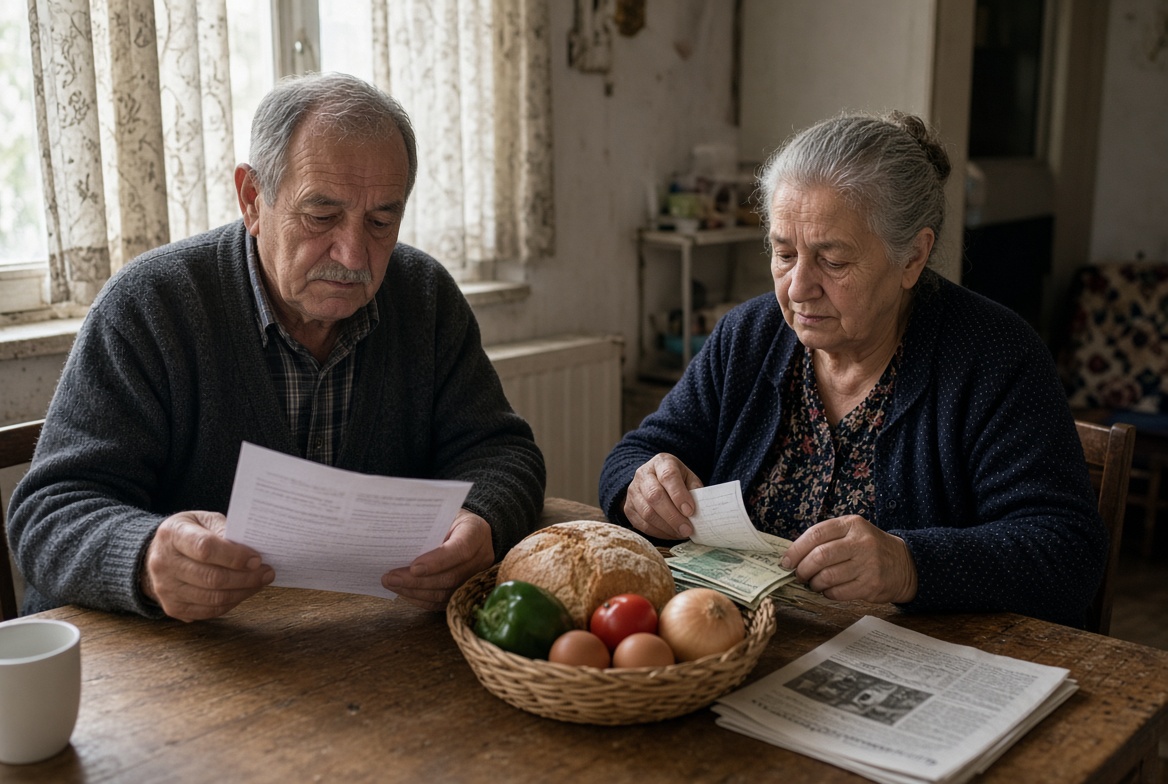
Pension reform 2026 between political promise and genuine dignity
Pensions should be measured by the standard of living they make possible, not only by the amount they promise
The target of a full urban pension of ALL 40,000 in 2030 is presented as a step towards improving pensioners’ incomes. However, reaching this amount does not in itself prove that the pension will be sufficient to cover living expenses.
A pension should be assessed not only by the amount a pensioner receives, but also by what that amount can buy. Nominal growth[1] may lose part of its effect when the prices of food, energy, medicines and other services continue to rise.
The 2026 reform should focus precisely on defining a measurable standard for a dignified pension, rather than only on the amount targeted for 2030.
What do the data and calculations show?
Using an average annual inflation rate of 3% through 2030 as an example, the following comparison illustrates the difference between the nominal amount and purchasing power.
| Indicator | Monthly value |
| Full urban pension, around 2026 | ALL 27,350 |
| Nominal target for 2030 | ALL 40,000 |
| Purchasing power of ALL 40,000 in 2030, expressed in today’s prices | Around ALL 34,500 |
| Amount in 2030 that preserves the purchasing power of today’s ALL 40,000 | Around ALL 46,300 |
| ALTAX’s indicative estimate for a dignified pension | ALL 45,000–50,000 |
Note: The calculations for 2030 are illustrative and based on an average annual inflation rate of 3%; they are not an official forecast. The amount of ALL 45,000–50,000 is an indicative estimate by ALTAX, not an officially approved standard.
These figures show that ALL 40,000 in 2030 will not have the same purchasing power as today’s ALL 40,000. However, preserving purchasing power is only part of the problem. A pension may maintain its real value and still be insufficient to cover all basic needs.
Therefore, the comparison should not end with the question of whether ALL 40,000 or ALL 46,000 is the right figure, since it must first be determined how much a dignified life costs for a pensioner in Albania.
Albania still lacks an official, measurable standard for a dignified pension.
Public debate focuses on how much pensions should increase, but there is no published and verifiable official methodology that determines the cost of a dignified life for an Albanian pensioner.
How much do food, electricity, water, heating, housing, medicines, medical check-ups and transport cost? How do these expenses differ for a pensioner who owns their home, someone who pays rent, a person living alone or a retired couple? Do national average prices reflect actual costs in Tirana and other parts of the country?
An amount announced as a target without supporting data serves political communication, but does not guarantee the level of income needed to sustain a decent standard of living.
In its [2]analysis, ALTAX has suggested an indicative monthly level of ALL 45,000–50,000 for 2026, taking into account needs related to food, housing, healthcare, energy and social participation. This amount should be viewed as an analytical hypothesis requiring verification, not as an indisputable threshold.
For this reason, the government should publish a dedicated pensioner’s consumption basket, the calculation methodology, the data sources and the method for updating it. The basket should take into account not only overall inflation, but also the weight of food, energy and healthcare expenses in an older person’s budget.
The absence of this standard weakens the reform debate itself. If there is no definition of what constitutes an adequate pension, neither the success nor the failure of the target can be measured transparently. Citizens are left without a reference point for judging whether public policy is genuinely improving their living conditions.
A dignified pension also has a fiscal cost.
A target of ALL 45,000–50,000 per month is not merely a social aspiration. It has direct implications for the budget, contributions and the sustainability of the pension system.
To understand the scale, a simple calculation is sufficient. Compared with the target of ALL 40,000, the difference is ALL 5,000–10,000 per month for each pensioner who would receive this level. If this difference were granted to 100,000 pensioners, the additional gross cost would be around ALL 6–12 billion per year.
This is only an illustration of the scale of the cost, since a full assessment of the budgetary impact requires concrete analyses and calculations for each beneficiary group. The final cost would depend on the number and categories of beneficiaries, the pensions they currently receive, the implementation phases, indexation and the sources of financing.
This makes a multi-year fiscal assessment essential. The government must show not only what level of pension it intends to guarantee, but also how it will finance it without creating unfunded pressures on the budget or on future contributors.
A dignified pension must be both adequate for citizens and financially sustainable for the state. These two requirements are not contradictory; they must be planned together.
The reform of pensions in 2014 did not resolve all structural weaknesses.
The pension reform of 2014 aimed to strengthen the link between contributions paid and benefits received, improve the scheme’s financial sustainability, and encourage the formalisation of employment and wages.
However, changes to the pension formula could not, by themselves, solve labour market problems. Informality, wage underreporting and insufficient social insurance coverage continue to affect the scheme’s revenues and the pensions that will be received in the future.
World Bank analyses have identified cases in which contributions are paid on the minimum wage, even though income data suggest that some employees earn more. These data relate to the periods examined in the relevant reports and should not be interpreted as a direct measurement of the current situation without an updated statistical assessment.
The problem remains fundamental because when wages continue to be declared below their actual levels, or workers remain outside the scheme, the budget loses contributions today and citizens risk receiving lower pensions tomorrow. This is deepening the ongoing dependence on budget financing, while the needs of the population of retirement age are increasing.
For this reason, the 2026 reform must be more than a package of increases. It should include a measurable plan to expand formal employment, increase the number of contributors and ensure that wages are declared in line with actual earnings.
Increases, compensations and bonuses are not the same thing.
Pension increases, indexation, compensations and bonuses serve different purposes. Indexation aims to limit the loss of purchasing power, compensations support specific categories under the applicable conditions, while bonuses provide additional assistance that is often temporary.
These measures can improve pensioners’ incomes, but they do not in themselves prove that the pension level is adequate. Neither a nominal increase announced for several years nor a one-off payment can replace a sustainable standard for the incomes of older people.
The government should separately publish the cost, beneficiary categories, funding sources and expected impact of each measure. The assessment should show how pensioners’ purchasing power changes and how this affects the long-term sustainability of the system.
Private pensions should be strengthened as a complement to the public scheme, not as its replacement.
Private pensions can create an additional source of income for older people, but their reach remains limited.
According to data from the Financial Supervisory Authority, at the end of 2025 private pension funds had 49,200 members and net assets of around ALL 9.8 billion. These figures show that the market is developing, but it has not yet reached a scale that would make private pensions a regular source of income for most pensioners.
Expanding this market requires clear tax incentives, schemes linked to employers, transparency regarding fees and investment performance, as well as financial education. Opportunities for employees and employers to contribute jointly to supplementary schemes should also be explored.
Nevertheless, private pensions cannot be presented as a solution for those who currently receive low pensions and have not had the opportunity to save during their working lives. The development of the private market should complement the public scheme, not transfer responsibility for its weaknesses to individuals.
What should change in the 2026 reform?
A reform aimed at delivering a dignified pension should be based on concrete measures and measurable results, drawing on the views of domestic stakeholders, since assistance from the World Bank alone can no longer justify the process, even though its expertise is beyond question. Based on the numerous analyses conducted for this purpose, we believe there is still room for recommendations, including issues that, judging by current practice, appear not to have been sufficiently analysed and incorporated. In short, we believe that the draft reform package for the pension scheme should:
- Adopt an official methodology for a dignified pension. A documented basket of expenses should be developed for food, housing, energy, healthcare, transport and other basic needs, with justified distinctions according to living conditions.
- Publish real pension indicators. In addition to nominal amounts, annual reports should show purchasing power, the ratio of pensions to average and median wages, and the ability to cover basic expenses.
- Set concrete targets for expanding contributory coverage. In the first year of the reform, an updated baseline should be published showing the number of active contributors, their ratio to employed people, and the percentage of employees whose contributions are based on wages declared at the minimum-wage level. On this basis, an indicative target should be set to increase by at least 5 percentage points by 2030 the share of employed people covered by contributory social insurance, with annual progress measured against the same methodology. At the same time, wage underreporting and informal employment should be monitored and reduced.
- Link fiscal enforcement to genuine formalisation. Efforts should not be measured solely by the number of inspections or fines, but by increases in active contributors, more accurate wage declarations and sustainably collected additional contributions.
- Publish the multi-year cost of the reform. Every target for increasing pensions should be accompanied by financial scenarios through 2030, distinguishing the cost of indexation, real increases, compensations and funding sources.
- Develop supplementary private pensions. Incentives, transparency and opportunities for participation through employers should be improved, alongside the introduction of individual pension accounts without weakening the state’s responsibility for the basic protection of pensioners.
These measures would shift the reform away from announcing nominal targets and towards a system grounded in the country’s actual needs, one that can be assessed through clear indicators, annual results and public accountability.
The target of ALL 40,000 in 2030 may represent an important political step towards increasing pensions, but it should not be used as proof of their adequacy without comparison with the actual cost of living. Likewise, the estimate of ALL 45,000–50,000 for a dignified pension should be supported by a transparent methodology and updated using data on prices and pensioners’ needs. The pension debate should not turn into a political competition over numbers. It should answer what standard of living society seeks to guarantee for older people, how that standard will be financed, and what changes are needed in the labour market and the insurance scheme to keep it sustainable.
[1] A simple increase in the monetary value of an amount, without accounting for the impact of inflation and rising market prices
[2] https://altax.al/en/introducing-the-study-on-decent-pensions-and-opportunities-for-pension-increases-in-albania/


Leave a Reply
You must be logged in to post a comment.