


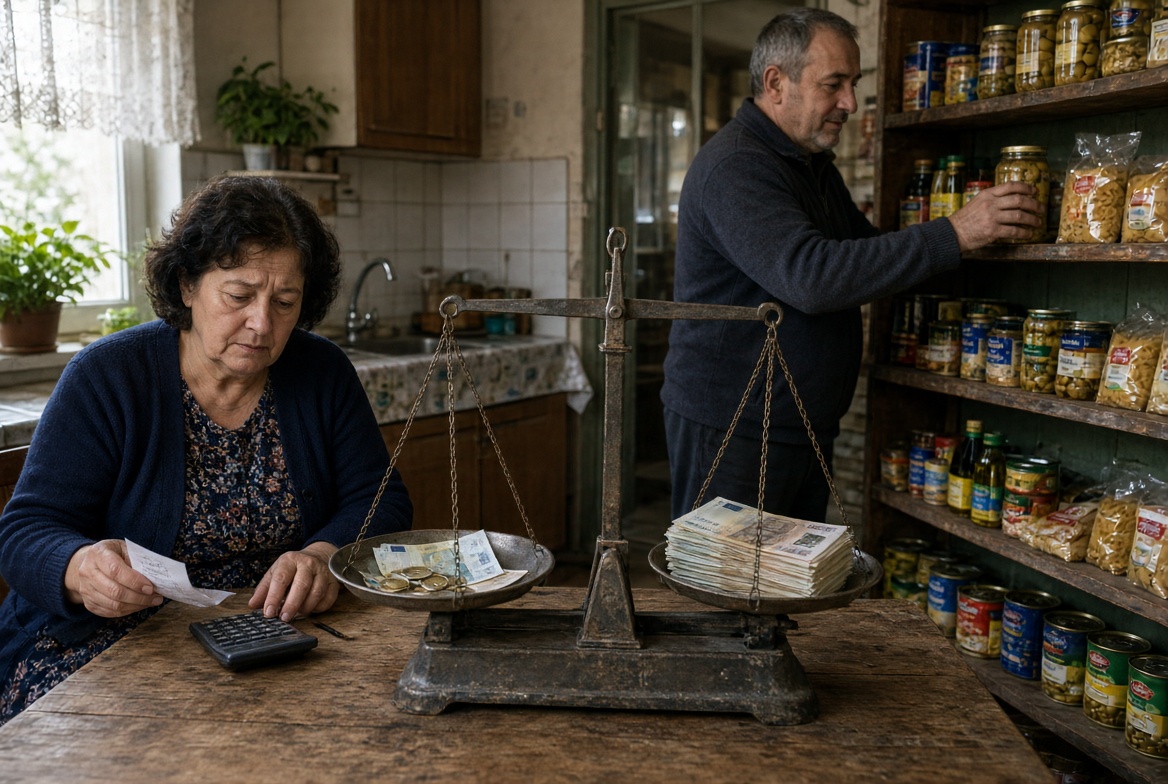
The cost of a weak euro
Who Wins and Who Loses from a Strong Lek?
The depreciation of the euro is redistributing income, savings and costs in the Albanian economy
The exchange rate is one of those economic indicators that affects everyday life even for those who have nothing to do with economics.
How many lek are needed to buy one euro determines, directly or indirectly, the lek value of remittances, tourism revenues, exports, imports, savings and foreign-currency liabilities.
At the end of September 2026, the euro was quoted at 91.92 lek, according to the official exchange rate of the Bank of Albania.
This level is significantly lower than the levels Albanian families and businesses had become accustomed to several years ago.
Albania operates under a free-floating exchange-rate regime, in which the value of the lek is determined by supply and demand in the foreign-exchange market.
But an exchange rate of 91.92 lek per euro is not, in itself, either a gain or a loss.
The economic significance begins with what happens after the euro is converted into lek.
The same euro is no longer worth the same amount in the economy.
The Albanian economy receives euros from emigrants, tourists, exporters and investors.
At the same time, a large share of household spending, wages and business costs is carried out in lek.
Therefore, a change in the exchange rate creates an immediate effect, whereby the same amount of euros is converted into a different amount of lek.
Consider a family that receives 500 euros in remittances per month.
At an exchange rate of 105 lek per euro, 500 euros would be converted into 52,500 lek.
At an exchange rate of 91.92 lek per euro, they are converted into 45,960 lek.
The difference is 6,540 lek per month, or around 78,480 lek per year.
The family has not lost its euros. It continues to receive 500 euros.
But their value when converted into the currency in which it conducts most of its spending is lower.
This is one of the channels through which the strengthening of the lek affects the real income of families receiving remittances.
Remittances make the effect larger than it appears
In 2025, individuals, households and businesses received around €1.1 billion in remittances, according to materials from the Bank of Albania.
The Bank of Albania also estimates that around 60% of remittances were in cash.
This places the exchange rate at the center of a large income flow that reaches Albanian households either directly or indirectly.
When a significant exchange-rate change is applied to a flow of around €1.1 billion, the effect of conversion into lek is no longer a small financial change.
It becomes an economic effect with macroeconomic and household dimensions.
But, how many fewer lek do families receive from the same volume of euros because of the change in the exchange rate?
In everyday life, a strong lek does not create only losers.
On the other side of the transaction is the importer.
An importer who needs to purchase goods worth 500 euros requires:
- 52,500 lek when the euro is at 105 lek;
- 45,960 lek when the euro is at 91.92 lek.
Therefore, for the same value in euros, the purchasing cost in lek is lower.
This is a benefit from the exchange rate for the importer.
The next question is whether this benefit actually reaches the consumer.
If the importer lowers the price of the product, part of the exchange-rate benefit goes to the consumer.
But this happens when competition is strong, and part of the savings may be transmitted into prices.
If the final price remains unchanged, the benefit may be reflected in the business margin, but because competition is weak, the transmission may be more limited.
Therefore, the exchange rate changes the cost of imports, but it does not automatically determine the final price.
Between the exchange rate and the consumer stand the margin, competition, market structure, other costs and business behavior.
This is where the effect on inflation begins.
The Albanian economy has considerable exposure to imports.
For this reason, the strengthening of the lek helps moderate imported inflation.
The Bank of Albania has identified the appreciation of the exchange rate as a factor limiting inflationary pressures.
In the second quarter of 2026, average inflation was around 2.9% in April and May, and in September 2026 it was 1.8%.
This is one of the positive sides of a strong lek. Goods and inputs purchased in foreign currency may cost less in lek.
But here too, a distinction must be made.
A cheaper euro does not automatically guarantee a cheaper product.
It creates an opportunity for lower costs. But how much of this opportunity reaches the consumer is another matter and is linked to the factors mentioned above.
The exporter faces the opposite mechanism.
If the importer benefits from a cheaper euro, the exporter may face the opposite effect.
An exporter selling abroad and receiving €100,000 would receive 10.5 million lek at an exchange rate of 105 lek/euro in September 2023.
At an exchange rate of 91.92 lek/euro in September 2026, the exporter receives 9.192 million lek.
But with costs largely denominated in lek, revenues converted into the domestic currency decline.
This can narrow the profit margin.
Therefore, the problem becomes more pronounced when wages are paid in lek, services are paid in lek, rents are in lek, taxes and liabilities are in lek, while revenues are generated in euros.
In this case, the exchange rate becomes a direct factor of competitiveness.
Tourism should also be viewed through this analytical lens.
In August 2026, around 3.46 million Albanian and foreign nationals entered Albania, 2.7% more than in August of the previous year.
Tourist flows remain important for the Albanian economy.
But the number of visitors alone does not show how much economic value is created and how much of it remains in the domestic economy.
A hotel in Berat may have more clients and more revenues in euros.
But when the euro is converted into fewer lek, its revenues expressed in the domestic currency are lower for the same volume of euros.
At the same time, domestic costs tend to increase (wages, food, energy, rents, services, maintenance).
Therefore, an increase in the number of tourists coexists with pressure on the margins of tourism operators.
As a result, even though tourism increases in volume, its value when converted into lek does not increase at the same pace.
This is one of the reasons why tourist statistics should be read together with the exchange rate and tourism revenues.
The same mechanism affects foreign-currency savings.
A citizen who has €10,000 continues to have €10,000 even after the exchange rate changes.
But the value of this wealth expressed in lek changes.
At an exchange rate of 105 lek/euro, €10,000 = 1,050,000 lek.
At an exchange rate of 91.92 lek/euro, €10,000 = 919,200 lek.
The difference is 130,800 lek.
This is not a nominal loss of the euro savings, but a decline in their value expressed in lek.
But the distinction is important, because if a citizen keeps their savings in euros and spends in euros, the effect is different from that on a citizen who must convert euros into lek to finance consumption.
Therefore, exposure to the exchange rate also depends on the currency in which income is generated and the currency in which spending is carried out.
From this it is clear that the exchange rate is a mechanism for redistributing value
In fact, this is also the core of the analysis, which determines who is exposed to the euro, on which side of the transaction they stand, and how large the effect of the exchange rate is on their income, costs and wealth.
Consequently, there is no single effect of a strong lek, because the effects differ according to the currency position of each actor, as also presented in the table below.
| Economic group | Effect of a weak euro | Magnitude of the effect |
|---|---|---|
| Families receiving remittances | Lose purchasing power | 14–15 billion lek/year (on more than €1 billion) |
| Exporters | Lower margins | Significant (especially textiles, processing) |
| Tourism operators | Euros are worth less in lek | Large (tourism generates billions of €) |
| Importers | Buy more cheaply | Large benefit |
| Consumers (if prices fall) | Cheaper imported products | Partial (not always transmitted) |
| Borrowers with euro loans | Lower debt burden | Benefit |
This opens a new possibility for measuring the cost of a weak euro.
Instead of looking only at the daily EUR/ALL exchange rate, we can build an indicator that measures the economic value of the exchange-rate change.
A “Cost of a Weak Euro” could measure the change in lek in:
- remittances;
- export revenues;
- tourism revenues;
- euro savings;
- imports;
- euro-denominated debt payments;
- and other transactions exposed to the exchange rate.
The basic formula is simple: Change in value in lek = Value in euros × change in the EUR/ALL exchange rate.
But the real significance of the indicator would be greater if it did not stop at the mechanical effect.
The indicator should distinguish the exchange-rate effect and its impact on income or costs, as well as the way this impact is transmitted to prices in order to determine the final effect on households and businesses.
This would transform the exchange rate from a daily statistic into a measure of the distribution of economic effects.
In fact, we are not dealing with a mechanical transfer of money, and here an important clarification is needed.
When the euro falls from 105 to 92 lek, it does not mean that the 6,500 lek of the family physically “move” to the importer.
What changes is the lek value of the same foreign-exchange transaction.
The family receives fewer lek when it converts 500 euros.
The importer pays fewer lek when buying 500 euros.
These are opposite effects of the same change in the price of the euro, but not necessarily a direct financial transfer from the family to the importer.
Only when we identify a specific transaction and its actors can we speak of an actual transfer of income or cost.
This is an important distinction for an accurate analysis.
Therefore, the more accurate conceptualization is that the change in the exchange rate redistributes economic effects and purchasing power among actors with different currency positions.
What is still missing from the Albanian picture also represents the most interesting clarification for ALTAX Insight.
We know the exchange rate.
We know remittances.
We know imports.
We know exports.
We know the number of tourists.
We know inflation.
We know foreign-currency deposits.
But these data are usually viewed separately.
What is missing is an integrated picture showing how much value in lek has been created or lost because of the exchange-rate change and how this effect has been distributed among households, businesses and economic sectors.
This point marks the transition from monitoring movements in the euro to understanding the real consequences that this currency brings to the economy.
In the end, citizens do not live by the exchange rate
They live by wages, pensions, remittances, savings, credit, bills, food prices, housing costs and the price of services.
Therefore, the importance of the euro is measured where the exchange rate meets real life.
The balance is not determined by the exchange rate itself, but by the magnitude of the effects, the structure of currency exposure and the extent to which these effects are transmitted through the economy.
This is the story behind a declining euro exchange rate.
A weak euro is not simply a lower number on the exchange-rate table.
It changes the lek value of income, costs, savings and liabilities.
Some gain. Some lose. Some gain only if their savings are transmitted to the consumer.
So, what is the real cost of a weak euro?
It is not that the economy “loses” money, but that value is transferred from families receiving euros (remittances + tourism + exports) to importers and (partly) to consumers through lower prices of imported products and lower inflation.
The exchange rate simply shows the price of the euro, but a complete analysis of the Albanian economy requires uncovering the real price that each actor pays for that exchange rate.


Leave a Reply
You must be logged in to post a comment.