


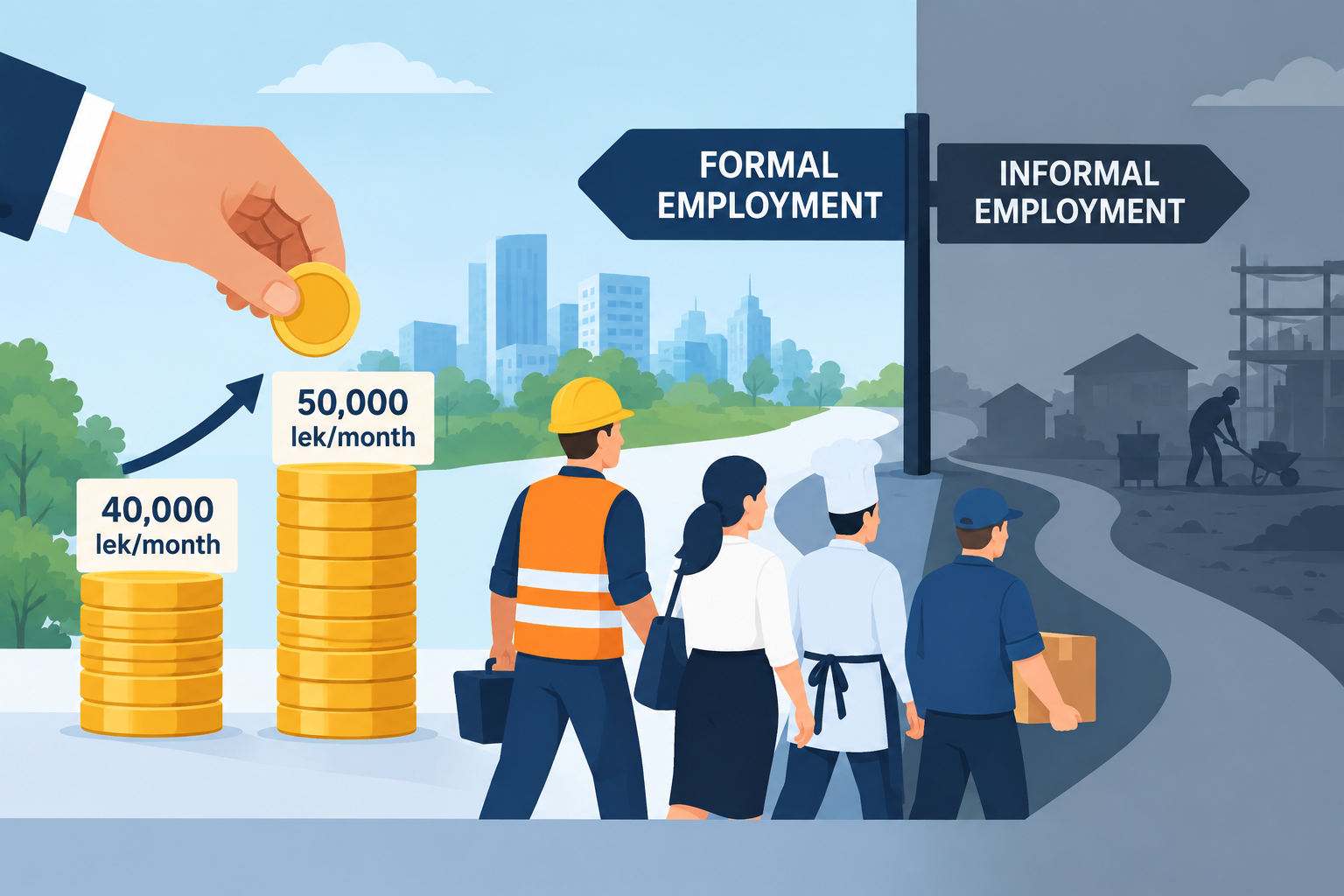
Minimum wage in Albania, more income, but also a new limit for formalization
The increase in the minimum wage from ALL 40,000 to ALL 50,000 in 2026 significantly changed the relationship between wages, productivity and the cost of formalization. The ALTAX Study shows that the main challenge is not only whether the minimum wage increases, but whether the Albanian economy manages to generate sufficient productivity to support this increase.
From January 2026, the minimum wage in Albania increased by 25%, from ALL 40,000 to ALL 50,000 per month. This is one of the most significant increases in the minimum wage in recent years and comes in an economy where the average wage has increased continuously, but where labor productivity remains relatively low.
The ALTAX study places this change within a broader framework. The minimum wage cannot be analyzed separately from productivity, informality, the cost of formal employment, unemployment and emigration. In this sense, minimum wage policy is part of a broader labor market equilibrium.
Albania has now entered a new zone of minimum wage pressure.
One of the key indicators used in the study is the Kaitz Index, which measures the ratio between the minimum wage and the average wage.
In 2025, this ratio is estimated at around 45%, while with the minimum wage of ALL 50,000 in 2026 it is expected to reach around 53%.
This brings Albania closer to countries in the region that have a relatively high minimum-wage-to-average-wage ratio. In the Western Balkans comparison, Albania approaches the levels of Montenegro and North Macedonia, while remaining significantly above Kosovo.
But what matters is not only the absolute level of the minimum wage. What matters is how affordable it is for the economy and for a business that must pay the total cost of a formal employee.
This is where the second problem emerges, which is not the minimum wage, but the gap with productivity.
The data used in the study show an economy where labor productivity is only around 36% of the European Union average. At the same time, informality is estimated at 28–32% of GDP, while the burden of labor contributions reaches around 27.9% of gross wages.
This creates a difficult equation:
higher wages + low productivity + high formalization costs = greater pressure on businesses to formalize employment.
The study finds that historically, labor productivity has increased by only around 0.6% for every 5–6% increase in wages, an elasticity of approximately 0.11.
If this ratio is applied to the 25% increase in the minimum wage in 2026, a significant gap emerges between the increase in labor costs and the increase in productivity.
To keep the wage–productivity ratio constant after a 25% increase in the minimum wage, productivity would have to increase by around 2.73% within the year. The estimate used in the study for the actual increase in productivity is around 1.5%, leaving a difference of around 1.2 percentage points.
This difference is precisely the area where pressure on low-productivity businesses may materialize in different forms: informality, part-time employment, slower recruitment or, in certain cases, exit from the market.
Is the minimum wage increasing unemployment?
This is one of the most important questions addressed by the study.
The empirical answer of the analysis is more cautious than the public debate might suggest.
The main regression for the 2016–2025 period does not find a statistically significant relationship between minimum wage increases and rising unemployment. The coefficient is positive, but not statistically significant: β = 0.034, p = 0.43.
Therefore, Albania’s historical data do not provide sufficient evidence to say that minimum wage increases have caused an increase in unemployment. In some of the years with strong minimum wage increases, unemployment remained unchanged or declined.
But this does not mean that the effect is zero.
The study emphasizes that an aggregate model with only 10–11 annual observations may fail to capture effects that emerge with a delay, in specific sectors or in small enterprises.
Rather than a minimum wage increase necessarily appearing as “more unemployment”, the effect may appear as:
- fewer new hires;
- a reduction in informal employment;
- a shift from formal employment to informality;
- part-time employment;
- pressure on low-productivity enterprises;
- or the closure of some small businesses.
This is why the study shifts the focus from unemployment alone toward informality and formalization.
The strongest signal comes from agriculture.
The strongest empirical finding of the study does not come from the national unemployment regression, but from an administrative indicator for agriculture.
The study compares the number of insured self-employed persons registered with ISSH with the agricultural labor force estimated by the Labor Force Survey (LFS-INSTAT).
In 2013, formal coverage was around 53.6%.
In 2022, it had fallen to 17%, while in 2023 it was around 20.8%.
Thus, within one decade, formal coverage in this sector fell by around 33 percentage points.
The study considers this the strongest quantitative signal of informality pressure.
But it also establishes an important limitation: this does not prove direct causality from the minimum wage, since rural migration, demographic changes and other factors also affected this period.
Nevertheless, agriculture remains the most exposed sector because it combines low productivity, a fragmented business structure and a significant share of the labor force.
What could happen after the 25% increase in 2026?
The study develops a counterfactual simulation to assess the potential impact of increasing the minimum wage from ALL 40,000 to ALL 50,000.
The simulation uses three scenarios for the elasticity of informality.
| ScenarioIncrease in estimated informalityInformality after the shock | ||
|---|---|---|
| Low elasticity | +1.12 p.p. | 31.1% of GDP |
| Medium elasticity | +1.88 p.p. | 31.9% of GDP |
| High elasticity | +3.00 p.p. | 33.0% of GDP |
Thus, according to this simulation, an informality baseline of around 30% could move into the range of 31–33% of GDP following the minimum wage shock.
These are not direct forecasts of actual informality. They are scenarios constructed on the basis of different elasticities and should be read as possible estimates, not as certified results.
Indeed, the study emphasizes this limitation: the Albanian simulation is a simple calibration and not a full CGE model.
What does international experience tell us?
The international debate does not provide a single answer.
Different studies have found different results regarding the effect of the minimum wage on employment. The classic Card–Krueger case did not find a negative effect on employment, while reanalyses by Neumark–Wascher found modest negative effects for low-skilled workers.
For developing countries, IMF and World Bank literature places informality at the center of the analysis.
One of the findings used as a reference point is the IMF model for Mexico: when the minimum wage approaches high levels relative to the median wage, effects may become more pronounced and may emerge through informality, welfare and the tax base. The study uses this as external validation of the mechanism proposed for Albania.
The message for Albania is not that it should copy another country’s model, but that the relationship between the minimum wage and productivity matters just as much as the nominal level of the wage.
But there is another problem, which is the growing shortage of labor.
The minimum wage does not operate in an empty labor market.
Albania is simultaneously facing:
- unemployment of around 8.3% at the end of 2025;
- labor force participation of around 75.9%;
- negative net migration; and
- a significant number of young people outside employment, education and training.
The study treats emigration and labor shortages as structural constraints that are just as important as informality.
This means that minimum wage policy should be accompanied by policies that increase labor supply: diaspora return, increased labor market participation, childcare and vocational training.
What policy does the study propose?
The study does not propose stopping wage increases. It proposes that minimum wage increases be linked to the economy’s actual capacity to absorb them.
1. Reducing the cost of formalization
A reduction in the contribution burden on wages up to ALL 80,000 is proposed, from 27.9% to 23%.
According to the estimate used by ALTAX, this could be accompanied by a 4–6% increase in formal employment and an expansion of the tax base.
The logic is simple: instead of a minimum wage increase being accompanied by an increase in the total cost of labor, part of the cost of formalization should be reduced.
2. Linking the minimum wage to productivity
The study proposes a formalized formula:
MW ≤ θ · LP
where θ varies around 0.45–0.55, depending on the productivity of the sector.
This would shift minimum wage policy away from administrative decisions disconnected from economic performance toward a more predictable mechanism linked to productivity.
3. Different policies for different sectors
A uniform minimum wage can create different pressures in sectors with very different productivity levels.
For this reason, the study proposes transitional mechanisms for sectors such as agriculture, where productivity is lower and exposure to informality is higher.
For agriculture, a 24–36 month transition period is proposed, accompanied by targeted support for mechanization and technology.
4. Formalization before another major increase
One of the study’s key messages is that after the increase to ALL 50,000, the scope for further increases without accompanying reforms is more limited.
Therefore, before another major increase in the minimum wage, public policy should focus on:
formalization → productivity → reduction of labor costs → then further wage increases.
In this sense, the minimum wage should be part of a labor market strategy and not a single social policy instrument.
What can the study not claim?
One of the important aspects of this study is its transparency regarding its limitations.
Albania does not have a regular official quarterly or annual series for informality. For this reason, the estimates of 28–32% of GDP are ranges derived from different methodologies and the simulation should not be interpreted as a direct measurement of informality.
The regressions also have only 9–11 annual observations, which is too few to produce strong causal inferences.
The IV test used in the study also results in a weak instrument. For this reason, its result is not interpreted as causal evidence, but as an indication of the type of data that would be needed for stronger identification of the minimum wage effect.
Therefore, the study does not say minimum wage increases cause unemployment, but it also does not say minimum wage increases have no cost.
What it shows is more specific and relates to historical data, which do not provide a statistically strong relationship between the minimum wage and unemployment, while the productivity mechanism and sectoral evidence raise a measurable concern about informality when wages increase faster than the productive capacity of the economy.
Ultimately, the debate on the minimum wage should not be reduced to whether the wage should increase, but how much the minimum wage can increase without pushing part of the labor market toward informality?
This dilemma becomes particularly important in an economy where informality remains high, productivity is significantly below the European level, the cost of formal employment is relatively high, and the labor force is shrinking due to emigration.
An increase in the minimum wage may improve the incomes of employees covered by it. But its long-term benefit depends on the economy’s ability to translate this wage increase into higher productivity, greater formalization and more sustainable jobs.
Therefore, Albania’s challenge for the coming years is not simply to determine a new number for the minimum wage.
The challenge is to build a sustainable minimum wage mechanism, where wage growth moves together with productivity, lower formalization costs, sectoral differentiation and expansion of the formal employment base.
The fundamental shift highlighted by the study moves away from the approach of how high the minimum wage should be toward the alternative approach of how much the formal economy can afford?



Leave a Reply
You must be logged in to post a comment.