


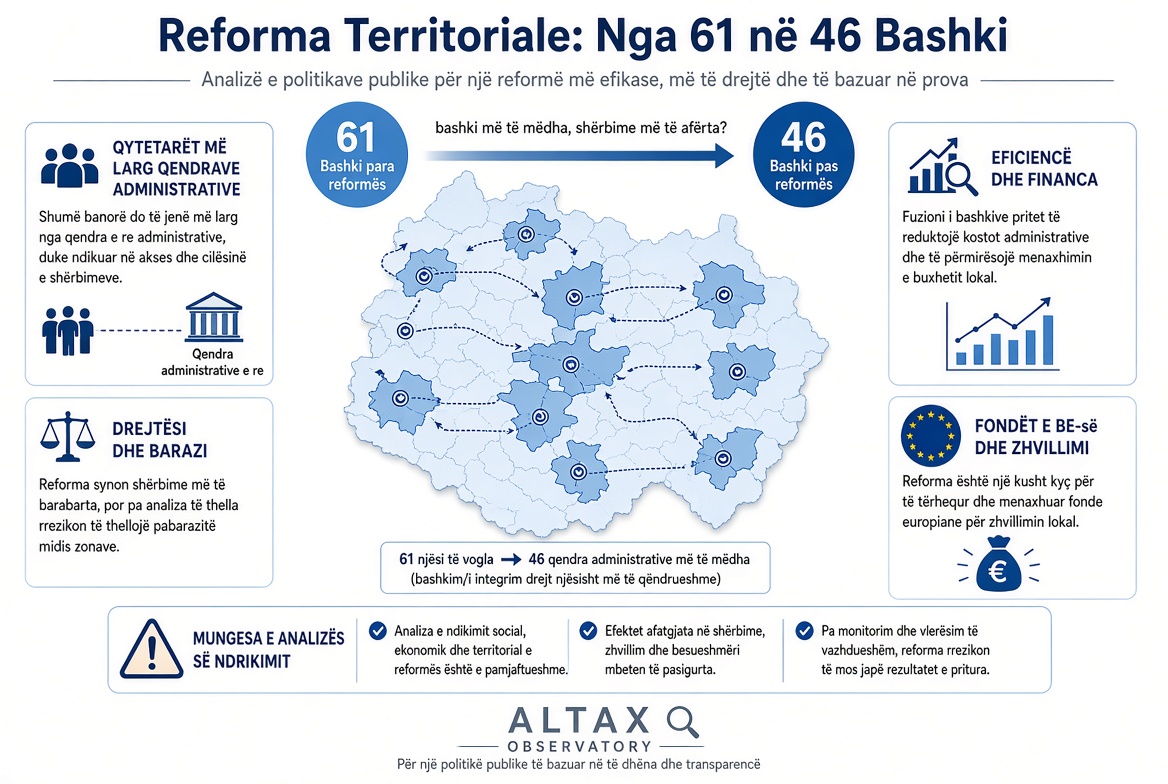
Administrative reform is necessary, but it presents serious limitations
ALTAX assesses that the reform of territorial division is necessary and overdue. The 2014 reform reduced the number of units from more than 370 to 61, but failed to fully resolve the problems of functionality, administrative capacities and fiscal sustainability of many small municipalities. The current legislative proposal to move to 46 municipalities through the consolidation of 15 smaller units with larger neighboring municipalities is a reasonable attempt to address these weaknesses. However, the draft presents serious limitations that require careful treatment before approval, which we have listed as follows:
First, the lack of a detailed impact analysis is highlighted.
The draft law and accompanying documentation provide general arguments for administrative savings and higher capacities, but do not contain complete, measurable and comparable analyses for each merger case. Clear calculations are missing for:
- the cost of transition (inventory, staff restructuring, information systems);
- changes in citizens’ access to services (actual distances, travel time, frequency of public transport);
- the impact on transfers and local budgets for the period 2027–2030;
- the risk of concentration of investments in the new centers to the detriment of peripheral areas.
Without these data, decision-making remains based more on the logic of size than on the logic of functionality.
Second, the risk of distancing power from the citizen is observed.
Larger municipalities may bring economies of scale, but historically they have increased the distance between decision-making and peripheral communities. In mountainous and rural areas (Prrenjas–Librazhd, Fushë-Arrëz–Pukë, Klos–Mat, Këlcyrë–Përmet, etc.), the new administrative centers will be farther away. The status of “city” with a deputy mayor and proportional representation is a weak guarantee if it is not accompanied by:
- real decentralized powers for the constituent cities;
- mandatory participatory budgeting for administrative units;
- mandatory service standards (hours, mobile service counters, maximum response time).
If these mechanisms are not made effective, the reform risks creating more peripheries and fewer effective decision-making centers.
Third, reservations are identified regarding the consultation process of the draft law.
Consultation with municipal councils and citizens has been scheduled after the submission of the draft law to Parliament. This turns the process into formal consultation after the fact, rather than substantive consultation before decision-making. According to the standards of the Council of Europe and good practice, the population’s opinion on territorial changes should be obtained before the map is finalized. The documentation of minutes, questionnaires and the positions of councils should be made public and mandatorily attached before consideration in plenary session.
Fourth, there are no strong arguments and guarantees for fiscal sustainability and the capacity to absorb EU funds.
The argument that larger municipalities will be more competitive for EU funds is valid in principle. But size does not automatically guarantee absorption capacity. Many medium-sized and large municipalities currently have problems with investment planning, project management and procurement transparency. The reform should be accompanied by:
- minimum standards of financial and investment management for the new municipalities;
- independent performance monitoring (IFB indicators, administrative cost per resident, service delivery time) no later than three years after establishment;
- guarantees that the unconditional transfer for the transition period will not be reduced for any consolidated territory.
Fifth, the model does not appear to change regarding what we should learn from the lessons of 2014
The 2014 reform showed that reducing the number of units did not bring better services. Many new municipalities continued to spend the overwhelming part of their budget on administration, while investments and services in villages remained weak. Repeating the same model without strong accountability mechanisms and internal decentralization risks producing the same result.
We suggest that Parliament should:
- require, before approval, a full impact analysis for each of the 13 consolidations (cost, access, fiscality, risks).
Parliament should have at its disposal a standardized analysis for each proposed consolidation. This analysis should show not only the expected benefits, but also the transition costs and the concrete consequences for citizens.
- strengthen provisions on the powers of constituent cities and participatory budgeting.
The creation of a larger municipality should be accompanied by mechanisms that guarantee that constituent cities and administrative units do not lose access to decision-making and investment. Participatory budgeting can serve as a mechanism to link community priorities more directly with the use of public funds.
- make public and review the results of local consultations before the vote in plenary session.
Consultation should produce public and verifiable documentation. Citizens should be able to see not only that a consultation has taken place, but also what was requested, what was opposed and how these positions were addressed in the decision-making process.
- establish clear monitoring indicators and a mandatory reassessment after three years.
The reform should have a measurable mechanism for assessing results. Administrative cost per resident, service delivery time, level of investment per territory, revenue collection, debt management and the ability to benefit from foreign funds are among the indicators that can be used to determine whether consolidation has brought real improvement.
- ensure that the reform is completed at least 12 months before the 2027 local elections, according to the standards of the Venice Commission.
The timing of the approval and implementation of the reform is just as important as its content. Territorial changes should have sufficient time to be implemented, understood by the administration and citizens, and to create legal certainty before the electoral process.
ALTAX supports the need for functional and fiscally sustainable municipalities. But functionality is not measured by the number of municipalities, but by the quality of services that citizens receive in practice.
For the citizen, the success of the reform is not measured by whether the map has 61 or 46 municipalities, but by the fact of how quickly and with what quality services are received, how close the administration is, how fairly investments are distributed across the territory, how transparent taxes and public expenditures are, and how strong the accountability of local leaders is.
However, if there are no detailed analyses, strong guarantees for peripheral areas and independent monitoring, the reform will remain a change of maps without achieving a real improvement in local governance.



Leave a Reply
You must be logged in to post a comment.