


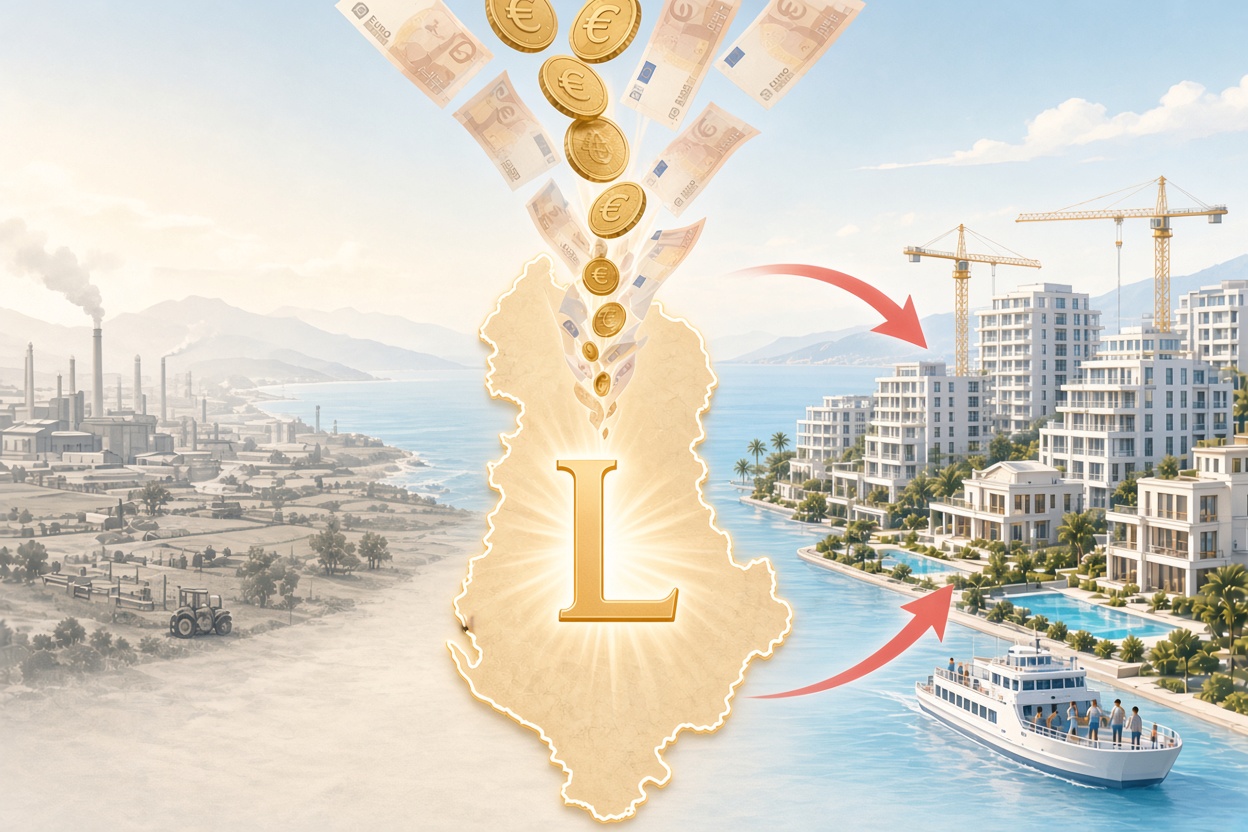
Euro entering an economy that does not produce enough
Euro is not printed in Albania. But what happens when an economy continuously receives purchasing power from abroad, without expanding its productive base to the same extent?
There is a simple way to understand one of the sharp problems of the Albanian economy today. Imagine an economy that does not have a machine for printing money, but in which large amounts of money created somewhere else enter every year.
This is not what is technically happening with the euro in Albania. Albania cannot print euros and the Bank of Albania does not create euros like a central bank of the Eurozone. But, from the perspective of the real economy, the discussion becomes interesting.
When the tourist brings euros, the emigrant sends remittances, the foreign investor brings capital, or when other financial flows enter, the Albanian economy receives purchasing power created outside its borders. When this purchasing power is converted into lek, it enters domestic circulation and seeks to buy goods, services, land, housing, vehicles, construction and imports.
The reason for the decline of the euro is closely linked to the structure of the economy that is creating such a strong lek.
A strong currency can be the product of two completely different realities. In one case, the economy has become more competitive: it produces more, exports more goods and services with added value, increases productivity and earns foreign currency because it has increased its ability to sell in foreign markets. In the other case, the economy is absorbing a great deal of foreign currency from abroad, while the domestic productive base is not expanding at the same pace. This is the difference that should concern us.
When a central bank creates new money, the mechanism follows the cycle new money → more liquidity → more demand → consumption and investment → increases in the prices of assets and goods, if supply does not adjust. Albania is not in this situation with the euro. But let us build an economic analogy according to the current cycle: euros from abroad → conversion into lek → more purchasing power in the economy → more demand → consumption, services, construction, real estate and imports.
In the first case, money is created by the monetary system. In the Albanian case, purchasing power is imported from abroad. Therefore, we do not have “euro printing”. We have something that, for the real economy, can produce an effect similar to a continuous injection of purchasing power, with more money seeking to buy an economy whose productive capacity does not necessarily expand at the same pace. This is precisely where our economy has more money in circulation and, at the same time, does not have more capacity to produce.
What happens to purchasing power after it enters the economy?
The euro can also finance an economy that does not produce euros. If the euro entering Albania is used to purchase machinery, technology, increase productivity, develop industry, modernize agriculture, create exporting companies or build human capital, the mechanism is positive. It follows a cycle in which today’s euro goes into productive investment, which affects productivity and competitive production with exports and new euros tomorrow. In this case, the euro that enters does not remain simply money, but is transformed into economic capacity.
But there is also the other cycle, the one that is taking root in our economy: today’s euro is directed toward the purchase of land to build apartments and villas, as well as toward consumption, demanding imports and stimulating services. In this case, the euro can increase the wealth of asset holders, the price of land and housing and the volume of consumption, without creating a new productive base. Thus, we have an economy that may become more expensive without becoming proportionally more productive.
This is the essence of what we may call the “second economy”, as an economy built on flows created by another economy. Tourism, remittances, foreign capital and other flows bring purchasing power. Construction, real estate, trade and services absorb it. But where is the expansion of the productive base that will make this economy less dependent on external flows?
Exchange Rate and Debt
This is where the exchange rate also comes in. A large flow of euros increases the supply of foreign currency in the market. If demand for euros does not increase at the same pace, the price of the euro in lek falls and the lek strengthens. This mechanism is normal in a functional and productive economy. In the case of the Albanian economy, the strength of the lek is not proof that Albania has become more productive, because it is occurring in an economy that is receiving more euros from tourism, remittances, investments and other financial flows. Therefore, the strong lek is mainly the result of financial flows, not productive capacity.
This mechanism also has an important beneficiary: public finances. A considerable part of Albania’s external debt is denominated in foreign currency, particularly in euros. Therefore, a stronger lek automatically reduces the value of this debt when expressed in lek.
For illustration: if in 2021 the stock of debt in euros was at levels of around 3.9 billion euros and the exchange rate was around 120 lek/euro, its value in lek was approximately 468 billion lek. With the 2026 exchange rate close to 92 lek/euro, the same nominal amount in euros represents a lower value in lek. Even if the nominal stock in euros has increased in the meantime (currently public debt in euros accounts for the overwhelming majority of foreign-currency debt), the exchange-rate effect makes it appear smaller on the balance sheet expressed in lek. But the budget has not repaid any extra euro and the nominal obligation remains the same. Here we have an effect that must be read carefully: the strong lek has made the debt smaller in lek equivalent, but it has not made the economy more productive.
If the strengthening of the lek were a consequence of increased productivity and competitiveness, this would be a healthy benefit. But when the strengthening has come mainly from a large supply of foreign currency generated by tourism, remittances, FDI and other flows, then we have a financial benefit that is linked more to the exchange rate than to an improvement in the structure of the economy. This is the difference between debt becoming more manageable because the economy is stronger and debt appearing smaller because the currency is stronger.
The problem is not the inflow of euros, but their use
We should not be afraid of an excess of euros, but we should be concerned about how they are being used and where they are going. The problem should not simply be linked to why so many euros are entering. On the contrary, the inflow of foreign currency is an advantage. The problem lies at the moment when the flow of foreign currency becomes a substitute for productive capacity.
Tourism euros, monetary flows and remittances are not financing enough productive investments that would strengthen the base for a stronger economy. Euros within Albanian territory are mainly financing real estate, consumption and imports, creating an economy that is richer in assets, but weaker in production.
Construction is one of the best tests: euros coming from abroad end up in land, apartments and villas, leading to increases in asset prices. In fact, they should have ended up at higher rates in technology, industry, agro-processing, energy, logistics, human capital and exporting companies, so that alongside residential construction, an increase in productive capacity would also be achieved.
When construction and services are dominant, the economy becomes more expensive. If we had more production, it would become more productive. These two approaches are not the same.
It would not be accurate to declare our economy a classic case of “Dutch disease”, but the risk mechanism is known and similar to what we have today. More foreign currency from abroad brings currency appreciation and relatively cheaper imports, but also increasing pressure on the competitiveness of exports. This approach has shifted capital toward sectors with quick returns: more construction, real estate, trade and services.
If this happens over a long period (10 years+), the economy creates a contradiction within itself: the more euros enter, the less incentive there will be to build capacities that produce euros sustainably. This is the point at which external flows can turn from a short-term economic advantage into dependency.
Tourism and the measurement of success
In this context, a wrong debate should be avoided regarding the question “is tourism good or bad for Albania?”. Tourism is an export of services. It brings foreign currency and creates demand for the domestic economy. What should be analyzed is: how much Albanian value is created from every euro brought by the tourist?
If one tourism euro passes through domestic food, transport, production, agriculture, culture, technology and professional services chains, it multiplies economic activity. But when a large part of it ends up in imports, land, real estate and consumption of existing wealth, the long-term impact is much more limited.
Therefore, the measurement of success that is advertised as “a lot of euros have entered from tourism” is political rhetoric as long as it has not influenced the growth of productive capacity in the sectors directly and indirectly linked to tourism and the competitive regional market.
Also, regarding the fact that euros are entering Albanian households, this may create the feeling that they are becoming wealthier. The facts show that the Albanian economy and some households may have more money circulating, more construction, higher land prices, more consumption and a stronger lek. But the economy is not producing more value at the same pace. If we return to the analogy of “printing money”, it is as if money were being printed without increasing productive capacity: more money is needed to buy the same quantity of goods and services.
Albania is not printing euros, but if it continuously receives purchasing power from abroad and does not transform it into new productive capacity, it faces a similar situation. In 2026, more money is needed to buy an economy that is not expanding sufficiently on the supply side. Then the price of land is increasing, the price of housing is increasing, services are becoming more expensive, imports are becoming more attractive even though they are hindered by informality and oligopolies, but consumption is also increasing. However, competitive production is not increasing at the same pace and this is not new wealth, but capitalization of new money on existing wealth.
The true objective
In the logic of the current economy, the government and the market should not have as their sole objective attracting more tourists or more capital. These are means. The objective should be for these flows to create economic capacity that remains even after the flow slows down, because the tourist may leave, remittances may fall, foreign investment may change destination and the exchange rate may reverse.
If a more productive factory, an exporting company, a more competitive farmer, a more qualified worker, a new technology and a domestic supply chain are supported, all of these remain in the economy. This is the difference between growth financed by flows and development financed by productivity.
If euros are converted into productivity, the strengthening of the lek may be part of a healthy convergence process. If they are converted mainly into real estate, consumption and imports, then a strong lek may also be a symptom of an economy that is being fed from abroad, while its productive base is not expanding at the same pace.
Therefore, we must produce more value from the money that is already entering. Our small economy can become richer by receiving euros from the world, but only a productive economy can become stronger by producing its own euros. This is precisely where economic growth (which we have today) is separated from development (which we should have).



Leave a Reply
You must be logged in to post a comment.