


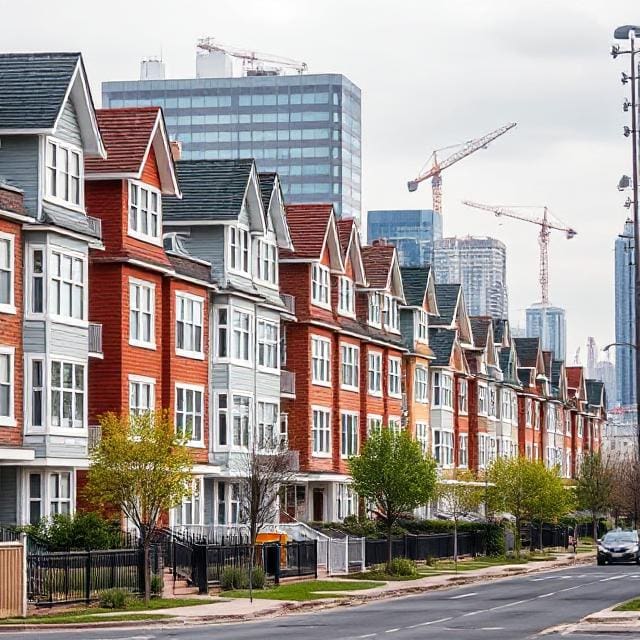
How will the housing boom skew productivity in Albania?
The rise in housing prices in Albania is producing a double effect. On the one hand, it increases the wealth of families and businesses with more property, enabling them easier access to credit. On the other hand, it is creating a “collateral channel” that channels capital where there is more real estate, not necessarily where higher productivity is generated.
In the long run, this mechanism risks slowing the modernization of the Albanian economy, blocking growth in low-productivity sectors such as construction and local services.
At a time when housing price growth in Albania is reaching historic rates, the fundamental question arises:
Is this development fueling the long-term productivity of the economy, or is it creating an illusion of sustainable growth?
The answer, based on the latest data, leans toward the second scenario.
Where we are today: Facts about the Albanian housing and credit market
According to the Bank of Albania, in the second half of 2024:
• Housing prices increased by +23.6% compared to the previous period and +44.5% year-on-year. In Tirana alone, the increase reached 56% (Official BoA website, Financial Stability Report, framework, periodicity, and systemic risk focus).
• The average time to sale fell to 9.3 months (only 7.1 months in Tirana), indicating an increasingly liquid market.
• Around 18% of purchases were made by non-residents, an additional factor putting pressure on prices.
• Approximately 50% of transactions were financed with credit, mostly with an LTV ratio ≤60%, indicating a cautious banking system, but still heavily focused on real estate.
On the other hand, household lending increased by 15% year-on-year, with mortgage loans now representing 67.4% of household debt. Interest rates in lek fell to 3.7%, further stimulating demand. Business credit increased by 16.6%, but mainly towards large enterprises in construction, trade, and tourism, while SMEs and innovative sectors remained in the shadows.
The economic message is clear!
Real estate has become not only the engine of prices but also the headline driver of lending and resource allocation in the economy.
From housing prices to productivity
In Albania, the rise in housing prices has been extraordinary, +44.5% over the course of one year (2024), while in Tirana up to +56%.
This means that an apartment that cost €100,000 last year now sells for over €150,000. Banks see more valuable collateral, making them willing to lend more to those who already own property.
In fact, around 50% of housing transactions in 2024 were financed with credit, mostly with LTV ≤60%, showing a cautious but still property-focused approach.
Builders, real estate companies, businesses owning land, hotels, or shopping centers are “asset-heavy”, as they have strong collateral and receive financing at favorable interest rates. These sectors, although often lower in productivity (more reliant on labor-intensive work than innovation), ensure continuous liquidity.
Tech startups, knowledge-based service companies, and export-oriented businesses with light capital do not have “bricks and mortar” to offer as collateral.
As a result, their access to credit remains limited.
This phenomenon is also documented by the Bank of Albania. Business credit in 2024 increased by 16.6%, but the vast majority went to large enterprises in construction, trade, and tourism, while SMEs and the innovation sector remained in the shadows.
At first glance, injecting capital into the economy seems positive.
Credit increases, construction flourishes, and demand for services rises. But the underlying mechanism shows a long-term risk.
Resources are shifting from “high-productivity” sectors (technology, export, innovative industry) to “real estate economy” sectors.
Instead of capital generating sustainable growth and higher productivity, it is trapped in a self-reinforcing cycle of real estate.
At the national level, this helps explain why Albania continues to have much lower labor productivity than the EU average and why progress toward economic diversification is slow.
Albania is no exception, but it has its own characteristics
Albania remains an economy where the housing market is extremely sensitive to monetary movements. Lower interest rates during 2024 were quickly translated into cheaper credit for individuals and businesses. This immediately increased mortgage demand, while, according to the Bank of Albania, lending conditions were significantly eased for large enterprises, but not for SMEs.
The result is a financial system that grows through “big collateral”, while small and medium-sized businesses continue to face structural barriers.
The real estate market is not uniform.
Tirana and the coast (Vlora, Saranda, Durrës) are the growth epicenters, where prices have risen above the national average.
Unsold inventories have fallen sharply.
The average time to sale has shortened, showing strong demand.
According to market reports, 72% of transactions close below the initially requested price, meaning negotiations have become tougher, but this has not stopped real price growth.
This geographic concentration deepens regional inequalities, where Tirana and the coast thrive, while inland cities such as Elbasan, Korça, or Shkodra experience much slower growth and lack fresh investment.
The role of non-residents
Another feature distinguishing Albania is the high presence of non-resident buyers. In 2024–2025, around 18% of the market was dominated by buyers from the EU, mainly Italians, Germans, Austrians, and Poles, who see Albania as a low-cost destination for coastal real estate.
This flow has influenced price increases, especially in tourist areas.
However, the impact on the productive capacity of the domestic economy is limited. Most of these investments are “storage of value”, not investments that generate sustainable economic chains.
Practically, Albania is witnessing a “touristification of the housing market”, where purchases for secondary purposes or as passive investments raise prices for locals, excluding young people and new couples from the market.
Consequences?
Let’s look at examples:
A SME in Elbasan seeks financing to increase furniture production for export. The bank asks for collateral in Tirana or the coast, which it does not own. The loan remains inaccessible.
An apartment in Vlora is bought by an Italian citizen as a “holiday home”. The cost rises, the market price for locals climbs, but this does not bring productivity growth to the Albanian economy.
A builder in Tirana benefits from cheap credit after interest rate cuts, starts new projects, and expands the portfolio.
Albania, like many developing economies, follows the universal logic linking housing prices and credit. But its features—high sensitivity to monetary policy, geographic concentration of the market, and strong presence of non-residents—make the risk even more pronounced.
The exception from developed markets is the distortion in the economic scale, locked into real estate, but with weak impact on productivity and long-term development.
As a result, the real risk is not a financial crisis, but a long-term deviation from productivity
Unlike economies that faced price surges and bank failures, the Albanian banking system today is solid, well-capitalized, with sufficient liquidity, and according to the Bank of Albania, there are no alarming signals for financial stability.
But the problem is less dramatic, less visible, and perhaps more dangerous: the silent misallocation of capital in our economy. This means that credit and investments are not going where productivity rises, but where there are bricks and mortar.
Construction and real estate firms benefit from rising prices and guaranteed collateral.
Innovative, technological, or export-oriented firms remain without financing access because they lack the assets banks require.
The macroeconomic result is an economy that “produces” more housing, but not more knowledge, not more value-added products, or export services.
In the short term, this mechanism creates an illusion of prosperity for businesses and individuals.
GDP rises, cities expand, and the labor market revitalizes.
But in the long term, growth becomes faster only in volume, not smarter in quality.
Thus, the risk is not an immediate financial collapse, but a long-term structural deviation.
Albania is anchoring its future in real estate instead of investing in human capital, innovation, and exports.
The moral for policy at this moment must be: “do not let collateral become a development strategy”.
In essence, Albania needs more ideas than walls, more innovation than concrete.
If we measure economic development only by square meters, real estate, and collateral, we risk building an economy that seems to grow, but on weak foundations.
Monetary and macroprudential policies are essential to maintain banking system stability and manage cyclical real estate risks.
But these alone are not enough.
A broader, more comprehensive approach is needed. Industrial and financial policy that creates space to finance ideas, technologies, and export sectors, not only those owning land and buildings.
The main challenge is to ensure that capital follows productivity, not just collateral.
In conclusion, according to our analysis, Albania does not face a classic financial crisis, but a “distorted growth”, where capital chases bricks and mortar rather than innovation.
If financial bridges for “asset-light” businesses are not created, progress will be measured by apartment prices, not productivity.
Sources:
Bank of Albania, “Trends in Lending”, pace of credit for households/businesses, interest rates, weight of mortgages in portfolio, orientation toward large enterprises and sectors, January 2025. Data up to December 2024.
Bank of Albania, “Survey on the Development of the Real Estate Market”, 6M II 2024, price index increases, time to sale, share of transactions with credit, LTV, role of non-residents, rental dynamics.


Leave a Reply
You must be logged in to post a comment.