


Economic trend in the second quarter of 2025 with its challenges and prospects
The second quarter of 2025 recorded a 3.51% real growth rate in Albania’s economy, reflecting a moderate recovery after the challenges of recent years.
Although this growth is a positive signal, its true value for the economy, the state budget, and citizens can only be understood by analyzing its structure and underlying drivers.
At the sectoral level, Public Administration, Education, and Health contributed +1.65 percentage points to GDP, showing the direct impact of government policies and public spending.
For citizens, this translates into improved public services, infrastructure projects, and social investments, which enhance overall quality of life, but do not yet reflect an increase in personal purchasing power or a stronger private sector.
The private sector, including Trade, Transport, Accommodation, and Food services, added only +0.47 p.p., a modest rise that indicates the economy still relies more on domestic consumption rather than production and exports.
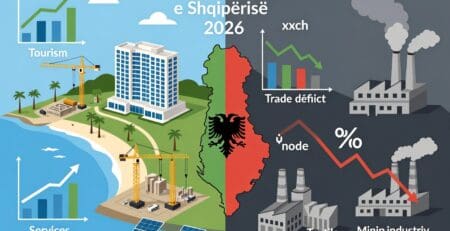
Real estate and Construction, with +0.37 and +0.30 p.p. respectively, show strong activity in the building and investment markets, but carry a risk of overcapitalization and speculative use, a concern highlighted by ALTAX analyses as a challenge to sustainable economic development.
Sectors in decline, such as Agriculture, Forestry, and Fishing (-0.46 p.p.) and Industry, Energy, and Water (-0.18 p.p.), reveal structural weaknesses.
This is linked to limited strategic investments, lack of new technology, and insufficient production diversification, which increase import dependence and restrict sustainable growth in key economic areas.
Growth rates by percentage reveal a clear disparity among sectors:
Public Administration, Education & Health +15.11%, Real Estate +7.86%, Information & Communication +5.38%, Arts, Entertainment & Services +5.07%, while the sharpest declines were in Agriculture, Forestry & Fishing -2.49% and Industry, Energy & Water -1.79%.
This analysis shows that growth is uneven and relies heavily on the public sector and construction, rather than the sustainable expansion of private industry.
In terms of consumption and spending, the gap between public and private consumption is striking.
Household consumption rose by 3.88%, while government consumption surged by 12.44%.
This indicates that the economy is being driven mainly by public expenditures, infrastructure projects, and service investments, rather than by real growth in purchasing power or private-sector development.
Gross fixed capital formation increased by 4.33%, but mostly in construction and real estate, limiting its medium-term impact on productive, technological, and energy sectors.
In foreign trade, exports grew by only 3.5%, while imports fell by 2.1%.
This shows that the Albanian economy remains dependent on foreign goods and services, especially for industrial and manufacturing needs.
Even though the balance of payments improved compared to last year, this dependence can translate into higher prices for imported goods and basic services, directly affecting living costs and limiting opportunities for domestic industrial development.
The analysis of resource management philosophy highlights that the economy has benefited mainly from public spending and real estate investments, while industrial diversification, technology, and renewable energy have received far less attention.
This approach carries clear risks, including:
- Overbuilding and real estate speculation, which could create a sectoral “bubble”,
- Weakness in industrial and agricultural sectors, which increases import dependence and undermines medium-term economic stability, and
- Reliance on public consumption, which shows that government stimulus remains the main engine of growth.
Nevertheless, there are clear opportunities for sustainable development, including investment diversification, stronger support for export-oriented sectors, strategic investments in agriculture, industry, and renewable energy, and careful monitoring of the real estate market to prevent speculation and capital overuse.
In conclusion, the second quarter of 2025 offers a clear picture of Albania’s economic rebound, but with uneven growth and a dominant reliance on the public sector and construction.
This growth shows that benefits for citizens remain largely indirect and unevenly distributed.
While public services such as education, healthcare, and infrastructure have improved and overall living conditions have seen some gains, personal purchasing power and private sector employment opportunities remain limited, and the economy’s dependence on public spending and government stimulus has not yet generated a tangible increase in individual well-being.
For the economy as a whole, the 3.51% growth has provided a positive impulse, strengthening economic activity in the public and construction sectors, generating investments and liquidity that support market stability and potential private sector development.
For the state budget, public spending and net taxes have ensured additional revenues, increasing capacity for infrastructure projects and services, but the dependence on these stimuli underscores the need for sustainable growth in productive and export-oriented sectors.
By pursuing a balanced and strategic approach to resource management, the economy can shift from a temporary rebound to sustainable, inclusive growth that not only enhances citizens’ purchasing power and well-being, but also stabilizes the budget and strengthens Albania’s long-term development, creating a positive cycle where citizens, the budget, and the economy benefit together.


Leave a Reply
You must be logged in to post a comment.