


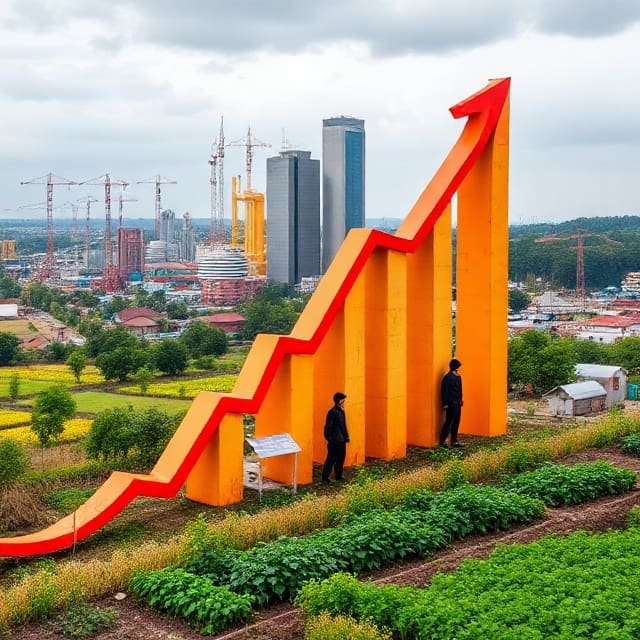
Economic growth of 3.5%: A sign of stability, but not success
In the second quarter of 2025, the Albanian economy recorded a growth of 3.5%, which the Ministry of Economy presented as a clear indicator of success.
At first glance, this seems like an argument that fits well with political rhetoric, since the percentage appears higher than that of developed countries.
In reality, however, this comparison is misleading and reveals little about the actual state of the Albanian economy. It is a partial reading of the figures, leaving out the weight of context, the much lower economic base, Albania’s need for much higher growth rates, and the lack of tangible benefits for citizens.
Why the comparison with the EU is misguided
Comparing Albania’s growth rate with that of European Union countries is inherently flawed, since consolidated Europe has a completely different development base. GDP per capita in most EU countries is several times higher than in Albania, which means that a modest growth rate of 1–2% there translates into billions of euros in new wealth and measurable improvements in living standards. In contrast, for Albania, a 3.5% growth rate remains too small to close the gap with developed countries.
In fact, low-income countries with similar economic structures need significantly higher growth rates, above 5–6% over a sustained period, if the gap with the EU is to narrow meaningfully.
Otherwise, the gap not only fails to shrink but growth becomes a mere statistic, detached from real improvements in citizens’ well-being, who continue to face high living costs and incomes insufficient for a dignified life.
The right comparison is with the region and countries with similar economic bases, not with the EU, which has deeply consolidated structures. Albania should be benchmarked against Western Balkan countries and some Eastern European economies, where challenges are more comparable, markets are more similar, and development resources are closer to Albania’s reality.
A clearer picture in the regional context
From this perspective, the picture becomes much clearer.
- Kosovo often records growth rates above 4%, mainly supported by remittances and domestic consumption, though this growth is highly dependent on external factors.
- Serbia hovers around 3%, but on a far larger industrial and productive base than Albania, which gives the figure a completely different meaning.
- North Macedonia fluctuates between 2.5–3.5%, driven primarily by exports and light industry.
- Montenegro often achieves higher rates, but these rely almost exclusively on seasonal tourism, making its growth unsustainable.
In this context, Albania at +3.5% does not stand out. It is neither a unique success story nor a failure; it simply positions itself within the regional average. But this average position is problematic, because a country with still-low incomes and urgent development needs cannot be satisfied with “ordinary” results.
A regional-average growth rate is not enough to significantly improve citizens’ well-being or narrow the gap with Europe. On the contrary, it shows that Albania is moving at the same pace as others, when in fact it needs a much faster rhythm to catch up on its development backlog.
The structure of growth: Construction and Public Spending
A critical element that cannot be overlooked is the structure of this economic growth.
Data show that growth is mainly supported by construction and public spending—two pillars that generate economic activity in the short run but do not guarantee long-term development. Real estate and construction continue to expand their share, often speculatively, creating an illusion of development that does not translate into real production, technology, or competitive capacities.
At the same time, the government increased public spending by over 12%, injecting capital into the economy and boosting the nominal value of GDP, but without generating a proportional impact on purchasing power or citizens’ welfare.
Meanwhile, the sectors that should drive sustainable growth, industry and agriculture, remain stagnant.
- Industry fails to produce meaningful increases in production, technology, or export capacity. It cannot generate new and sustainable value, leaving the economy dependent on non-productive sectors.
- Agriculture, where a large part of the population works, remains fragmented and fragile, heavily dependent on weather conditions and lacking mechanization or modern processing. Limited market access and ineffective support further weaken its ability to generate stable incomes and improve rural livelihoods.
This is why the 3.5% growth rate looks fragile and insecure: because it is rooted in sectors that cannot ensure long-term development. An economy driven by construction and public spending is inherently unstable, at risk of stalling once public investment slows or the real estate boom cycle ends.
The citizen’s perspective: Missing welfare
From the citizens’ viewpoint, growth figures feel distant and disconnected from daily reality.
For the average Albanian household, food, energy, and service prices remain high, while real wages fail to sustainably cover basic expenses. Data make this clear: private consumption rose only by 3.9%, a strong indicator that citizens’ purchasing power has barely improved.
In practice, citizens benefit only indirectly from this growth. Public investments and improvements in some services or infrastructure provide limited relief, but not enough to create the feeling of tangible improvement in daily living standards. Wages remain low, the consumer basket expensive, and the gap between macroeconomic statistics and social reality wide.
For many Albanians, a dignified life remains more of an aspiration than a reality. The reported 3.5% growth has not translated into better living standards but has remained locked in statistics, far from the tables of families struggling with high living costs.
Growth as stability, not success
A 3.5% growth rate may be seen as a sign of stability, but it cannot be called success.
True success would mean modernizing Albanian industry and making it competitive, creating sustainable jobs, and generating new value. It would mean transforming agriculture, where much of the population still works into a profitable sector with processing, technology, and stable exports, instead of leaving it fragmented and weather dependent. It would mean growth driven by private-sector dynamism, not by public spending increases.
Above all, growth would only have real value if it translated into higher wages, better-quality employment, and purchasing power that allows citizens to live with dignity.
In this sense, comparing Albania’s growth with that of the European Union has no real basis.
Consolidated Europe enjoys high living standards and does not need rapid growth to maintain well-being. Albania, with much lower incomes and a vast gap to close, cannot afford to be content with a modest 3.5% rate.
This rate is average for the region and uncertain in its sources, as it relies more on construction and public spending than on production and real value creation. For the ordinary citizen, 3.5% does not translate into meaningful welfare. Prices keep rising, real wages remain low, and the consumer basket is more expensive than ever. Declaring it a “success” is more political narrative than a reflection of economic reality.
True success would only come when the economy builds sustainable foundations for development and when growth figures reflect a genuine transformation of citizens’ lives. Until then, percentages remain numbers on paper rather than evidence of an economy moving forward.

Leave a Reply
You must be logged in to post a comment.