


Albania’s economic evolution 2014–2025
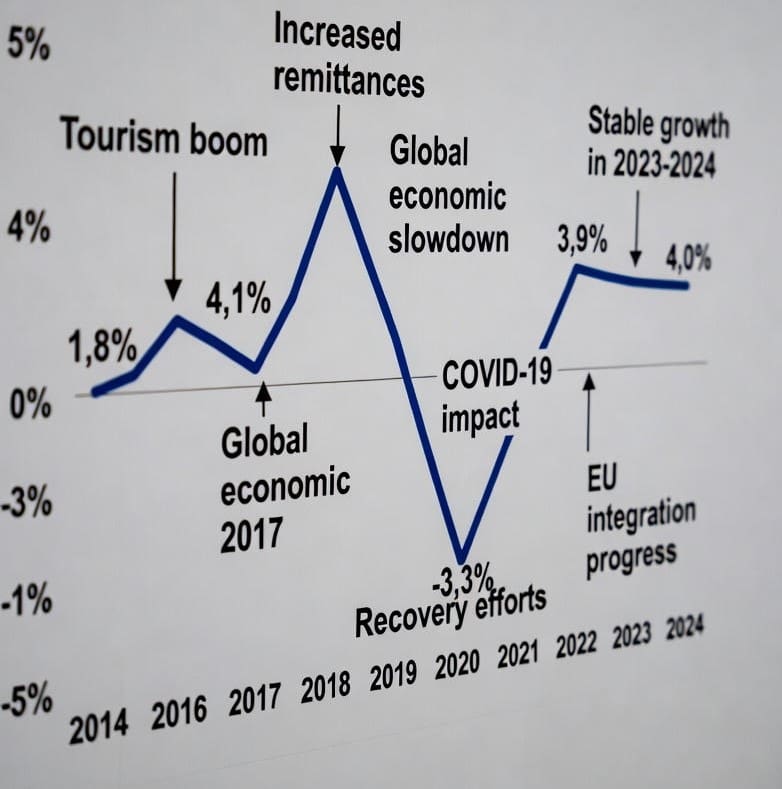
During the decade 2014–2025, the Albanian economy has experienced a fluctuating growth trajectory, starting from a slow recovery after the global financial crisis, a rapid acceleration until 2018, a drastic decline in 2020 due to the COVID-19 pandemic, and a strong subsequent rebound that stabilizes at moderate rates toward 2025.
This cycle is not only the result of internal factors such as consumption and investments, but also of external influences such as remittances, tourism, and emigration, which have shaped an economic model mainly dependent on services and domestic demand, without a deep structural transformation that would stimulate productivity, innovation or export competitiveness at the global level.
Compared to the previous decade, the Albanian economy has marked a clear shift from agriculture toward services (including tourism) and construction, but this has not been accompanied by strong growth in industry or high technology.
According to data from the World Bank and IMF, real GDP has grown on average around 3.5% annually in the period 2014–2024, but this growth has been unbalanced, with high dependence on remittances (around 8–10% of GDP) and tourism (up to 25% of GDP in recent years).
Mass emigration, with around 1.1 million people having left since 2014 (around 40% of the population), has created a vicious cycle.
Remittances inject liquidity and stimulate consumption, but the departure of skilled labor reduces productive potential, shrinks the demographic base and limits the development of advanced sectors.
The slow growth in 2014–2015 (around 2%) reflects an economy in transition after the fiscal crisis and investment uncertainty, influenced by public administration reform and macroeconomic stabilization.
From 2016–2018, the pace accelerated to 3.3–4.1%, thanks to the increase in public investments (including infrastructure projects such as TAP), the expansion of bank credit, rising minimum wages and the tourism boom. The latter, with over 5 million visitors in 2017, turned services into the main contributor to GDP (around 48% in 2024). However, according to economic development theory (such as Lewis’ model of sectoral transition), this shift from agriculture (which fell from 22% to 18% of GDP) toward services temporarily increases GDP but does not ensure sustainability without investments in human capital and technology.
The 2020 pandemic caused a GDP decline of -3.3%, mainly due to the shutdown of tourism (loss of around 20% of indirect GDP), transport, and supply chains.
The recovery in 2021 (8.9%) was symmetrical, driven by the base effect, the reopening of the economy, fiscal support (stimulus packages around 2% of GDP) and the increase in remittances (up to 9% of GDP). This phenomenon was seen in the region as well, but Albania stood out for the rapid return of tourism (over 10 million visitors in 2023). From 2022–2025, growth stabilizes at 3.4–4.0%, supported by domestic consumption, construction (contributing 11–12% of GDP) and services.
However, this is not structural growth: the trade deficit continues to deepen (exports 4.3 billion USD vs. imports 8.4 billion USD in 2023), with dependence on imported machinery and food.
Table 1. Real GDP growth in Albania (2014–2025)
| Year | Real GDP growth (%) | Main source (for estimate) |
|---|---|---|
| 2014 | 1.8% | World Bank / INSTAT |
| 2015 | 2.2% | TradingEconomics / INSTAT |
| 2016 | 3.3% | World Bank / Wikipedia (consensus) |
| 2017 | 3.8% | INSTAT / WIIW |
| 2018 | 4.1% | WIIW / TradingEconomics |
| 2019 | 2.1% | TradingEconomics / World Bank |
| 2020 | −3.3% | COVID-19 impact, World Bank / IMF |
| 2021 | 8.9% | Strong rebound (base effect), WIIW / IMF |
| 2022 | 4.8% | IMF / World Bank estimates (robust tourism/real estate) |
| 2023 | 3.9% | World Bank / TradingEconomics (consolidation) |
| 2024 | ~4 | INSTAT |
This economic model, oriented toward consumption and services, relies heavily on remittances (8.57% of GDP in 2023, down from the historical average of 14%), which inject around 1.2 billion euros annually, stimulating aggregate demand but creating dependency.
Emigration, with net emigration of -25,000 people in 2023 and a cumulative 1.1 million since 2014, reduces labor supply, increases pressure on the pension system and diminishes innovation. According to the EBRD, emigration has cost -0.2% of annual GDP per capita growth from 2000–2023 and is expected to deepen to -0.3–0.4% by 2050.
Table 2. Sectoral contribution to GDP (2024, estimates)
| Sector | Contribution to GDP (%) | Annual growth (%) |
|---|---|---|
| Services (incl. tourism) | 48.7% | +3.2% |
| Construction | 11.9% | +12% |
| Agriculture | 18% | -1.5% |
| Industry | 12% | +2% |
| Others (finance, etc.) | 9.4% | +1.8% |
(Sources: INSTAT, World Bank)
Other indicators complete the economic picture.
Unemployment fell to 9.4% in 2024 from 17% in 2014, but remains high among youth (around 20%). Inflation averaged 2.2% in 2024, below the Bank of Albania’s target (3%), thanks to the strengthening of the lek (+30% vs. the euro since 2015). Public debt fell to 55.7% of GDP in the first half of 2024, from 72% in 2016, reflecting prudent fiscal management.
However, the trade deficit remains large (-4.1 billion USD in 2023), with exports dominated by textiles and minerals, while imports are dominated by machinery and food.
In theoretical terms, according to development models (such as Solow’s model for capital- and technology-based growth), Albania is operating below its long-term potential (3–4% growth), due to the lack of diversification.
Remittances and tourism provide short-term stability but hinder transformation by keeping consumption artificially high without increasing productivity (decline of -1.2% annually in 2023–2025). Emigration worsens this, creating “brain drain” and lowering birth rates (below replacement level since 2021).
For the upcoming trend (2026–2028), the IMF and World Bank forecast growth around 3.4–3.5%, but this remains within the “natural limit” of a consumption-services economy. To break this cycle, structural reforms are needed: export diversification (through incentives for industry), agricultural modernization (to reduce food imports), anti-emigration policies (such as a Youth Guarantee for the young), and channeling remittances into productive investments (not only consumption). If these are implemented, Albania may achieve faster convergence with the EU (currently GDP per capita at 35% of the EU average); otherwise, it risks demographic and economic stagnation, with rising poverty (42% of the population at risk in 2023).

Leave a Reply
You must be logged in to post a comment.