


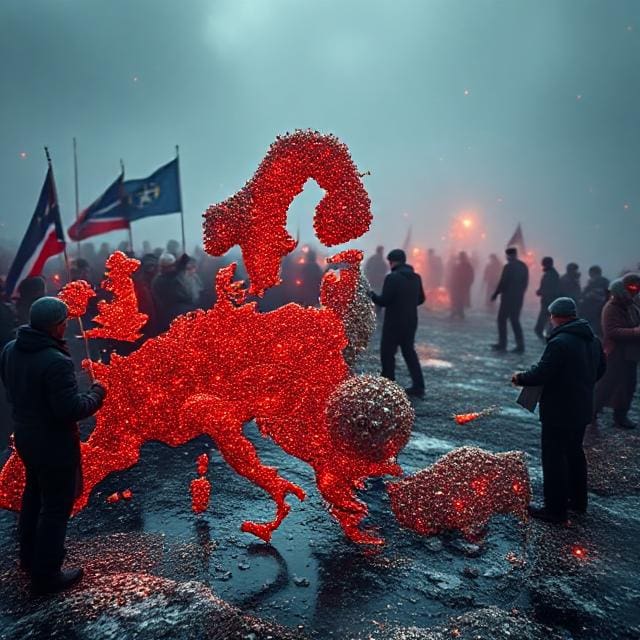
Albania between NATO pressure and its social reality
At the Hague Summit in June 2025, NATO countries adopted a bold new target: increasing defense spending to 5% of Gross Domestic Product (GDP) by 2035.
This target is not merely symbolic.
It is a clear sign that the Alliance is transitioning from an era of passive defense to a phase of high strategic engagement. In a world facing increasingly complex threats—from conventional warfare to cyber warfare—this move is understandable.
However, for countries like Albania, which are on the margins both economically and institutionally, this demand is not just challenging; it is almost impossible without severe long-term consequences.
In 2024, Albania recorded a GDP of €25.2 billion and spent about €504 million on defense, equivalent to 2% of GDP.
The 5% target means that in less than a decade, the defense budget must more than double, exceeding €1.26 billion annually—more than the entire current public education budget.
This increase, in a country where budget revenues constitute only 27% of GDP, represents a major shock to the budgetary framework.
To achieve this, the state will have to choose between:
- cuts in social sectors,
- increasing the fiscal burden on citizens and businesses, or
- increasing public debt, which is already a latent threat to macroeconomic stability.
What is the real risk?
In a society where trust in institutions is low, public spending is perceived as unfair, and basic needs in education, health, and housing remain unmet, a large increase in the defense budget without clear explanation and public involvement is likely to be perceived as a top-down imposition—an unquestioning political obligation to NATO that does not reflect the real needs of Albanian citizens.
Even worse, such an increase in a sector traditionally closed to public oversight may create conditions for politically protected economic interests to concentrate power through classified tenders, questionable contracts, and lack of parliamentary control.
This target should be seen as a guideline, not a mechanical obligation. NATO has not demanded financial uniformity, but proportional commitment and continuous modernization. Albania can become a more important partner not by chasing high numbers but by investing wisely:
- in defense technologies such as drones, cyber defense, and satellite communications;
- in advanced technical and military education;
- in interoperable and flexible forces—not necessarily larger in number.
An increased budget makes sense only if it is used as a tool to develop domestic industry, technology, and production capacities; otherwise, it will remain an empty figure spent on external purchases without internal economic impact.
Instead of blindly imitating the 5% target, Albania should reformulate a National Security and Defense Strategy where the budget increases:
- gradually and in line with real economic growth,
- integrating civilian-military use of investments (such as infrastructure and communications), and
- with strong parliamentary, public control, and external auditing.
The 5% target should not translate into “more tanks” or “more soldiers,” but into smarter security, with less social cost and greater economic benefit.
Albania is a country aspiring for European integration, sustainable development, and an increased role in regional security. But the path to these goals does not necessarily go through a brutal increase in defense spending.
If this target is not understood as part of an overall vision for the state, it will end up as just another propaganda signpost that serves neither NATO, nor the people, nor our real security.
Therefore, let us not imitate, but think. Let us not race after percentages, but build real, sustainable capacities with multiple impacts. And above all, let us remember that numbers are a means, not an end.

Leave a Reply
You must be logged in to post a comment.