


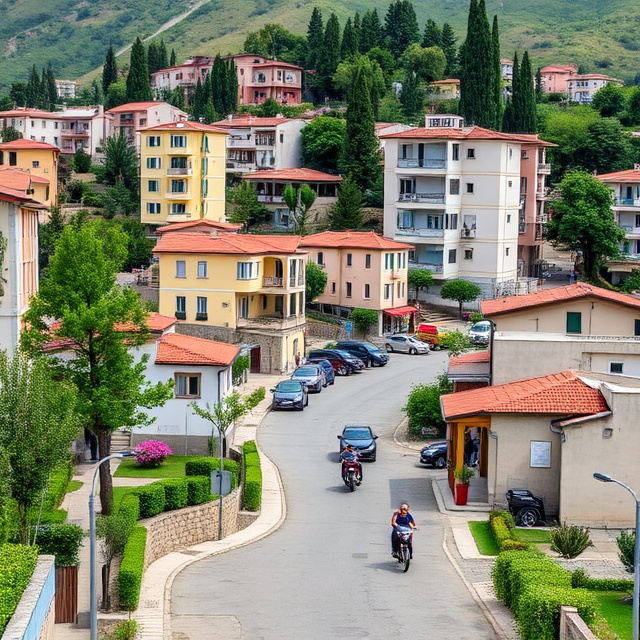
Albania is growing faster than the region, but how sustainable is this growth?
The Albanian economy grew by 3.66% in 2025 and by 3.71% in the first quarter of 2026. The indicators place Albania above the Western Balkans average, but an analysis of the structure of growth raises a more important question than the percentage itself: Who is producing the growth and are the capacities being built for it to continue?
The POLIFAKT report on Albania’s economic growth in 2025 and the first quarter of 2026 shows that the economy has maintained a steady pace of expansion, but its growth engines have changed significantly.
In 2025, GDP grew by 3.66%, compared with 4.03% in 2024. In the first quarter of 2026, growth reached 3.71%. At first glance, this is a positive result. But the question that arises is: is growth above 3.5% enough to say that the economy is structurally strengthening?
The answer requires us to look beyond the overall figure.
First question – Albania is growing faster than the region, but how strong is the advantage?
In 2025, Albania, with growth of 3.66%, was above the average of the six Western Balkan countries, which according to the World Bank was 3.0%. The difference of 0.66 percentage points is positive, but it does not place Albania in an entirely distinct category from the region.
According to the World Bank’s projections for 2025, Kosovo was expected to grow by 3.8%, Albania by 3.7%, Montenegro by 3.3%, North Macedonia by 3.1%, Serbia by 2.8%, and Bosnia and Herzegovina by 2.6%. Thus, Albania is among the economies with the best performance in the region, but it is not the only economy with high growth rates.
The question, then, is: is Albania creating a competitive advantage over the region, or is it simply going through a favorable cycle of consumption, tourism, and investment?
This is important because in order to sustainably outperform the region, it is not enough for GDP to grow faster for one or two years. Productivity, the value added of exports, and the economy’s ability to create higher-paid jobs must grow faster.
Second question – Who produced the 3.66% growth in 2025?
Here the report produces a result that deserves particular attention.
Of the total growth of 3.66%, household consumption contributed 2.33 percentage points, or around 64% of total growth. This confirms that purchasing power and domestic demand remain the main engine of the economy.
But government consumption also played an exceptionally strong role. It increased in real terms by 11.37% and contributed 1.40 percentage points, or around 38% of total growth.
Fixed investment contributed 0.80 percentage points, while net exports contributed 1.13 percentage points. On the other hand, the change in inventories made a negative contribution of –2.07 percentage points.
This raises the main question: how much of the 2025 growth came from the expansion of the economy’s capacities and how much from immediate demand, particularly private and public consumption?
The report suggests that the structure of 2025 was more demand-oriented than based on a proportional expansion of productive capacities. The decline in inventories, meanwhile, may signal greater caution among businesses regarding production and expectations for the future.
Third question – Can the same growth be maintained without government consumption?
This is perhaps the most interesting question arising from the comparison between 2025 and the beginning of 2026.
In 2025, public consumption was one of the main engines of growth. In the first quarter of 2026, this situation changed. Government consumption went from an increase of 11.37% in 2025 to a negative change of –1.36%, while the economy continued to grow by 3.71%.
The main engine shifted toward household consumption and investment. According to the report, household consumption accounted for approximately 73% of the force supporting growth in the first quarter of the year.
This raises two possible interpretations.
The first is positive: the economy is becoming less dependent on public stimulus and private demand is sustaining the pace of growth.
The second requires caution: the decline in public consumption may be the result of a high comparative base effect from 2025, and it is still unclear whether the economy has created new, long-term, and more productive engines of growth.
Therefore, the question is not only “why did the economy grow by 3.71%?”, but “what will sustain this growth when public consumption no longer has the same role?”
Fourth question – Is the economy investing enough for future growth?
Fixed investment made a positive contribution of 0.80 percentage points to growth in 2025. This is positive, but it remains lower than the weight that investment has in the structure of the economy.
If Albania aims to maintain growth rates above the regional average and genuinely approach EU standards, investment must not be merely a supporting component.
It must become one of the main engines of growth.
This implies more private investment in technology, industry, energy, logistics, and sectors with added value. The World Bank has emphasized that, for the Western Balkans as a whole, long-term growth requires reforms that strengthen productive capacity, the creation of quality jobs, and participation in the labor market.
Fifth question – If we grow faster than the EU, why does the welfare gap remain?
Albania grew in 2025 at around 2.4 times the pace of the Eurozone, which recorded growth of 1.5%.
But this comparison must be read carefully.
Economies with a lower level of GDP per capita have the potential to grow faster because of the convergence process. A higher growth percentage on a lower base does not automatically mean that the gap with developed economies is closing rapidly.
This leads to the bigger question for Albanian economic policy:
Is current growth producing more productivity, higher wages, and competitive skills, or is it expanding mainly through consumption?
If the second answer dominates over a long period, the economy may maintain numerical growth without managing to close the welfare gap at the same pace.
Sixth question – Does Albania have more room to invest?
The fiscal situation has brought about a positive development. Public debt fell to around 53% of GDP at the end of 2025, continuing its downward trajectory. The report considers this an element that may create greater fiscal space, while the World Bank reported that public debt stood at 53.2% of GDP at the end of 2025.
But the question is not only whether fiscal space exists.
The question is what it should be used for.
If the space created is used mainly for consumption, the economic effect is more immediate. If it is used for high-productivity public investment, human capital, infrastructure, technology, and reforms that mobilize private investment, the effect may be more long-term.
The IMF assesses that Albania has maintained high growth compared with many European economies, low inflation, and declining public debt, but has emphasized that maintaining stability and progressing toward convergence require continued reforms in public revenues, human capital, the labor market, and governance.
The comparison with the region shows that Albania is above average, but the region faces the same problem
The comparison with the Western Balkans produces a dual picture.
On the one hand, Albania has maintained a higher growth rate than the regional average. For 2026, the World Bank expects the growth of the six Western Balkan countries to slow to 2.8%, while projections for Albania have been around 3.5%.
On the other hand, the region’s problem is shared: economic growth exists, but it is still not sufficient to meet citizens’ aspirations and to rapidly close the gap with the European Union. The World Bank directly links this to the need for more quality jobs, productivity, and the mobilization of human capital.
This is precisely where Albania’s position should be viewed.
The current advantage in the pace of growth is real. But it is still not sufficient evidence that the economic model has gained a structural advantage over the region.
Therefore, the value is positive, but the question of the quality of growth remains open
The Albanian economy entered 2026 with a steady growth rate. Growth of 3.66% in 2025 and 3.71% in the first quarter of 2026 are results that position Albania above the Western Balkans average.
But analyzing their structure requires a deeper debate.
Is today’s growth the result of an economy that is expanding its productive capacity, or mainly of an economy that is consuming more?
Can the pace of 2026 be maintained after public consumption has lost the role it had in 2025?
Are private investments growing fast enough to become the next engine of the economy?
Is the advantage over the region being transformed into productivity, higher wages, and higher-value-added exports?
And above all:
If Albania continues to grow faster than the region and the EU, how much of this growth will manage to be transformed into a real improvement in citizens’ welfare toward the European standard?
These are the questions that should define the debate on economic growth after 2026. Because the challenge is no longer only to maintain a rate above 3%. The challenge is for every percentage point of growth to produce more productivity, more investment, more quality jobs, and real convergence with European economies.
Main source of the analysis: “Albania’s Economic Growth 2025 – Q1 2026”* report, POLIFAKT/, July 2026, regional comparison with World Bank and IMF data and projections.)*

Leave a Reply
You must be logged in to post a comment.