


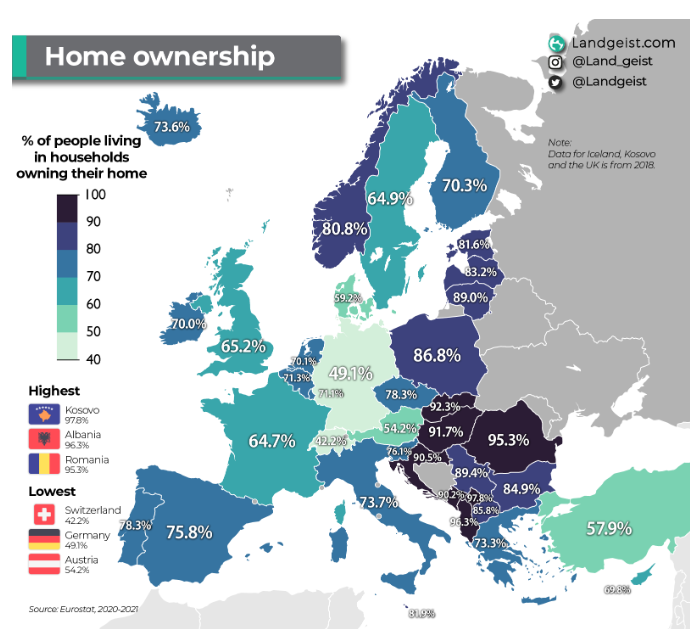
Why do Albania and Kosovo lead Europe in home ownership?
Based on the latest Eurostat data (2024) for European Union countries, as well as consolidated international sources such as Statista, Visual Capitalist, and Landgeist for non-EU countries, the homeownership rate in Albania is estimated at around 95.9–96% for the period 2024–2025. This places Kosovo and Albania at the top of Europe in terms of homeownership, above all EU member states.
The accompanying comparative map makes this dominance visually evident, showing that Albania ranks at the same extreme level only with Kosovo (97.8%), which appears as the country with the highest homeownership rate in Europe. This shifts the analysis away from a simple Albania–EU comparison toward a Balkan model of near-universal homeownership, clearly distinct from the European model.
Albania, Kosovo, and the EU average
The EU average stands at 68.4%, a significantly lower level that nonetheless conceals strong structural differences among member states. Within the EU, Romania (~95.3%) represents the highest level of homeownership, while Germany (~49.1%) lies at the lower end. However, even Romania the most “home-owning” country in the EU remains below Albania and Kosovo, as clearly reflected in the map.
The gap between Albania and the EU average reaches around 28 percentage points, placing Albania not merely above the European average but outside the typical spectrum of the EU housing model.
Two different housing models
The visual map confirms the existence of two main housing models in Europe:
- The Balkan and Eastern European model, with very high levels of homeownership (Albania, Kosovo, Romania, Slovakia, Hungary), built on post-communist mass privatization, self-construction, and the role of housing as a substitute for social policies.
- The Western and Northern European model, with lower homeownership rates (Germany, Austria, Switzerland, France, Denmark), where rental markets are institutionalized and supported by long-term public policies.
In Albania and Kosovo, housing functions as a social security asset, in a context where social housing is limited and rental markets remain weak and poorly regulated. Private ownership serves as protection against economic insecurity, unemployment, and the lack of public safety nets.
Albania beyond the EU’s “high-ownership group”
Even when compared only with EU countries that have high homeownership rates (above 80%), which appear on the map mainly in Eastern Europe, Albania remains above the European ceiling. Differences with countries such as Croatia, Hungary, or Slovakia range from 1 to more than 10 percentage points, while Kosovo goes even further, creating an absolute extreme.
This shows that Albania is not simply part of an Eastern European model, but rather represents a more pronounced and less balanced variant, where the lack of structural alternatives has pushed society toward mass homeownership.
Comparison with medium- and low-ownership countries
Compared with EU countries with medium ownership rates (Italy, Spain, Portugal, Czechia), the gap with Albania widens to 16–25 percentage points. In these countries, advanced urbanization, high housing prices, and functional rental markets have created a more balanced housing model.
The contrast becomes extreme when compared with low-ownership countries, particularly Germany and Austria, where the gap with Albania reaches nearly 50 percentage points. The map clearly illustrates this geographic and philosophical divide: in Western Europe, renting is part of social policy; in Albania and Kosovo, mass private ownership has informally replaced the welfare state.
Determining factors
The extraordinarily high level of homeownership in Albania and Kosovo is the result of a combination of factors, including:
- mass privatization of housing after the 1990s,
- migrant remittances directed toward housing construction and purchase,
- self-built and informal construction,
- a strong culture of ownership as a form of long-term security,
- the lack of social housing and functional rental markets.
In the EU, especially in Western Europe the factors are largely the opposite, shaped by strong rental markets, protective legal frameworks for tenants, advanced urbanization, and fiscal policies that do not necessarily favor ownership.
Trends and outlook
In Albania, although the homeownership rate remains very high and relatively stable, market signals point to medium-term risks. Rising housing prices in Tirana, youth emigration, growing speculative investment, and purchases by foreigners may gradually push the system toward a greater role for renting over the next 5–10 years.
In the EU, both the map and the data show a long-term downward trend in homeownership, from around 71% in 2010 to about 68% in 2024, particularly among younger generations.
In conclusion, Albania together with Kosovo (and also Romania) remains at the top of Europe in homeownership, as clearly demonstrated by the comparative map.
However, this “leadership” is not necessarily an indicator of well-being, but rather a reflection of the lack of housing alternatives.
What is expected to bring Albania closer to EU models is gradual integration into European dynamics, urbanization, and price pressures, yet this remains a major challenge, given the extremely high starting point and the country’s specific social and economic constraints.



Leave a Reply
You must be logged in to post a comment.