


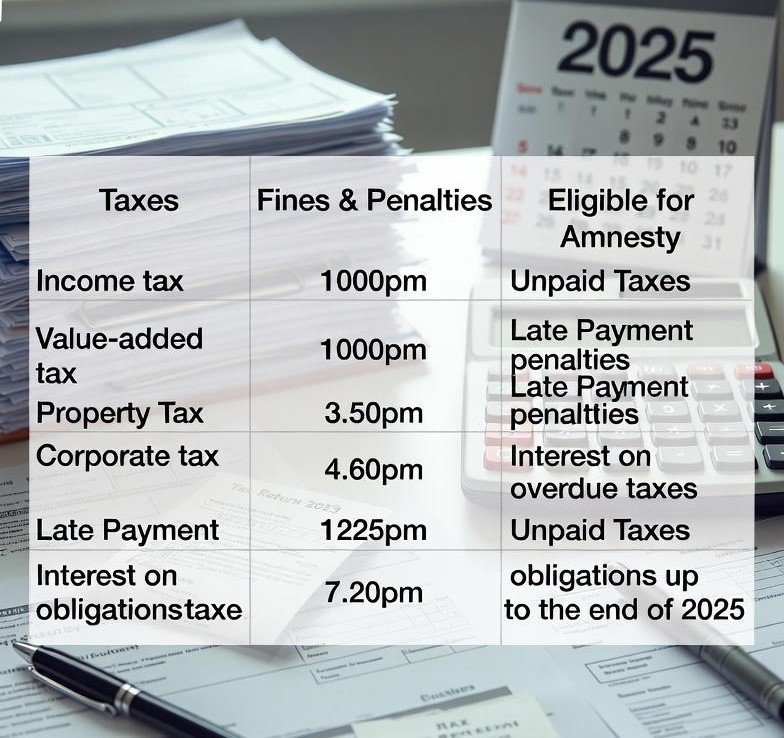
What is forgiven with the package of forgiveness of fines and tax obligations until 2025?
Governments periodically resort to tax and penalty forgiveness packages to reduce the administrative burden, clear old debt stock, and help taxpayers regularize their fiscal position. The current package follows the same logic, because it aims to clean the system from outdated liabilities, encourage payment of real tax principal, and ease pressure on both taxpayers and the administration.
Below is a clear, narrative explanation of what is forgiven under each article, followed by an analytical summary from ALTAX’s perspective.
Article 1 – Scope of Forgiveness
The law defines the types of obligations eligible for forgiveness. It applies to:
- Unpaid tax liabilities recorded or unrecorded in the tax system.
- Unpaid customs liabilities from past years.
This article essentially sets the foundation for all subsequent provisions, outlining the general categories of debt that may be reduced or eliminated.
Article 2 – Key Definitions
This article provides the legal terminology that governs the implementation of the law.
By defining each term precisely, it ensures uniform interpretation and reinforces a consistent application for all taxpayers, regardless of their status.
Article 3 – Beneficiaries
The scope of beneficiaries is intentionally broad. It includes:
- Active taxpayers
- Passive or deregistered taxpayers
- Entities with special statuses in the e-tax system
- Individuals and companies with customs liabilities
In practice, almost anyone with unpaid obligations, tax or customs may benefit, except for those explicitly excluded under Article 4.
Article 4 – Exclusions from Forgiveness
This is one of the most critical provisions for understanding who cannot benefit.
Those excluded are:
- Taxpayers with final criminal court decisions related to tax or customs offenses
- Taxpayers currently under investigation
- Taxpayers involved in ongoing court disputes initiated by authorities
Importantly, this article does not apply to ordinary declaration delays or routine business liabilities.
It only excludes cases involving criminal violations or active judicial processes.
Article 5 – Full Forgiveness for Liabilities up to 31 December 2014
This article eliminates a substantial volume of old debt. It provides:
For direct and indirect taxes (before 31.12.2014)
- Complete forgiveness of all liabilities
- Excluding social and health contributions
For social and health contributions (before 31.12.2014)
- 100% forgiveness of penalties and interest
- Principal contributions must still be paid
- Farmers and self-employed individuals are included
If the principal tax was already paid in previous years, all associated penalties and interest are automatically forgiven.
Article 6 – Liabilities from 2015–2019 and 2020–2024
This article introduces two mechanisms depending on the time period.
A. For 2015–2019 Liabilities
Taxpayers choose between two payment paths:
1) Lump-Sum Payment by 30 June 2026
- Pay 50% of the principal
- Remaining 50% is forgiven
- All penalties and interest are eliminated
2) Installment Plan Until 31 December 2026
- Pay 75% of the principal
- Remaining 25% forgiven
- All penalties and interest eliminated
In both cases, if the principal was previously paid, all penalties and interest are simply forgiven.
B. For 2020–2024 Liabilities
A simpler rule applies:
- If 100% of the principal is paid by 31 December 2026, then
- 100% of penalties and interest are forgiven
Social & Health Contributions (2015–2024)
- Penalties and interest are forgiven
- The principal must be paid in full
- Farmers and self-employed are included
Article 7 – Forgiveness of Administrative and Technical Penalties
This article addresses a broad range of procedural penalties and system-generated liabilities, including:
- Obligations of deregistered taxpayers
- Penalties for delayed declarations
- Penalties for financial statements submitted late
- Penalties arising from payroll corrections
- Penalties due to retroactive administrative decisions or court rulings
In practice, this part of the law has major impact because many of these sanctions result from technical errors rather than intentional non-compliance.
Article 8 – Offsetting Forgiven Liabilities with Tax Credits
If a taxpayer has tax credit balances, such as VAT credit the administration offsets the credit before applying forgiveness.
Exception:
Social and health contributions cannot be settled through tax credits.
Articles 9–10 – Customs Debt Forgiveness
The rules for customs mirror those of taxes.
For liabilities up to 31 December 2014
- Full forgiveness of all customs debt
For 2015–2019
- Pay 50% by 30 June 2026 → 50% forgiven
- Pay 75% by 31 December 2026 → 25% forgiven
- Penalties and interest always forgiven
For 2020–2024
- Penalties and interest forgiven if all principal is paid by 31 December 2026
Article 11 – Liabilities under Appeal or Court Review
Taxpayers may benefit if they:
- Withdraw administrative appeals
- Withdraw lawsuits or judicial complaints at any level
Once the taxpayer withdraws the case, the debt is treated according to the applicable forgiveness rules.
Those with final court judgments against them cannot benefit.
Article 12 – Conditions for Benefiting and Administrative Decisions
Taxpayers lose their right to forgiveness if:
- They fail to fulfill conditions within legal deadlines
The tax or customs administration must issue a formal, reasoned administrative act approving or denying forgiveness.
Articles 13–15 – Implementation Rules and Timeline
- Implementing institutions: Tax Administration & Customs Administration
- Implementation period: 1 January – 31 December 2026
- A detailed guideline will be issued by the Minister of Finance
- The law enters into force on 1 January 2026
ALTAX Summary & Assessment
From a policy standpoint, the forgiveness package:
- reduces the burden of uncollectible legacy debt
- offers businesses and individuals a pathway to fiscal normalization
- promotes administrative efficiency and reduces court disputes
- encourages payment of core tax liabilities
However, the measure also presents risks:
- Frequent forgiveness cycles may undermine compliance culture
- It may create expectations for future amnesties
- It does not substitute deeper tax administration reforms
- It cannot on its own address structural weaknesses in enforcement
A forgiveness package can be an effective corrective tool—but only when:
- applied rarely
- combined with stronger controls
- supported by digital systems
- implemented transparently and consistently
Without these conditions, forgiveness risks becoming a recurring escape route rather than a one-time opportunity to strengthen fiscal discipline.



Leave a Reply
You must be logged in to post a comment.