


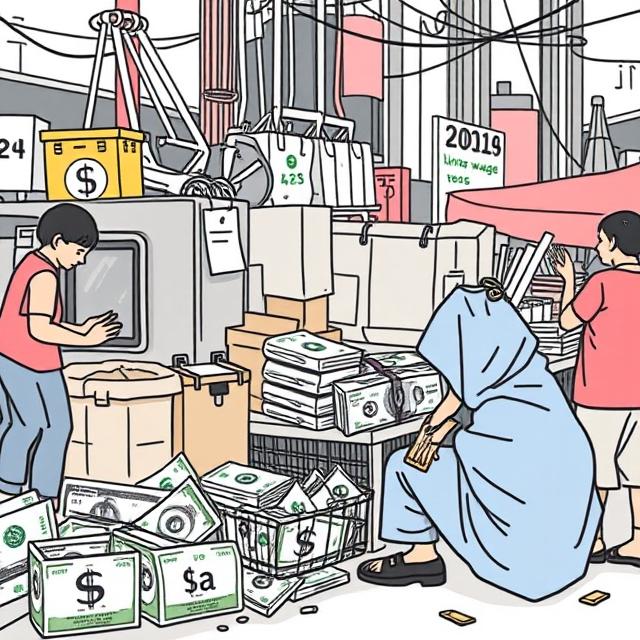
Minimum Living Standard in 2025 and growth without dignity
The economy appears to advance with figures that draw attention. Services face dynamism, retail is growing, while construction is one of the few productive sectors carrying weight.
Yet, when we delve deeper into citizens’ daily lives, the picture becomes concerning. The minimum wage of 40,000 lek does not align with what should be considered a life with dignity. Conservative calculations set the living minimum for an individual at around 24–26 thousand lek per month and for a family of four at 90–100 thousand lek well above what today’s minimum wage realistically offers, especially for single-income households.
This is not just a technical issue, but a legitimate social security crisis, a test showing that GDP growth is not translating into universal well-being.
Understanding the situation: a brief diagnosis
Economic growth in Albania during Q2 2025 has a clear profile: it is concentrated in services and trade, mainly in hotels, bars and restaurants, and real estate. These sectors have created jobs, and wages in hotels have risen noticeably compared to previous years, due to migration pressures and labor shortages. Nevertheless, even this growth remains far from the minimum living standard and does not guarantee long-term security, as contracts often remain seasonal and unstable.
On the other hand, retail shows significant growth (+6.2%), but this pace is not sustainable. It is largely driven by hydrocarbon consumption and non-food goods, which depend on imports and price fluctuations. This makes the market vulnerable and the economy dependent on factors beyond domestic control.
In stark contrast, manufacturing and energy are shrinking (-7.5% and -5.2%).
This is an alarming indicator. An economy without a productive base cannot raise real wages or support a broad workforce. Here lies the structural problem: services grow, but without industry and energy as strong pillars, growth remains fragile.
Construction reports positive results (+5.2%), but this growth is limited. This sector does not necessarily generate stable employment or widely distributed income, as it is primarily focused on large infrastructure projects and real estate.
Social consequences are visible
The gap between the minimum wage and the living minimum remains deep. This means that even those with jobs often live in relative poverty. In other words, “macro” growth does not translate into “micro” well-being. This contrast highlights the weakness of the current model: an economy that grows on paper but fails to raise citizens’ real living standards.
Why this is a high-cost problem
The gap between the minimum wage and the living minimum is not merely arithmetic. It has real, multiple consequences for the Albanian economy and society. This situation creates a series of high-cost challenges for economic stability, development, and citizen well-being.
Firstly, in-work poverty becomes the socio-economic norm. Even full-time jobs often fail to provide dignity and sustainable living. When citizens work but cannot meet basic expenses, domestic demand weakens in the medium term, slowing sustainable economic growth. This makes it difficult to stimulate local investment, and domestic consumption does not translate into real growth.
Secondly, talent migration. Qualified youth, seeing that local wages are insufficient for a decent living, choose to migrate to countries where they can develop their potential. The loss of human capital directly delays industrial modernization, innovation, and strengthening the productive base. This creates a vicious cycle where talent shortages curb economic development and foreign or domestic investment.
Thirdly, inflationary risks remain. Selective wage increases, as seen in hotels, gastronomy, and certain activities, without proportional productivity growth, may partially pass through to prices. This means citizens’ real purchasing power could be harmed, creating pressure on daily expenses and limiting the real benefits of economic growth.
Fourthly, inequality and social instability emerge. Economic growth that benefits certain service segments while leaving most workers behind increases social inequality and weakens trust in institutions. When citizens perceive that economic progress is not shared, it creates social tension, reduces motivation for economic and political engagement, and heightens sensitivity to crises or social pressures.
Integrated intervention is needed
The gap between minimum wage and the living minimum requires integrated intervention: smart social and economic policies, gradual minimum wage increases, support for vulnerable groups, and encouragement of modernization and innovation in productive sectors. Only then can economic growth be real, inclusive, and sustainable.
The latest review of the minimum living standard and economic conditions clearly shows that Albanian economic growth presents a divided panorama: services and trade move at high pace, generating visible economic activity, while the productive and energy base remains weak.
Experience over several years shows that when wages and growth rely mainly on sectors with unstable contracts and import dependence, attractive statistics do not automatically translate into economic dignity for families.
Practical social and economic experience indicates that real growth must involve all actors (government, business, unions, and citizens) and be measured not just by indices but by a family’s ability to afford food, energy, healthcare, and education.
With this approach, any policy package, whether emergency or long-term, avoids being just a list of aspirations detached from daily reality.
Another lesson from past experience is that targeted support and monitoring implementation are crucial. Rhetoric and promises without concrete mechanisms do not increase purchasing power or prevent talent migration.
This minimum living standard reality shows that while the economy pulses, its fiscal “lungs and liver” are weak—a clear reminder that growth must be measured by real well-being, not just appealing table figures.
In daily life, this means every step forward must be shared with citizens: wages sufficient for living, real employment opportunities, and an economy that does not create poverty among the working. This is the picture emerging from statistics and experience, and it cannot be ignored in discussions about social and economic policies.



Leave a Reply
You must be logged in to post a comment.