


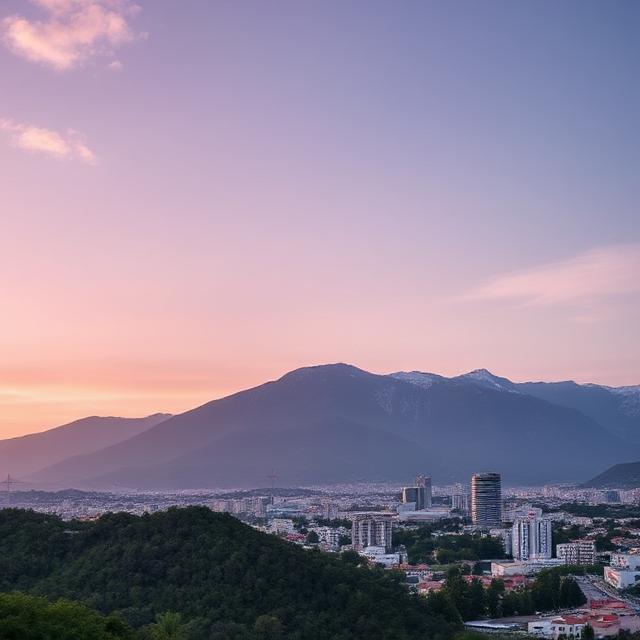
Restructuring the Albanian economic model after the 2024 growth
Analysis based on three methods of calculating GDP: Production, Expenditure, and Income.
From the data processed and published by INSTAT for the 2024 gross domestic product (semi-final), it appears that the economy needs to refocus priorities as we are within an economy that is growing, but not developing.
In 2024, the Albanian economy grew by 4.05% in real terms, a figure that at first glance may convey a sense of stability and vitality in the economic system[1]. However, when this growth is analyzed in depth using the three standard methodologies for calculating Gross Domestic Product (GDP)—the production, expenditure, and income approaches—the picture becomes more complex and, in some respects, concerning.
What emerges is a one-sided economic structure, largely reliant on consumption, non-productive sectors, and public spending, while the productive and export base continues to shrink or stagnate.
Growth Structure: Where is value created?
1. Production Method: The Rise of Services, the Decline of Production
If we ask the Albanian economy “where is value created?”, the answer for 2024 is clear: in services. They accounted for 48.69% of GDP and contributed +6.51% to real growth. Within this category, the public sector (administration, education, health) dominates, followed by tourism, trade, and transport.
Industry and agriculture, by contrast, had a negative counterweight: -4.55% and -2.00% real decline, respectively. Agriculture, although representing 15.45% of GDP, continues to suffer from informality, lack of infrastructure, and land fragmentation. The manufacturing industry, accounting for only 6.51% of GDP, declined by -3.65%, signaling a lack of structural transformation.
Construction, despite a positive growth of 4.52%, remains a sector that does not forge strong links with production or exports. Its growth is mostly cyclical and speculative, driven by private investments and remittances rather than productive strategies.
Demand Structure: An Economy Based on Consumption
2. Expenditure Method: The Consumption Engine and the Burden of the Trade Deficit
An economy where 81.93% of GDP stems from final consumption is one that grows more through consumption than production. Household and public sector consumption were the main driving forces behind the 2024 growth. This was supported by wage increases, remittances, and an expansion of government spending.
Meanwhile, Gross Fixed Capital Formation (GFCF), a key indicator for future investment, grew by 5.81%, accounting for 24.36% of GDP. But the lack of transparency about the sectoral composition of these investments (real estate or productive capacities?) leaves room for doubt.
More concerning is the external balance: net exports contributed negatively by -2.59 percentage points. Goods exports fell by -15.8%, while imports rose by +5.99%. This development highlights the worsening competitiveness of Albanian goods and increased reliance on imports, even for basic goods.
Income Structure: The Imbalance Between Capital and Labor
3. Income Method: Profits Dominate, Subsidies Are Absent
In 2024, gross operating surplus—which refers to income remaining after wages and production taxes—accounted for 61.49% of GDP, or approximately 1.4 trillion ALL. This indicates the dominance of capital income, while employee compensation accounted for 29.39% of GDP. Wage growth, especially in the public sector, positively impacted purchasing power and consumption.
On the other hand, public subsidies accounted for only 0.06% of GDP—a symbolic level, indicating a lack of will or capacity to support sectors that genuinely need state intervention to compete in markets.
What Does This Say About the Health of the Albanian Economy?
If we were to describe Albania’s 2024 economic condition not only through statistics but through a narrative that reveals the internal tensions of its economic model, we would have to focus on several key development vectors:
Economic growth was positive in numbers, at a rate of 4.05%, but rests on fragile structural foundations. It is not built on productive transformation but on consumption expansion and wage increases unrelated to productivity improvements. This is numerical, not qualitative growth.
The sectoral structure remains skewed, with a strong dominance of public services like administration, education, and health, and a continued decline of productive sectors like industry and agriculture. Rather than shifting towards transformation, the economy is deepening its consumer and non-competitive profile.
The trade balance has significantly worsened. There has been a decline in exports, particularly of goods, and an increase in import dependency, reducing the contribution of net exports to economic growth. This indicates not only a lack of competitiveness but also a deepening weakness in generating sustainable external revenues.
The labor market has experienced wage increases, especially in the public sector, but is still characterized by low productivity and high levels of informality, particularly in rural areas and service sectors. Thus, employment has grown more in nominal than qualitative terms.
Supportive public policies are concentrated on domestic consumption, with insufficient support for production, innovation, and the transformation of competitive sectors. Subsidies are minimal, and there is a lack of an active approach guiding the economy towards production-based growth.
This narrative reading makes clear that what grows is not necessarily what develops. And within this contrast lies the need for a new economic policy—one that sees the present not as a destination but as a starting point for transformation.
From this overview, it becomes evident that a fundamental shift is needed—from consumption to production—through an unwavering, responsible approach that addresses future challenges and ensures purposeful, sustainable development.
To escape the trap of unsustainable growth, Albania needs a return to production and export. This does not mean abandoning services but balancing the model through the following policies:
Sectoral Policies:
- Development of manufacturing through co-financing funds, infrastructure improvements, and linkages with universities, leveraging EU integration opportunities for market access, higher standards, and development funds.
- Modernization of agriculture, focusing on farmer cooperation, supply chains, and integration with agro-tourism, benefiting from the EU Common Agricultural Policy and rural development support.
Fiscal and Public Investment Policies:
- Revision of the tax structure to reduce the burden on producers and address the imbalance between consumption and supply, integrating EU fiscal practices for competitiveness and long-term sustainability.
- Increase in subsidies for strategic sectors and productivity growth in rural and industrial areas, aligned with EU standards and funding opportunities.
Employment and Education:
- Reform of vocational and technological education to better align with labor market needs and prepare a workforce compatible with EU integration requirements.
- Promotion of sustainable and quality employment through policies that encourage formalization and productivity growth, utilizing EU support for social and economic development.
The 2024 Economic Growth Is Not an Endpoint, But a Mirror
It reflects a system growing inwardly but not in essence.
Without structural reform prioritizing production, exports, innovation, and fairer income distribution, Albania risks remaining stuck in a consumption-driven, import-dependent growth model with no real ability to build sustainable wealth.
Future policy-making must be rooted in a full understanding of today’s reality. It must change the direction of growth—from growth driven by consumption to one built on productivity, exports, and real value creation.
[1] GDP at current prices was estimated at 2,517,821 million ALL for 2024 and 2,364,275 million ALL for 2023.

Leave a Reply
You must be logged in to post a comment.