


Kosovo: Tax Revenue performance based on investments and the need to address informality
According to the report on the tax burden in Kosovo, in absolute value budget revenues in 2021 are 1.94 billion Euros. Direct tax revenues are 343 million Euros, indirect tax revenues are 1.59 billion Euros, as well as non-tax revenues and other income and grants are 10 million Euros.
The structure of budget revenues consists mainly of tax revenues (88%), non-tax revenues, the part that does not constitute taxes and charges (11%) and Grants and other revenues (1%). Central tax revenues account for 24.7% of GDP, while tax revenues from local government account for 1.1% of budget revenues. Tax revenues include also royalties and some taxes and charges from the central and local level of government that are constituent items in budget indicators, such as non-tax revenues.
If we look at individual tax revenues, this indicator is at levels comparable to other WB6 countries, even higher than Albania. It is noticeable that revenues from PIT have increased over the years due to the removal of exemptions, but also due to increased capacity of the administration giving another impact in limiting the size of the informal economy. However, corporate tax revenues are still low and this is a policy that needs to adapt to the positive trend that has occurred with personal income tax.
Tax revenues collected within the country, have historically followed the trend of economic activity in the country, with a gradual improvement. Although the base of these revenues continues to be low, thanks to the design and implementation of structural reforms there are positive signals for an accelerated growth trend beyond that driven by increased economic activity (as a result of increased voluntary compliance and narrowing of tax gap).
Kosovo is committed to implementing the 2030 Agenda for Sustainable Development, which includes 17 Sustainable Development Goals (SDGs) and 169 objectives, many of which are reflected in the Kosovo National Development Strategy (NDS).[1]
The potential positive impact of behavioral interventions, rather than simply indicating the cost of administration, is in itself an adaptation of compliance strategies between direct and indirect taxes and the diversification of the economy model from trading to manufacturing.[2]
This approach can be seen in the fact that FDIs are no longer at low levels compared to years ago, but has begun to feel like a big complementary part of Kosovo’s economy rather than remittances. Even for 2021, unlike other economies in the Western Balkans region, FDI in Kosovo is still not a significant driver of structural transformation, especially towards more export-oriented growth.
This approach of foreign investment, as well as a maintenance of tax rates in competitive positions confirms the hypothesis that there is a positive relationship between FDI in the mining sector, tax productivity and growth. The FDI ratio in the mines is positive, but it is quite small suggesting a very minimal effect on GDP per capita, however it suggests that there is a need to further support and attract FDI in order for the economy to benefit.
One goal that needs to be assessed by the policies of the current government is to try to strengthen the climate of investment hospitality in the country by taking some policy measures to achieve the goal of increasing FDI and increasing FDI benefits for the rest of the country economy.
These measures include:
the establishment of a “one-stop-shop” for all procedures related to the establishment of a new company,
the reduction of export taxes for companies that invest in processing plants in order to positively stimulate investment in factories of processing that will localize the benefits of FDI.
Informality, evasion and impact on the tax burden
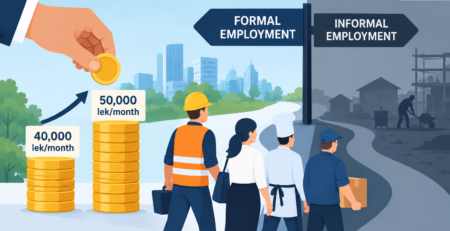
The significant size of the informal sector, as well as the considerable informal employment within the formal sector, have limited the scope of measures aimed at protecting income and employing people in the most affected sectors. As informality is widespread in the sectors most affected by the pandemic crisis, but also already by influences from foreign markets, including retail and tourism, they have not been able to benefit from measures such as government subsidies, favorable conditions credit or loan guarantees. The development of a more resilient economy also depends on the extent to which incentives for formalization can be increased and how much oversight and sanctioning of non-compliance can be improved.
Unfair competition, especially from the informal sector, poses a significant constraint on businesses in Kosovo. In a recent study, 63.4% of firms stated that competition from informal businesses poses a significant barrier to their business. High and sustained levels of informality are mainly due to poor enforcement and inhibitory costs of doing business in the formal sector, as tax rates in Kosovo are relatively low, but high tax evasion is linked to corruption between politicians and administrations. tax and customs.
High informality and tax evasion have had a significant negative impact on revenue collection. In addition, current high and rising spending, especially very generous and poorly targeted social transfers, have increased non-discretionary fiscal spending. This has hampered public investment in infrastructure and spending in critical sectors such as health and education, thus hindering an even more efficient distribution of budget revenues.
Among the measures that can be best used to address many of the issues mentioned in the reports of domestic and foreign expert organizations can be divided the comment that:
- Increasing tax revenues and diversifying tax rates by strengthening the role of CIT, PIT and insurance contributions would reduce tax dependence on goods and services in terms of fiscal policy by having a need for dialogue with local government regarding with room for diversification in the tax harmonization. While the current scheme for pension funds also needs another breath as a remodeling of this scheme would help fund the welfare system for the next generation.
- Given the confrontation with the fiscal policies of neighboring countries with Kosovo (Albania, Montenegro, North Macedonia and Serbia) should be analyzed the entry of a more progressive tax rate system in the tax system for income of individuals, but also for corporates, as the current system seems to have come to an end to generate additional revenue.
- Diversification of the local tax portfolio, mainly with the necessary reform for property taxation as well as environmental taxes should be explored as a policy option, which are not only to best fill the local spending space, but also as a source and incentives for tax culture.
Curbing the informal economy, which generates tax evasion should be seen in two directions, (a) in the direction of curbing corruption, which is also a haven for evasion, but also as (b) an education campaign and incentives with development initiatives for businesses initially aiming not only to encourage enrollment, but also to specifically and purposefully stimulate technology and innovation activities and those that increase employment.
[1] https://www.oecd-ilibrary.org/kosovo-profile_573f3543-en.pdf?itemId=%2Fcontent%2Fcomponent%2F573f3543-en&mimeType=pdf
[2] https://www.worldbank.org/en/country/kosovo/publication/promoting-tax-compliance-in-kosovo-with-behavioral-insights


Leave a Reply
You must be logged in to post a comment.