


Increase of Minimum Wage in Albania from January 2026 in light of the latest IMF study
The increase of the minimum wage is always one of the most debated interventions in economic policy.
It represents a direct attempt to raise the incomes of low-wage workers, but at the same time raises deep dilemmas regarding its impact on employment, productivity, and the structure of the labor market. In Albania, this dilemma is even more sensitive, as the labor market carries large regional disparities, sectors with fragile productivity, and a long history of economic migration.
Against this complex backdrop, the government’s decision to raise the minimum wage to 50,000 lek from January 2026, a 25% increase from the current level, constitutes one of the most significant interventions of recent years.
Approximately 307,000 workers will be directly affected, while the political objective aims to raise it to 60,000 lek by 2028. This decision is taken in an economy where the average monthly wage has reached 83,900 lek (Q2 2025), bringing the minimum-to-average wage ratio to high levels by European standards.
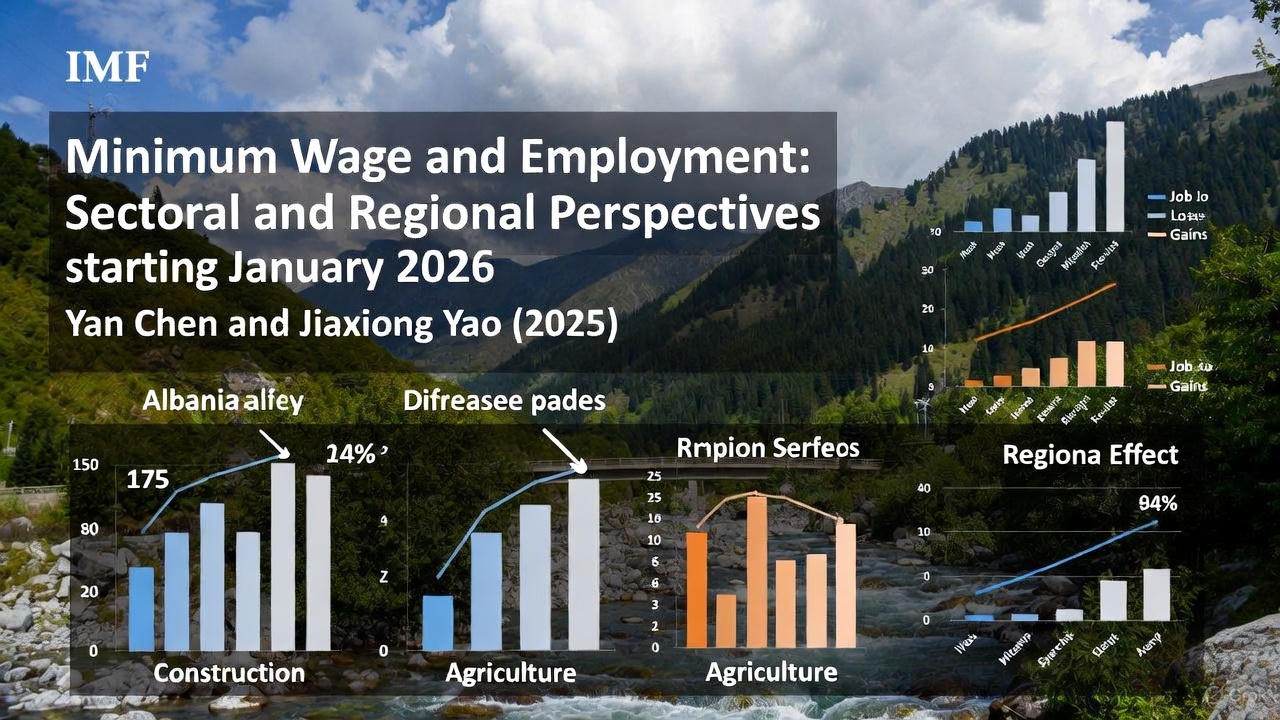
This increase comes at a time when the International Monetary Fund (IMF) has published a new and in-depth study, “Minimum Wage and Employment: Sectoral and Regional Perspectives” (Chen & Yao, 2025), offering a much more nuanced perspective on the impact of minimum wages across different sectors and regions. This study is particularly relevant for Albania, precisely because it highlights that the effect of a uniform minimum wage is never uniform; it is far harsher in sectors and areas with lower average wages.
A uniform minimum wage, a multi-faced economy
Albania has a single national minimum wage, but the economic reality is far from uniform. While Tirana is an economic hub with higher wages and more productive firms, other regions, especially in the north and south operate under very different conditions.
The textile sector, agriculture, agro-processing, and basic services have significantly lower average wages, making any increase in the minimum wage heavier and more restrictive for their operations.
The IMF study explains this using the Kaitz index, the ratio of the minimum wage to the average wage. When this ratio is high, low-wage firms face an immediate rise in costs, which they often struggle to absorb. With a minimum wage of 50,000 lek, Albania will stand at around 60% of the average wage, a level that, according to the IMF study, is significantly above the threshold where negative employment effects become persistent.
What the IMF study shows and why it matters for Albania
The IMF analyzed hundreds of minimum wage increases across European countries and reached a clear conclusion: the effects of minimum wage hikes are nonlinear and do not appear immediately.
First effect: temporary “calm,” no immediate hit to employment
In the first year following the increase, the average effect is almost neutral. Firms adjust, costs are distributed through moderate price increases, internal reorganizations, or even some informal practices. For Albania, this means that 2026 is not expected to produce major employment shocks, as the economy takes time to respond. This initial calm is often misinterpreted politically as immediate success.
Second effect: pressure rises over 2–4 years
When the minimum wage increase is large and the ratio to the average wage is high, negative effects emerge in the second, third, and fourth years. The IMF estimates that a 10% increase in the minimum wage reduces employment by about 0.1 percentage points after several years. For an economy like Albania’s, this could mean thousands fewer jobs by 2029, especially in regions with:
- low productivity,
- lack of investment,
- limited economic diversification.
Kukës, Dibra, Elbasan, and Berati are expected to be among the most sensitive regions.
Who benefits and who is hit?
The study identifies a distinct dynamic.
Young workers (especially men) often benefit in the first period after a minimum wage increase. This effect is linked to the increased attractiveness of employment and the fact that young people move more rapidly between jobs. Women in low-wage sectors are more exposed to negative effects, particularly after several years. In Albania, this directly impacts the textile and garment sector, employing tens of thousands of women.
In many cases, employment does not fall through layoffs but rather through:
- reduction in working hours,
- non-replacement of departing employees,
- decline in labor force participation.
The latter is especially problematic for Albania, as it relates to increased emigration, particularly among youth with limited domestic opportunities.
A critical threshold: 35% minimum-to-average wage ratio
The IMF identifies a critical threshold: when the minimum wage exceeds 35% of the sectoral average wage, negative effects become systematic. Firms begin to:
- reduce working hours,
- slow down new hires,
- postpone investments,
- reduce activity,
- seek informal alternatives.
Albania will be above 60%, not only surpassing the threshold but well beyond it, if the minimum wage is politically set to reach 70,000 lek in three years. This makes the Albanian economy particularly exposed in sectors such as:
- textiles,
- food processing,
- agriculture,
- low-value-added services.
Secondary aspects not to be underestimated
The IMF study emphasizes several side effects often overlooked in public debates:
Net migration is affected in low-productivity regions because higher minimum wages raise labor costs for local firms, reduce employment or working hours, discourage investments, and lower labor force participation. As a result, poorer regions lose jobs and economic prospects, increasing the outflow of youth to urban centers or abroad, while simultaneously becoming less attractive for new migrants.
Formalization may rise slightly, but it does not neutralize the negative effects of high costs, as firms remain influenced by informal practices and corruption. Even though higher minimum wages may push some firms toward formal compliance to avoid penalties, the effect is limited.
High labor costs encourage some small firms to seek alternative survival strategies, including partial wage reporting or administrative loopholes. Therefore, slight increases in formalization do not compensate for the pressure of high costs and the risk of declining employment.
Large, productive firms handle increases more easily, while small firms struggle.
In Albania, where over 95% of enterprises are micro or small, this is a serious warning.
Implications for Albanian policymaking
From the analysis of IMF findings and the realities of the Albanian market, several conclusions emerge:
- A single minimum wage does not reflect the country’s economic reality. Regional and sectoral disparities are too pronounced to justify a uniform approach.
- Large and rapid increases must be accompanied by active policies, such as:
- training programs,
- employment subsidies,
- targeted support for low-income households,
- fiscal relief for small firms.
- Sectoral or regional differentiation of the minimum wage should be considered, despite administrative challenges.
- Labor market monitoring after 2026 must be intensive, as real effects appear after 2–4 years.
- Emigration and labor force participation should be carefully observed, as they are key channels where minimum wage increases exert the strongest impact in developing countries.
Raising the minimum wage is a powerful policy instrument, but it is not neutral.
It provides immediate relief for low-wage workers but generates increased pressure on the most fragile sectors and regions of the economy.
The IMF study makes it clear that the real impact emerges not in the first days, but after several years, when firms face accumulated costs and must make strategic decisions regarding investment, hiring, and survival.
For Albania, raising the minimum wage to 50,000 lek is a politically significant decision with profound economic effects. It offers immediate benefits but creates a horizon of risk that requires attention, accompanying policies, and careful labor market analysis in the coming years.



Leave a Reply
You must be logged in to post a comment.