


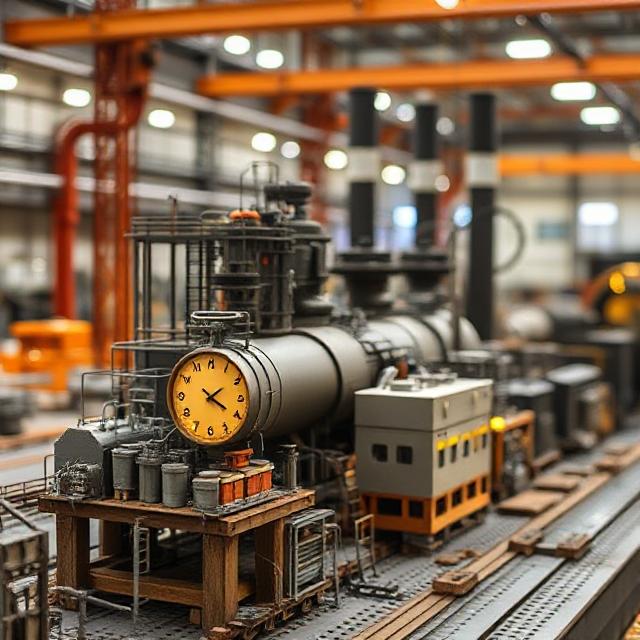
From Trade to Production, as a necessary Shift
Albania has spent 30 years paying more attention to trade than production, more to consumption than to technology.
This model is not sustainable.
If we want higher wages, a more balanced economy, and a stronger role in European markets, we must become a producing country.
To do this, we need to learn from developed countries – from both the West and the East – but with our own thinking.
Because Albania will never be Germany, China, the US, or any other large and powerful country – but it can become a much stronger version of itself.
Not imitators, but smart adapters
The Albanian industrial model must not be a copy, but an adaptation to real priorities and constraints.
Albania cannot build its industry by blindly following the models of large economies.
Our structural reality is different: smaller market, more vulnerable human capital, and weaker state capacity.
But precisely these constraints make it essential to create a smart, focused, and long-term production model.
A small market requires great integration
Unlike economies that rely on large domestic consumption, Albania operates in a limited demographic and consumer space.
This means production cannot be built to feed only the domestic market.
On the contrary, every industrial investment must aim to connect with regional and European production chains, becoming part of a broader and more competitive supply.
Small but specialized clusters are the way to access larger markets through cooperation and standardization.
An educated human capital, but at risk of leaving
Albania does not suffer from a lack of knowledge – but from its outflow abroad.
Human potential exists, especially in younger generations who have pursued vocational or university education but find no space for development in the country.
This is a call for the manufacturing industry to build on existing skills, offering dignified, well-paid jobs connected to technology.
Not factories that exploit labor, but production units that attract and retain young professionals.
A state that must move from obstacle to partner
For decades, the Albanian state has been perceived (and often acted) more as a bureaucratic obstacle than a driver of industrial development.
In a country with limited capacities, a state that plans, intervenes intelligently, and accompanies development is essential, through clear industrial policies, targeted financing, and public-private partnerships.
The state should not be a producer – but a facilitator, supporter, and guarantor of direction.
Not mass production, but clean, smart, and value-added production
Albania does not have the scale to compete in mass production or low labor costs.
It does, however, have the opportunity to develop a specialized, technologically updated industry focused on quality.
This means targeting sectors such as:
• Processing of agri-food products with export quality
• Electrical equipment and smart lighting
• Technical textiles and sustainable materials
So, not quantity for the sake of quantity, but production with a clear profile and the goal of high-value exports.
An Albanian industrial model that adapts, not copies
For Albania, industrialization is not a race to imitate others, but a smart adaptation process based on our advantages – from geographic position to human potential.
This is a model that must be built on:
• Regional cooperation, not isolation
• Technical skills, not mass labor
• Sustainable industrial policy, not sporadic projects
• And on human capital that lives and works here, not just abroad.
Only in this way can we become a producing country with identity and influence in the European economy, without needing to be a copy of anyone, or the forgotten edge of the global chain.

Leave a Reply
You must be logged in to post a comment.