


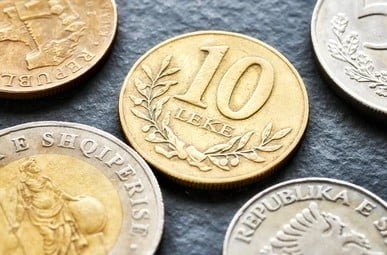
A weaker euro is affecting everything and cutting some gains in the country
By far, the euro’s biggest obstacle is a single monetary policy that often does not suit local economic conditions. It is common for EU countries to benefit under these conditions. In contrast, others, including Albania, suffer from this discriminatory course and it affects the prolonged economic decline and higher unemployment in the future.
The economy’s over-reliance on the Euro is leaving investors jittery, and the dilemma could herald a painful blow to manufacturers.
Bank of Albania is caught in the worst dilemma that a central bank can face on the one hand, inflation needs to decrease and requires an increase in interest rates, on the other hand, the growth of the economy without the informal euros and pounds is anemic and it would only benefit if this situation continued.
The fall of the euro is making the inflation problem worse than it already is by importing further inflation due to the weak euro, meaning that an ongoing panic in an informal and unstructured economy could lead to a decrease in turnover and an increase in informality even further.
Therefore, in conditions where Albanian consumers are sufficiently encouraged by market uncertainties and the still passive situation of monetary and fiscal policies, they can expect even higher prices.
Living costs are threatening consumption and tourism to grow, and to prevent rising living costs and eroding household purchasing power, fiscal policy is the only way out.
From this weakened euro, it is creating premises to benefit from European importers by buying the labor of export products even more cheaply, and this is happening especially with Italy, and other European countries.
A sliding euro is adding to the burden on households and businesses, which respectively depend on remittances and capital investment flows that are already reeling from inflation. A weaker currency is not making investment and domestic products cheaper, as informality and policy obfuscation, which prevent imports from affecting their still excessive costs, prevent it.
In normal times, a weak euro is seen as good news for an import-dependent economy, but these are not normal times due to global supply chain frictions, sanctions and domestic structural problems heavily influenced by the backlog of Albanian politics.
For European travelers, a weak euro is a factor in reducing budgets planned to spend in Albania.
Somehow the weak euro is not strengthening the Albanian economy, but the short-sighted policy for a lower public debt and for achieving a lower inflation, which in the informal reality of the Albanian economy do not lead to more benefits for the needy classes, as well as in a medium-term perspective for producers and tourism.


Leave a Reply
You must be logged in to post a comment.